Can you imagine a wild endangered animal being brought back from frozen cells? The banteng (Bos javanicus), a wild cattle species in the family Bovidae, lives in the forests of Southeast Asia and is also part of an important scientific story.
In 2003, the banteng became the second endangered species in the world to be successfully cloned. It was the first cloned endangered animal to survive for many years, giving hope for future conservation.
However, while science tries to save banteng genes in laboratories, life in the wild is very different. Banteng numbers have dropped by more than 80% in only a few decades, making this species one of the most threatened wild cattle in the world.
| Common name | Banteng |
|---|
| Scientific name | Bos javanicus |
|---|
| Taxonomy
|
Kingdom: Animalia
Phylum: Chordata
Class: Mammalia
Order: Artiodactyla
Family: Bovidae
|
| Weight / Size | 600–800 kg; large males up to 900 kg. Body length 1.9–2.25 m. Shoulder height: females ~1.4 m; males ~1.6 m (1.55–1.65 m). |
|---|
| Lifespan | Wild: 16–20 years (up to 25). Captive: 26+ years. |
|---|
| Population | Strongly declining; fragmented populations across Southeast Asia. |
|---|
| Habitat | Dry deciduous (dipterocarp) forests, semi-evergreen forests, lowland forests, open grasslands; near water and salt licks. |
|---|
| Range | Southeast Asia. Introduced population in northern Australia. |
|---|
| Diet | Mixed feeder: grasses, bamboo, leaves, shoots, branches, bark, fruits. |
|---|
| Conservation status | Endangered (IUCN); Critically Endangered in Vietnam; CITES Appendix II. |
|---|
Physical Characteristics of Banteng
The banteng (Bos javanicus) is a large wild cattle species found in Southeast Asia. An adult banteng usually weighs 600–800 kg, while large males can reach up to 900 kg. Body length ranges from 1.9 to 2.25 meters. At the shoulder, females stand about 1.4 m, while males average around 1.6 m (some records note 1.55–1.65 m).
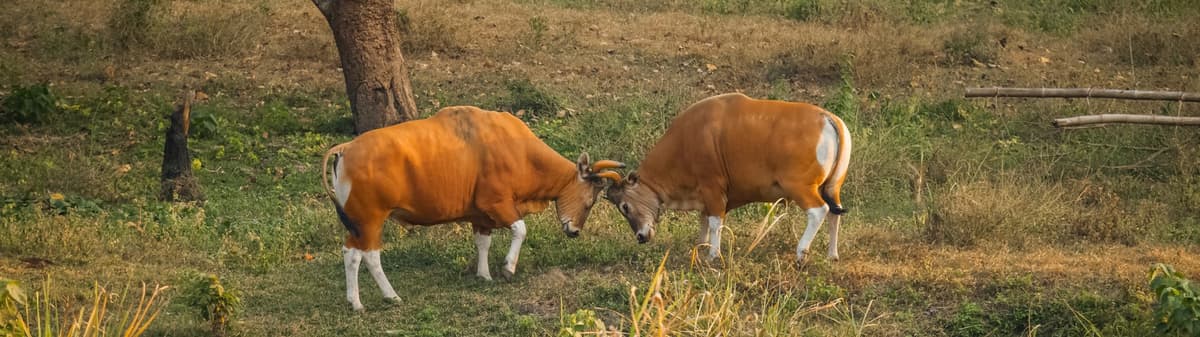
The tail measures 65–70 cm and ends with a black hair tuft. Banteng shows clear sexual dimorphism. Adult males are dark brown to glossy black and strongly built. Females and juveniles are lighter brown or chestnut, often with a dark stripe along the back. In Indochina, some males keep a reddish coat, but most older bulls turn grey or very dark.
A key identifying feature is the large white rump patch, easy to spot in the wild. All four legs have white “stockings” from the knees down. The horns are 60–75 cm long. Males have long, upward-curving horns that angle slightly forward, while females have shorter, tighter horns pointing inward. Compared to gaur, banteng are smaller, have a white rump, and a much less developed shoulder hump.
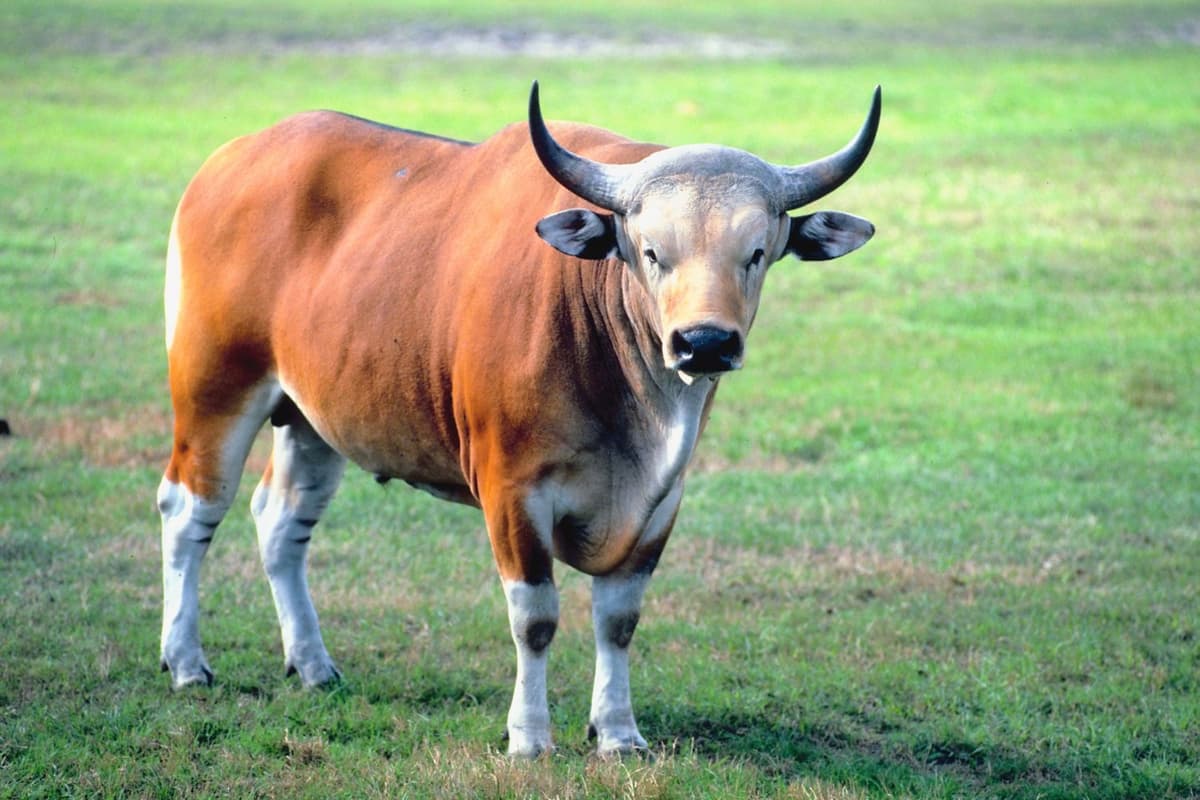
Dark coats and white lower legs give banteng a bold look.
Subspecies of Banteng
Banteng has four common subspecies, based on differences in appearance and geographic range. Some scientists debate this classification because hybridization has occurred in several regions.
1. Javan Banteng (Bos javanicus javanicus)
This subspecies is native to Java and possibly Bali in Indonesia. Adult males are typically jet black, with a strong and compact body shape. This is the “classic” banteng form and often used as the reference when describing the species.
2. Indochinese or Burmese Banteng (Bos javanicus birmanicus)
Found across mainland Southeast Asia, including Vietnam, Cambodia, Laos, Thailand, and Myanmar. Unlike the Javan form, adult males usually have a reddish-yellow or chestnut coat instead of pure black.
3. Bornean Banteng (Bos javanicus lowi)
Restricted to the island of Borneo, this is the smallest banteng subspecies. It has a more compact build and is considered rarer, with very limited populations remaining today.
4. Bali Cattle (Bos javanicus domesticus)
This is the domesticated form of banteng. It originates from Bali but has spread to Australia, Malaysia, the Philippines, and New Guinea. Bali cattle are smaller, easier to manage, and widely used in agriculture.
Banteng Habitat and Distribution
Habitat
The banteng is well adapted to open and drier habitats than its close relative, the gaur. It prefers landscapes where forests mix with grassland, allowing easy movement and grazing.
Preferred habitats of banteng include dry deciduous forests, especially dipterocarp forests, semi-evergreen forests, lowland deciduous forests, and open grasslands.
Banteng usually stay close to permanent water sources, but they can tolerate short periods without water during the dry season. They also regularly visit natural mineral salt licks, which are important for nutrition.
Interestingly, banteng can benefit from moderate forest disturbance. Secondary forests and abandoned farmland often produce fresh grass that attracts them. However, in areas with heavy human activity or hunting pressure, banteng tend to become mainly nocturnal to avoid people.
Distribution in Asia
The banteng is a wild cattle species native to Southeast Asia. In the past, it was widely distributed across the region. Today, its range has shrunk sharply and is fragmented into small, isolated populations.
Current distribution shows banteng still surviving in Cambodia, Indonesia (Java, Bali, and Kalimantan), Malaysia (Sabah in Borneo), Myanmar, Thailand, and Vietnam. Very small remnant groups may still exist in Laos.
The largest remaining population is found in eastern Cambodia. The Eastern Plains Landscape supports an estimated 2,000–5,000 banteng, making it the most important stronghold globally.
In Thailand, the Huai Kha Khaeng Wildlife Sanctuary holds the largest mainland population. In Indonesia, key populations survive in national parks such as Ujung Kulon and Baluran on Java.
Outside Asia, a large introduced wild population lives in Australia. Around 8,000–10,000 banteng roam northern Australia’s Cobourg Peninsula, descended from domesticated animals introduced in 1849.
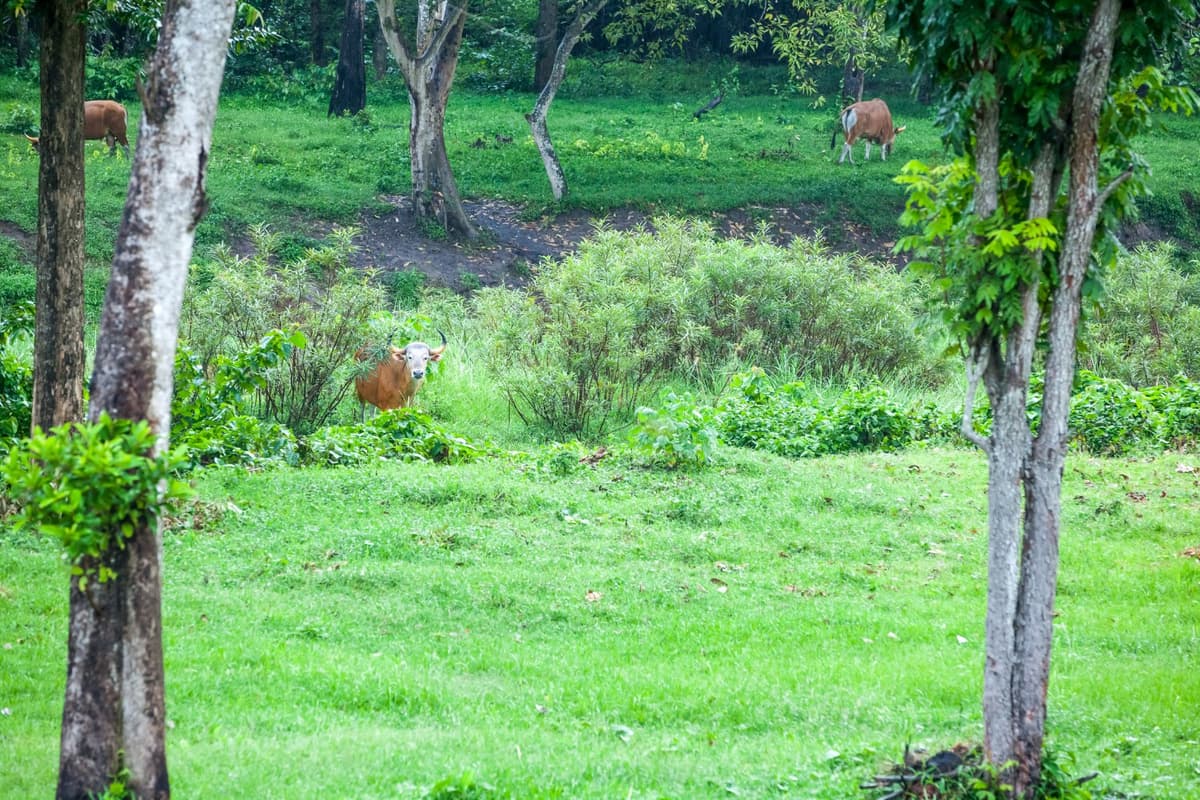
Tropical forests and open grasslands form their natural range.
Banteng Distribution in Vietnam
In Vietnam, the banteng (Bos javanicus birmanicus) is now critically endangered. Its distribution has declined by at least 50% since the mid-1990s, leaving only a few isolated populations.
Today, banteng survive mainly in the Central Highlands and nearby areas. Their range stretches from Chu Prong District in the north to Vinh Cuu Nature Reserve in the south. The total population is fragmented into about five isolated herds, increasing extinction risk.
The most important populations are:
- Yok Don National Park: Home to the largest banteng population in Vietnam, estimated at 30–44 individuals.
- Ea So Nature Reserve: The second-largest population, with around 23–31 individuals.
Banteng have become locally extinct in several former strongholds since the early 1990s. These include Cat Tien National Park (now dominated by gaur), Chu Mom Ray National Park, and Bi Doup – Nui Ba National Park.
Banteng Diet and Predators
Grazing Habits
Banteng eat a wide range of plant foods. They are mixed feeders, meaning they both graze on grasses and browse on leaves and woody plants, which allows them to adapt to different habitats.
Their diet includes grasses, bamboo, leaves, young shoots, branches, bark, and fruits. In Java, studies show banteng feed on about 20 grass species and more than 70 shrub species. Imperata grass and bamboo, especially Bambusa bambos, are key food sources in many areas.
In terms of foraging strategy, banteng usually move into open grasslands at night or early morning to feed. During the day, they retreat into dense forest to rest and ruminate for 2–3 hours. In the rainy season, they may shift to higher-elevation forests to search for fresh bamboo shoots.
Banteng also have a strong need for minerals. They regularly visit natural salt licks to obtain essential nutrients. Where salt licks are absent, they may drink brackish or seawater. During the dry season, banteng can tolerate thirst for several days, helping them survive in dry, open landscapes.
Predators and Defense of Banteng
The main natural predator of banteng is the tiger. Adult banteng are an important prey species for tigers, providing a large amount of energy. The decline of banteng populations has directly affected tiger survival in many regions.
Dhole, or Asiatic wild dogs, mainly hunt calves, weak, or injured individuals, often working in packs. In some areas of Java, dholes are a key cause of juvenile mortality. Leopard can also prey on banteng, especially where tigers are absent, though they usually target younger animals.
Despite these threats, banteng have strong defense strategies. Adults are large and muscular, weighing 400–900 kg, making them difficult to kill. They often live in small herds (2–30 individuals), which improves vigilance and allows adults to protect calves. When threatened, banteng can use their horns, body mass, and group formation to deter predators.
Banteng Habits and Behavior
Social Structure
The banteng is a highly social species, living in small groups or larger herds depending on habitat quality and human pressure.
Herd size usually ranges from 2 to 40 individuals. In safe, open feeding areas, herds can be much larger. At Sadengan grassland in Alas Purwo National Park, gatherings of up to 100 banteng have been recorded. In contrast, in Vietnam, especially in Yok Don National Park and Ea So Nature Reserve, the average herd size is much smaller, around 7 individuals, mainly due to hunting pressure.
A typical herd consists of adult females, calves, and one dominant adult male. In large feeding grounds, such as Sadengan, two to three adult males may temporarily join the same herd.
In terms of leadership, older females often act as the matriarch, guiding group movement and feeding decisions. The dominant male usually stays nearby to defend the herd and mate.
Adult males that do not control a breeding herd often live alone or form small bachelor groups of 2–3 males, especially outside the breeding season.
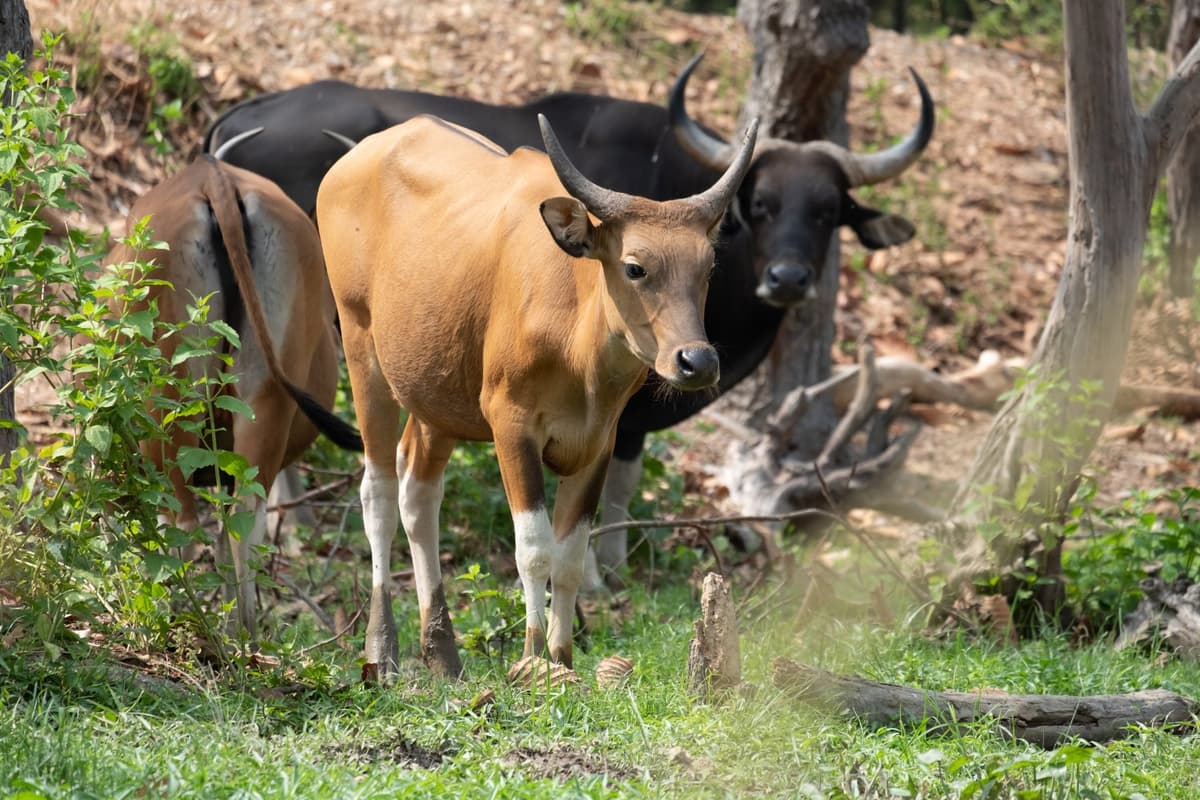
Small herds are led by adult females and calves.
Are Banteng Nocturnal or Diurnal?
Banteng can be diurnal, nocturnal, or active both day and night, depending mainly on human disturbance.
In undisturbed habitats, banteng follow their natural behavior and are mostly diurnal, or cathemeral, meaning they are active throughout the day and night without a clear pattern. They feed in open grasslands and rest in forest cover during warmer hours.
However, in areas with high human activity or hunting pressure, banteng show strong behavioral adaptation. They shift to being mainly nocturnal to reduce the risk of detection. This pattern is common in Vietnam and many parts of Southeast Asia.
Camera-trap studies in Cambodia show that around 90% of banteng activity occurs between 18:00 and 06:00, with peak movement from 03:00 to 07:00. In contrast, in less disturbed areas such as Prambei Mom, banteng display cathemeral activity, moving and feeding both day and night.
Reproduction Cycle of Banteng
Female banteng usually reach sexual maturity at 2–3 years of age. In introduced populations in Australia, females may mature slightly later, at 2–4 years. Male banteng become sexually mature at around 3–4 years, but they only reach full body size at about 5–6 years, which affects their ability to dominate breeding herds.
In the wild, breeding is seasonal and varies by region. In Thailand, mating peaks in May and June. In northern Australia, especially on the Cobourg Peninsula, peak breeding occurs in October and November. Banteng follow a polygynous system, where one dominant adult male mates with multiple females in the herd.
The gestation period lasts about 285 days (roughly 9.5–10 months), slightly longer than that of domestic cattle (Bos taurus). Females usually give birth to a single calf.
At birth, male calves weigh 16–17 kg, while female calves weigh 14–15 kg. Calves can stand and walk shortly after birth. They are weaned at 6–9 months, but nursing may continue up to 16 months if the mother does not conceive again. Newborn calves are reddish-brown; young males gradually darken with age.
Calf mortality is highest during the first 6 months. In the wild, banteng live 16–20 years, occasionally up to 25 years. In captivity, individuals can live over 26 years.
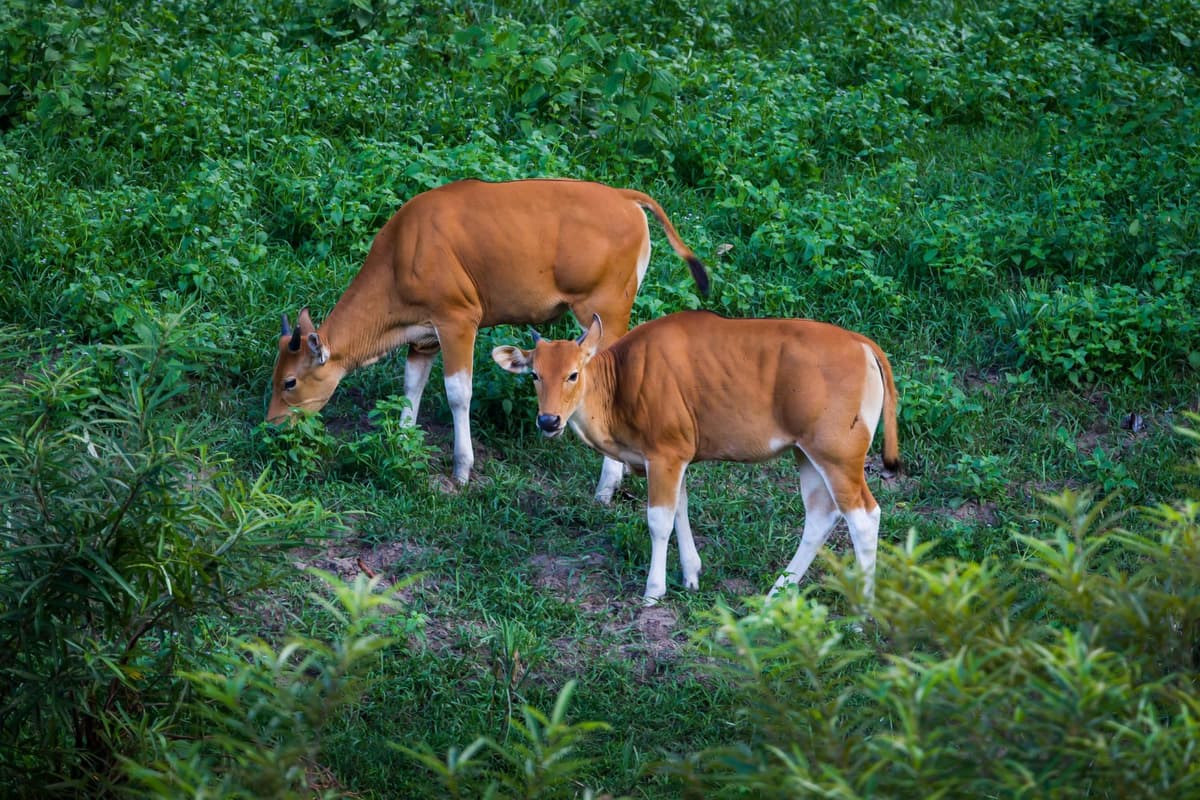
Young calves stay close to their mother for safety.
Threats and Conservation
Threats
Banteng are declining mainly due to human activities. These threats act together and directly cause population collapse.
Poaching and trade are the most serious threats. Banteng are heavily hunted for meat (local consumption and illegal trade) and horns used as trophies or decorations. In Vietnam, demand from wealthy urban consumers has driven commercial hunting and pushed banteng close to local extinction.
The snaring crisis is another major cause. Thousands of wire snares are set across Southeast Asian forests. Even when banteng are not the target, they are often caught and killed in traps meant for other wildlife.
Habitat loss and fragmentation also play a key role. Dry dipterocarp forests and evergreen forests are converted into farmland, rubber plantations, oil palm estates, and infrastructure. Remaining populations become small and isolated, reducing genetic diversity. In Baluran National Park, invasive Acacia nilotica has taken over more than 50% of grasslands, removing key food sources.
Disease and hybridization add further pressure. Contact with domestic cattle increases the risk of diseases such as foot-and-mouth disease. Banteng can also breed with domestic cattle, especially Bali cattle, causing genetic pollution of wild populations.
Conservation
Stopping poaching, removing snares, protecting habitats, and engaging local communities are the key to saving banteng from extinction.
Community-based efforts show promise. In Green Island ELC (Kratie), local Banteng Forest Patrol Teams remove snares and reduce poaching with early positive results.
Thailand is a rare success story. Huai Kha Khaeng Wildlife Sanctuary is the only site where banteng numbers have increased over the past 15 years due to strong law enforcement. Thailand has also successfully reintroduced banteng to Salakphra Wildlife Sanctuary, creating a self-sustaining population.
In Indonesia (Java and Borneo) and Malaysia (Sabah), strict protection has helped stabilize some populations. Sabah has implemented the Bornean Banteng Action Plan (2019–2028) to strengthen law enforcement and reconnect habitats.
At the global level, the IUCN SSC Asian Wild Cattle Specialist Group promotes national action plans, anti-poaching strategies, and habitat management. Programs like SAFE Action Indonesia mobilize international zoo support for in-situ conservation.
Ex-situ conservation also plays a role. Captive populations protect genetic stock, and banteng became the second endangered species successfully cloned in 2003, highlighting future genetic rescue potential.
Interesting Facts about Banteng
1. Banteng is the second endangered animal in the world to be successfully cloned. The first was the gaur, but it lived only two days.
2. In northern Australia, banteng work with Torresian crow. The birds sit on their backs and eat ticks.
3. Banteng must get minerals to stay healthy. If there are no salt licks, they can drink seawater or brackish water.
4. The banteng head appears on the Indonesian national emblem, Garuda Pancasila, to represent democracy.
5. Cave paintings in East Kalimantan, dated to about 10,000 BC, may show banteng. This means humans have known this animal for a very long time.
Reference
- Gardner, P., Hedges, S., Pudyatmoko, S., Gray, T. N. E., & Timmins, R. J. (2016). Bos javanicus. The IUCN Red List of Threatened Species, 2016, e.T2888A46362970. https://doi.org/10.2305/IUCN.UK.2016-2.RLTS.T2888A46362970.en
- Gray, T. N. E., Prum, S., Pin, C., & Phan, C. (2012). Distance sampling reveals Cambodia’s Eastern Plains Landscape supports the largest global population of the endangered banteng Bos javanicus. Oryx, 46(4), 563–566. https://doi.org/10.1017/S0030605312000567
- Pedrono, M., Ha, M. T., Chouteau, P., & Vallejo, F. (2009). Status and distribution of the endangered banteng Bos javanicus birmanicus in Vietnam: A conservation tragedy. Oryx, 43(4), 618–625. https://doi.org/10.1017/S0030605309990147
- Nguyen, M. H. (2009). The status of vulnerable gaur Bos gaurus and endangered banteng Bos javanicus in Ea So Nature Reserve and Yok Don and Cat Tien National Parks, Vietnam. Oryx, 43(1), 129–135. https://doi.org/10.1017/S0030605307000440
- Lim, H. Y., Gardner, P. C., Abram, N. K., Yusah, K. M., & Goossens, B. (2019). Identifying habitat and understanding movement resistance for the endangered Bornean banteng Bos javanicus lowi in Sabah, Malaysia. Oryx. Advance online publication. https://doi.org/10.1017/S0030605318001126
- Chaichanathong, S., Klinsawat, W., Sukmak, M., Sakulthai, A., Wajjwalku, W., Sripiboon, S., Kaolim, N., Nakbhun, S., Tunpradit, B., Nipanunt, T., Tipkantha, W., Yindee, M., & Thongtip, N. (2021). Genetic characterization of banteng (Bos javanicus) populations in Thailand for conservation. The Thai Journal of Veterinary Medicine, 51(4), 647–654. https://doi.org/10.56808/2985-1130.3162
- Leroux, N., Roth, B., & Marx, N. (2025). Herd demographics, behaviour and threats to a critically endangered banteng Bos javanicus population in southwest Cambodia. Oryx.
- Wharton, C. H. (1968). Man, fire and wild cattle in Southeast Asia. Proceedings of the Annual Tall Timbers Fire Ecology Conference, 8, 107–167.
- IUCN SSC Asian Wild Cattle Specialist Group. (2010). Regional conservation strategy for wild cattle and buffaloes in South-east Asia, 2011–2020. IUCN Species Survival Commission.