Imagine walking deep inside the dense forests of Southeast Asia. Suddenly, a warm and familiar smell reaches your nose, the smell of fresh popcorn. You look around, wondering if there is a movie theater or snack shop hidden in the jungle.
But there is nothing there.
The surprising smell does not come from food. It comes from a strange animal called the binturong. It belongs to the civet family (Viverridae), even though it is often called the “bearcat” because it looks a little like both a bear and a cat.
The binturong is also one of the few mammals in the world with a prehensile tail, which works like a fifth hand and helps it climb and hang in trees. These unique traits make the binturong one of the most unusual and fascinating animals in the forests of Asia.
| Common name | Binturong (Bearcat) |
|---|
| Scientific name | Arctictis binturong |
|---|
| Taxonomy
|
Kingdom: Animalia
Phylum: Chordata
Class: Mammalia
Order: Carnivora
Family: Viverridae (civet family)
Genus: Arctictis
Species: A. binturong
|
| Weight / Size | 9–20 kg (up to 32 kg); body 61–96 cm; tail 50–89 cm. |
|---|
| Lifespan | ~18 years in the wild; over 25 years in captivity. |
|---|
| Population | Decreasing (down >30% in 18 years). |
|---|
| Habitat | Tropical and evergreen forests, near fruit trees and water. |
|---|
| Range | South & Southeast Asia, southern China, Indonesia, Philippines. |
|---|
| Diet | Mostly fruit (especially figs), also insects, fish, small animals. |
|---|
| Conservation status | Vulnerable (IUCN); Endangered in Vietnam. |
|---|
Physical Characteristics of the Binturong
The binturong is the largest and heaviest member of the civet family (Viverridae). Its head–body length ranges from 61 to 96 cm, and its long, bushy tail is almost as long, measuring 50 to 89 cm. Most individuals weigh 9–20 kg, but some captive females can reach 25–32 kg. Females are usually about 20% larger and heavier than males.
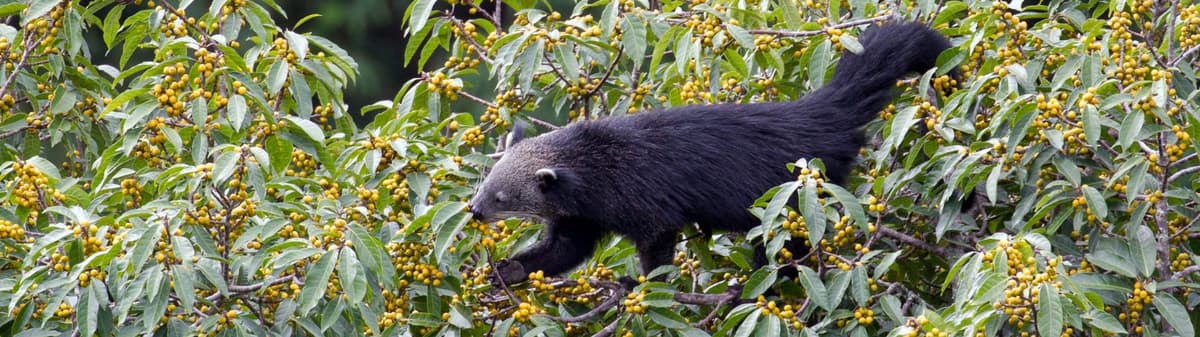
The binturong has a unique appearance and is often referred to as the “bearcat,” although it is neither a bear nor a cat. Its body is covered in long, rough, black or dark brown fur, sometimes mixed with gray or white hairs that give a silvery, grizzled appearance. The face and snout are usually lighter in color.
It has small, round ears with white edges and a distinctive black tuft of hair behind each ear. The eyes are large and dark, and long white whiskers grow from its cheeks. Its thick, muscular tail is prehensile, meaning it can grip branches like a fifth limb, a rare trait among mammals in Asia.
The binturong has short, strong legs with sharp claws and walks on the soles of its feet like a bear. Its hind ankles can rotate 180 degrees, allowing it to climb down trees headfirst with ease.
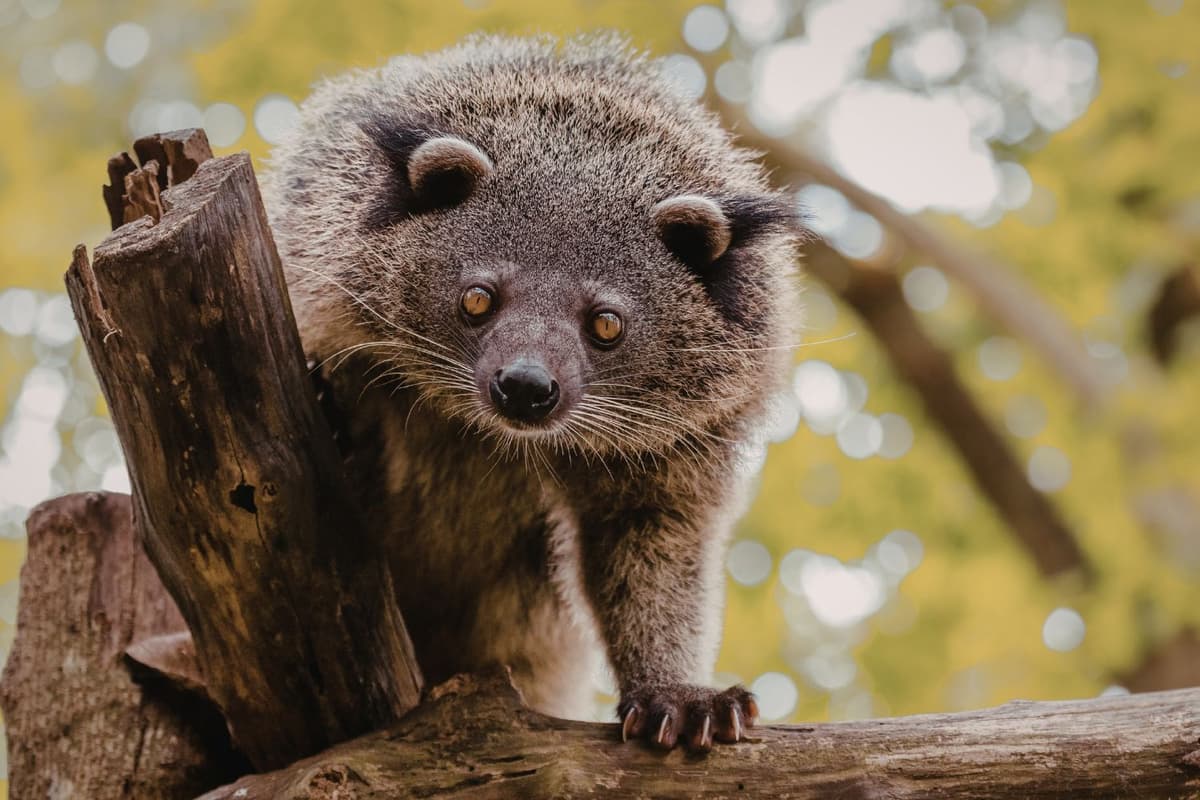
Binturongs feature a muscular build, thick fur, and a prehensile tail.
Habitat and Distribution
The binturong prefers mature evergreen forests, including both primary and well-regenerated secondary forests. It needs large, well-connected forest cover, at least 40% within a 20-km radius, to survive. These animals depend strongly on fruit-bearing trees and areas close to water.
Global Range
The binturong is native to South and Southeast Asia. It occurs in India (including Assam), Nepal, Bangladesh, and Bhutan, and across Myanmar, Thailand, Malaysia, Laos, Cambodia, Vietnam, and the Philippines (Palawan). In Indonesia, it is found on Sumatra, Borneo (Kalimantan), and Java, and it also reaches southern China (Yunnan).
Distribution in Vietnam
In Vietnam, the binturong is recorded mainly in mountainous regions and becomes rarer toward the south. It is now considered extremely rare in the wild. Historical records show it in Lai Chau, Yen Bai, Cao Bang, Tuyen Quang, Ha Giang, Lang Son, Son La, Hoa Binh, Quang Ninh, Thanh Hoa, Nghe An, and Ha Tinh. Its range is thought to extend from northern Vietnam down to the Annamite Range (Truong Son).
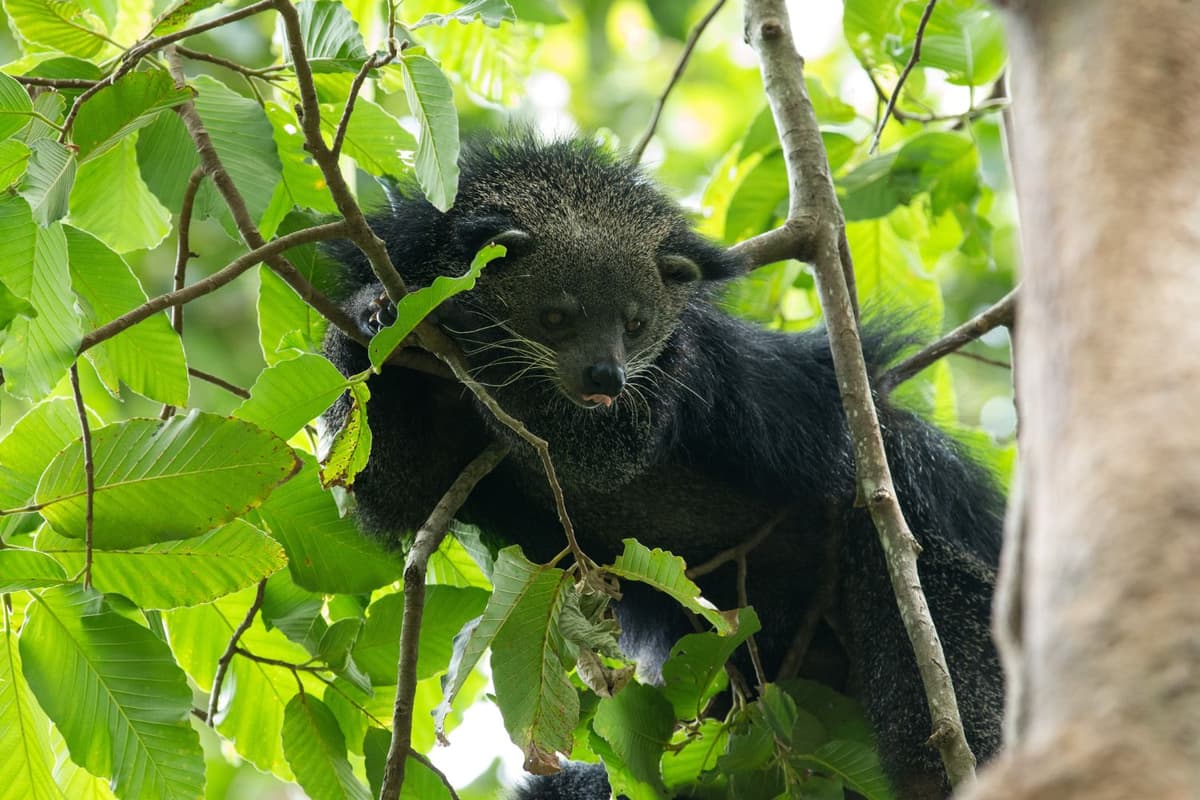
Tropical forests and dense jungles serve as the habitat for binturongs.
Binturong Diet and Ecology
Diet
Although the binturong belongs to the order Carnivora and has sharp teeth and claws, it is mainly fruit-eating (frugivorous). Figs are its most important food. It also eats insects, birds, fish, earthworms, small rodents, and bird eggs, and will sometimes feed on carrion.
Foraging
Binturongs use their mouth to grab fruit directly from branches or their front paws to pull branches closer. Their prehensile tail acts like a fifth limb, helping them balance or hang while reaching for food.
They are poor hunters and mostly take slow or easy prey, though they can swim and dive to catch fish. They are mainly nocturnal or active at dawn and dusk, resting in trees during the day.
Ecology
In the wild, binturongs have few natural predators because of their size and tree-dwelling life. They defend themselves by releasing a strong-smelling scent from glands under the tail and in their urine, which also marks territory. Their biggest threat is humans, due to hunting for meat, traditional medicine, pets, and fur.
The binturong plays a key role in seed dispersal, especially for fig trees (Ficus). It digests fruit quickly and passes seeds intact, helping forests regenerate and stay diverse.
Habit and Communication
Arboreal Lifestyle
The binturong leads a mostly arboreal life, spending much of its time high in the forest canopy. Its famous prehensile tail works like a fifth limb, helping it balance or hang securely while moving through branches.
Unlike monkeys, however, it does not use the tail to swing or leap between trees. Binturongs are skilled but slow climbers, moving carefully and deliberately. Their hind ankles can rotate almost 180 degrees, allowing them to climb down tree trunks headfirst in a controlled way. Because they cannot jump far, they often climb down to the ground and walk to another tree before climbing back up.
Once thought to be strictly nocturnal, binturongs are now known to be flexible in their activity patterns. They may be active by day, night, or mainly at dawn and dusk. During the day, they often rest curled up on branches or bask in the sun. In areas with heavy human disturbance, they tend to become more strictly nocturnal to avoid people.
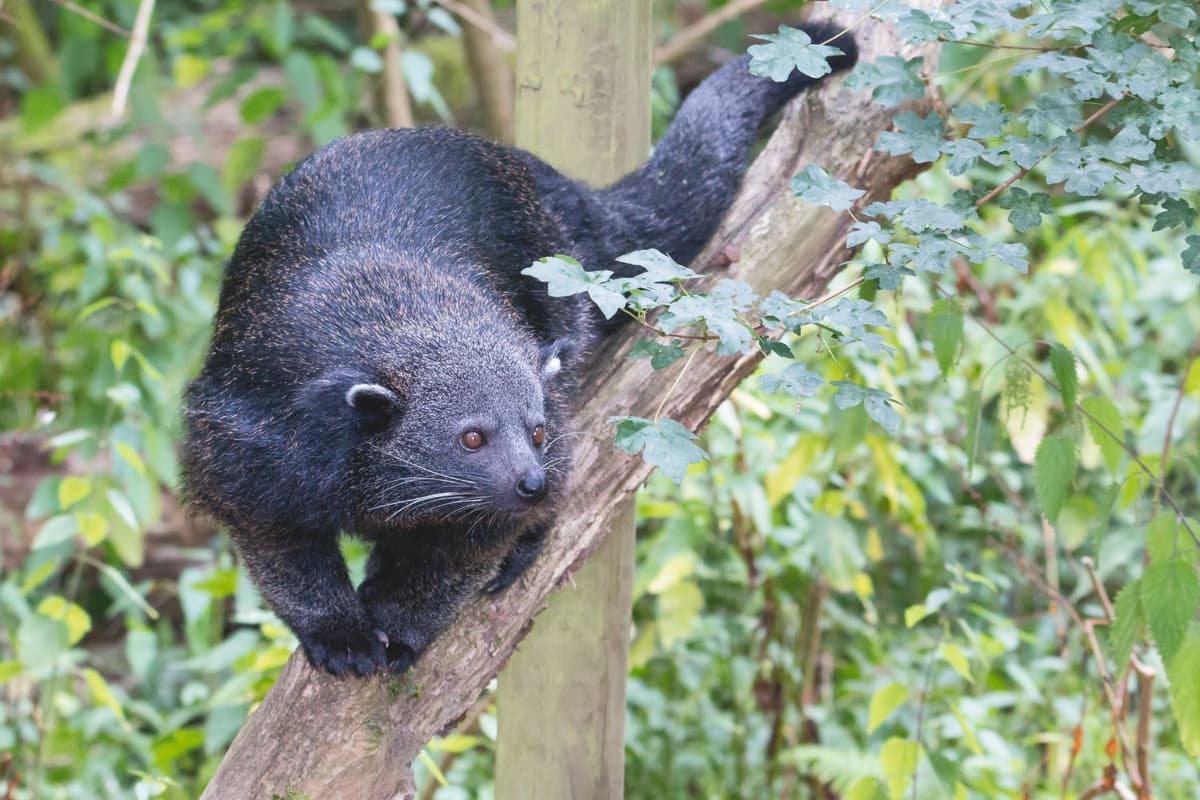
Nocturnal and arboreal, binturongs primarily consume fruits and small animals.
How Do Binturongs Communicate?
Binturongs communicate in several ways. They are famous for their “buttered popcorn” smell, produced by scent glands under the tail and in their urine. This scent, caused by the compound 2-acetyl-1-pyrroline, is used to mark territory and attract mates.
They also make a wide range of sounds, from soft chuckles when relaxed to purrs, grunts, hisses, and screams when threatened. Body language, especially tail movements, also plays a role in social communication.
They groom themselves like cats, sharpen their claws on tree trunks, and are strong swimmers, able to dive for food. In temperament, binturongs are usually shy but can become fierce when provoked. Even in captivity, friendly individuals still retain a strong wild instinct.
Reproduction of Binturongs
Binturongs do not have a fixed breeding season. They can mate throughout the year because females have a special system called delayed implantation. This lets the mother time the birth when environmental conditions are best, increasing survival of the young.
The gestation period lasts about 84–99 days. A female usually gives birth to 2 cubs, but litters can range from 1 to 3, and in rare cases up to 6.
Newborn cubs, called bintlets, are born with their eyes closed and stay hidden in the mother’s thick fur. They are completely dependent on her for warmth and protection.
By 6–8 weeks, the cubs grow coarse fur, begin to move around, and start eating solid food. Sexual maturity is reached at about 30 months in females and 27 months in males.
Females are about 20% larger and usually dominate. Males sometimes stay with the female and help care for the young.
In the wild, binturongs live about 18 years. In captivity, females live about 15 years, males about 18 years, with some individuals living over 25 years and one at Cúc Phương National Park reaching nearly 30 years.
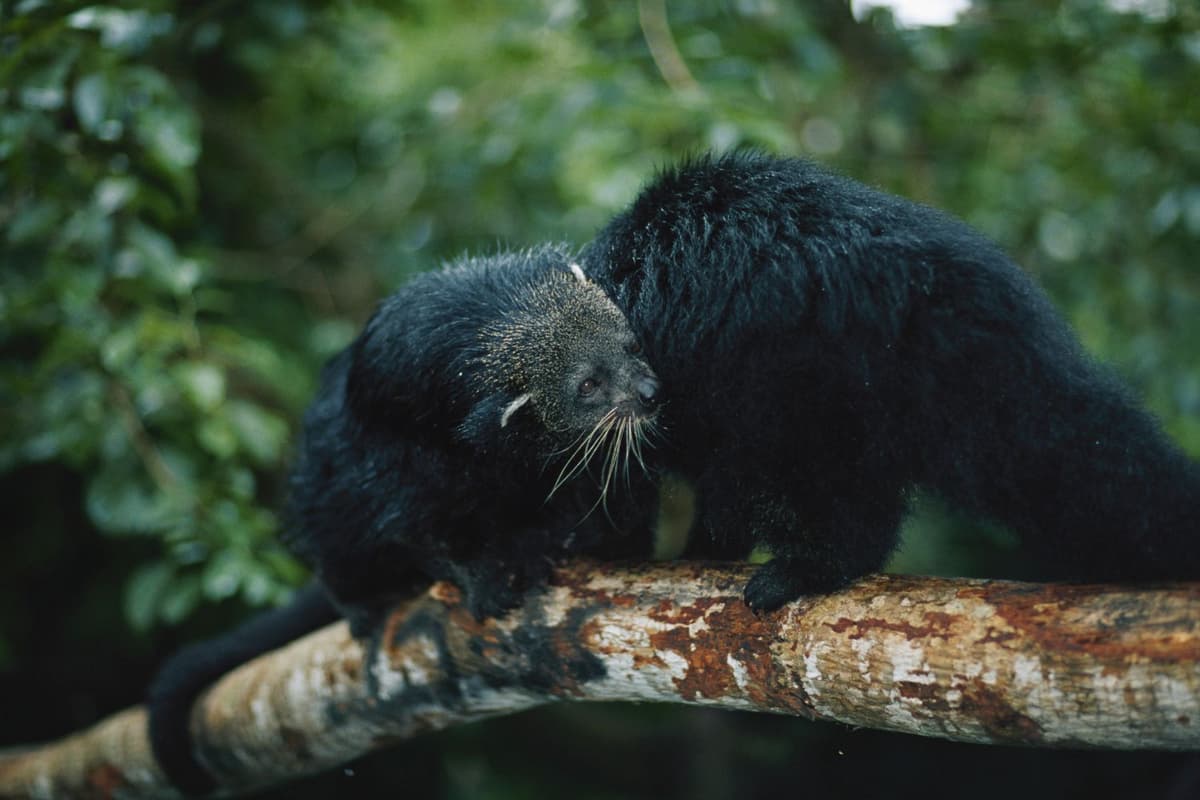
Binturong mothers provide care, protection, and nourishment for their young.
Binturong Threats and Conservation
Threats
The binturong is listed as Vulnerable (VU) on the IUCN Red List. Its global population has declined by more than 30% in the last 18 years (about three generations). In Vietnam, the species is even more threatened and is classified as Endangered (EN) in the national Red Data Book.
The main threat is habitat loss and fragmentation. Large areas of forest have been destroyed by logging, agriculture, oil-palm and rubber plantations, which breaks up the continuous forest the species needs. Climate change is predicted to reduce up to 90% of suitable habitat for binturongs in the future.
Hunting and illegal trade are also severe threats. Binturongs are hunted for meat (considered a delicacy in Laos and Vietnam), for traditional medicine, and for the pet trade. Wire snares are widely used and often injure or kill binturongs when they come down from trees to the ground.
Conservation Efforts
The binturong is listed in CITES Appendix III, which controls international trade. In Vietnam, it is strictly protected under Group IB of Decree 06/2019/NĐ-CP and Decree 84/2021/NĐ-CP, meaning all commercial use is illegal.
Save Vietnam’s Wildlife (SVW) works with Cúc Phương and Pù Mát National Parks to rescue and rehabilitate binturongs. Rescued individuals include “Mr. B”, kept in a cage for 14 years, and “Hoi An”, who became obese due to poor care.
International zoos support conservation through Species Survival Plans (SSP) and the European Endangered Species Programme (EEP).
Camera traps confirmed wild binturong in Tam Hợp (Pù Mát NP) and, for the first time in December 2024, in Động Châu – Khe Nước Trong Nature Reserve (Quảng Bình).
World Binturong Day is held every year on the second Saturday of May to raise public awareness.
5 Interesting facts about Binturong
1. Although it is called a “bearcat” and its scientific name Arctictis means “bear-weasel” in Greek, the binturong is neither a bear nor a cat.
2. Binturong urine smells like buttered popcorn because of a natural chemical it produces.
3. Many fig trees in tropical forests depend on binturongs to spread their seeds, helping new fig trees grow each spring.
4. The binturong’s hind ankles can rotate 180 degrees, allowing it to grip tree trunks and climb down head-first safely.
5. Even though it lives mostly in trees, the binturong is not afraid of water. It can swim well and even dive to catch fish or find food.
Reference
- Adam, Š., Piaček, V., Bednaříková, Š., Havelková, B., Němcová, M., Bomon, M., Lauer, R., & Pikula, J. (2024). Comparative cardiorespiratory and body temperature effects of ketamine-medetomidine, ketamine-xylazine, and ketamine-xylazine-diazepam anaesthetic protocols on the binturong (Arctictis binturong). Acta Veterinaria Brno, 93, 417–424. https://doi.org/10.2754/avb202493040417
- Allam, M. S., Balon, J. L. I., & Fernandez, D. A. P. (2022). Diet of Arctictis binturong (Viverridae, Carnivora) in Aborlan, Palawan, Philippines. Journal of Nature Studies, 21(1), 1-9.
- Bourgeois, A., Kayser, P., Debruille, A., & Veron, G. (2020). Binturong Arctictis binturong conservation: the relationship between the zoo community and ABConservation for an integrated conservation programme in Palawan, Philippines. International Zoo Yearbook, 54, 1-11. https://doi.org/10.1111/izy.12280
- Gray, T. N. E., Marx, N., Khem, V., Lague, D., Nijman, V., & Gauntlett, S. (2017). Holistic management of live animals confiscated from illegal wildlife trade. Journal of Applied Ecology, 54, 726–730. https://doi.org/10.1111/1365-2664.12916
- Greene, L. K., Wallen, T. W., Moresco, A., Goodwin, T. E., & Drea, C. M. (2016). Reproductive endocrine patterns and volatile urinary compounds of Arctictis binturong: discovering why bearcats smell like popcorn. The Science of Nature, 103(5-6), 37. https://doi.org/10.1007/s00114-016-1361-4
- Honda, A., Amir, Z., Mendes, C. P., Moore, J. H., & Luskin, M. S. (2024). Binturong ecology and conservation in pristine, fragmented and degraded tropical forests. Oryx, 58(2), 218-227. https://doi.org/10.1017/S0030605322001491
- Monitor. (2024, December 13). Wildlife Trade Poses Serious Threat to Binturongs as Illegal Trade in Indonesia Flourishes.
- Semiadi, G., Ross, J., Hearn, A. J., Heydon, M., Samejima, H., Mathai, J., Augeri, D., Fredriksson, G., Lim, N. T.-L., Rustam, Mohamed, A., Boonratana, R., Brodie, J. F., Giordano, A., Nakashima, Y., van Berkel, T., Hon, J., Loken, B., Marshall, A. J., … Wilting, A. (2016). Predicted distribution of the binturong Arctictis binturong (Mammalia: Carnivora: Viverridae) on Borneo. Raffles Bulletin of Zoology, Supplement No. 33, 96–102.
- Veron, G., Debruille, A., Kayser, P., Fernandez, D. A. P., & Bourgeois, A. (2020). Genetic diversity and structure of the binturong Arctictis binturong (Carnivora: Viverridae) – status of the elusive Palawan binturong and implications for conservation. Zoological Journal of the Linnean Society, 188(1), 302–318. https://doi.org/10.1093/zoolinnean/zlz100