Most cats seem to love fish, from familiar house cats to wild felines in the forest. But in nature, there is one wild cat that truly specializes in catching fish. This species has a set of physical traits and hunting behaviors that allow it to hunt and live in wetland habitats - something rare among members of the cat family. It is known as the Fishing Cat. At first glance, it looks very similar to the Leopard Cat, which often leads to confusion. So what makes the fishing cat different, and how is it adapted to hunt fish in the wild? Let’s take a closer look.
| Common name | Fishing Cat |
|---|
| Scientific name | Prionailurus viverrinus |
|---|
| Taxonomy
|
Kingdom: Animalia
Phylum: Chordata
Class: Mammalia
Order: Carnivora
Family: Felidae
Genus: Prionailurus
|
| Weight / Size | 5 - 16kg. |
|---|
| Lifespan | ~12 years |
|---|
| Population | Approx 3,000 individuals |
|---|
| Habitat | Wetland habitats, mangroves, marshlands, rivers and streams. |
|---|
| Range | Patches across South and South East Asia. Countries include India, Thailand, Sri Lanka and Nepal. |
|---|
| Diet | Predominantly fish but also include rodents and birds. |
|---|
| Conservation status | IUCN Status: Vulnerable. |
|---|
Physical Characteristics of Fishing Cat
At first glance, the fishing cat (Prionailurus viverrinus) might remind you of a large, spotted domestic tabby. However, this semi-aquatic feline is built very differently from the pet sleeping on your couch.
The most obvious difference is its powerful, stocky build. While a normal house cat weighs around 4 kilograms, the fishing cat size and weight can range anywhere from 5 to 16 kilograms, making it about twice as large and heavily muscled. Instead of a long, elegant tail that house cats use for balance on land, it has an unusually short and thick tail that acts like a boat's rudder to steer underwater.
When looking at its face, the fishing cat has a broader head and much stronger jaws designed to catch and hold slippery fish. Its ears sit lower on the sides of its head to keep water out while swimming. A quick tip for wild cat identification is to look at the back of its ears: you will see distinct white spots, a feature rarely seen on domestic cats. To camouflage perfectly in its native wetland habitats, its ashy-grey fur is covered with dark spots and thick stripes rather than typical tabby patterns.
But the most fascinating differences are hidden in the body parts designed for the water. We all know that domestic cats usually hate water and their fur gets completely soaked. In contrast, the fishing cat has a specialized water-resistant double coat. The inner layer of fur is incredibly dense, acting just like a biological wetsuit that keeps its skin completely dry and warm even when it dives into cold water.
Finally, look at their paws. Unlike the soft paws of a house cat, they have semi-webbed toes that help them paddle through the water like a duck. Also, while your pet cat can hide its claws completely inside its paws, the fishing cat's claws do not fully retract. They remain slightly exposed all the time, giving them the perfect built-in hooks to grab onto struggling fish.
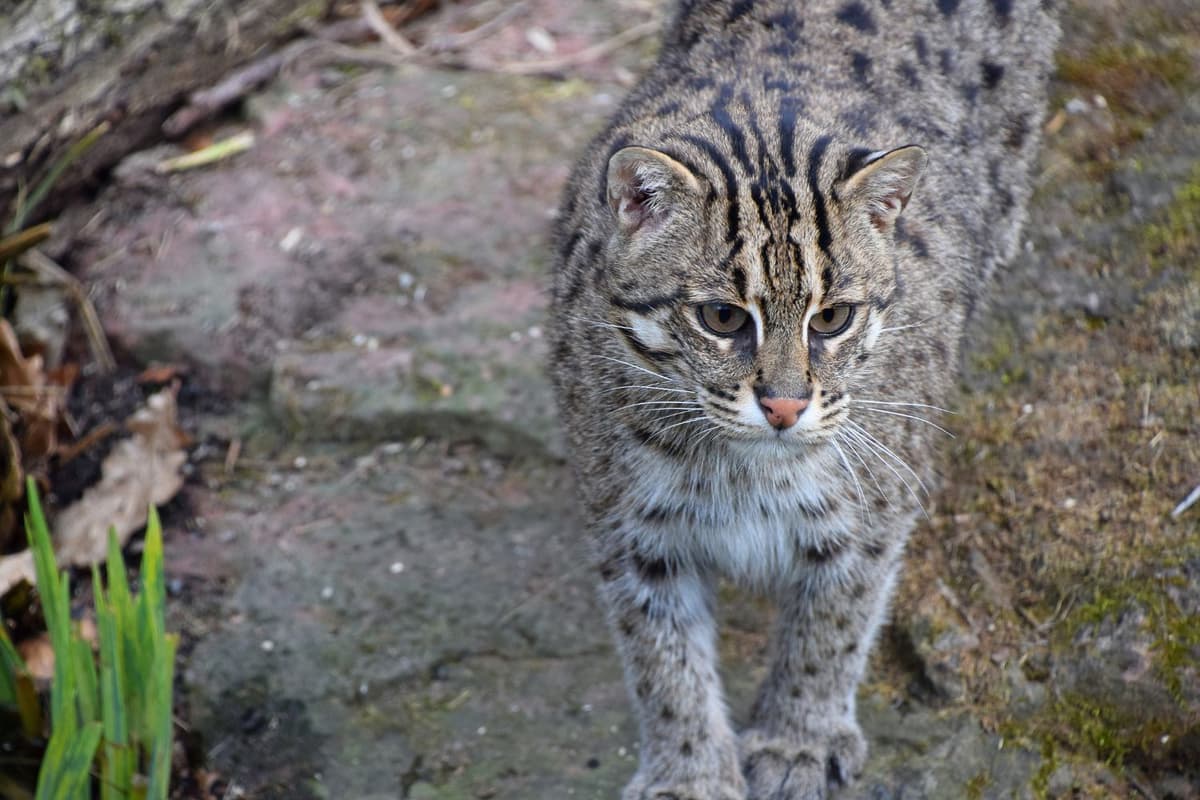
Its fur features a mix of dark spots and stripes, providing excellent camouflage in wetland habitats.
Global Distribution and Habitat
Fishing Cat Distribution
The fishing cat is primarily found in South Asia wildlife zones and parts of Southeast Asia. However, their population density varies drastically depending on the region, highlighting a severe Southeast Asia conservation crisis. Currently, the global population is estimated to be roughly between 3,000 and 7,500 individuals.
South Asia is undoubtedly the stronghold for this species. Countries like India, Bangladesh, and Sri Lanka hold the largest share of the global population. They thrive particularly well in coastal wetland habitats and mangrove swamps. For instance, in the famous Sundarbans and eastern India, they can reach incredibly high densities of up to 50 - 70 individuals per 100 square kilometers. In contrast, inland areas like Nepal’s protected parks support much smaller numbers.
Sadly, the situation in Southeast Asia is deeply concerning. Fishing cats are far less numerous and are facing localized extinctions. Countries like Thailand and Cambodia combined are estimated to hold fewer than 200 individuals.
In Vietnam, the situation is particularly critical. After many years without reliable sightings, the fishing cat in Vietnam was officially recorded in 2008 in U Minh Thuong National Park (Mekong Delta). Despite this discovery, there are currently no reliable population estimates for Vietnam, strongly suggesting that the cat has become extremely rare or possibly locally extinct due to the rapid loss of its natural mangrove swamps and wetland homes.
Fishing Cat Habitat
The fishing cat mainly lives in wetland areas, especially marshes and swamps. These places are typical swamp and marsh land feline habitats for the species. The fishing cat depends strongly on areas with a steady water source. It is often found in wetlands such as reed beds, scrub areas, tidal creeks, and mangrove forests. It can also live in forested areas that are close to rivers or near jungle environments. Most records of fishing cats come from lowland wetlands. However, the species is not limited to low areas only.
Fishing cats have been recorded in Himalayan forests at elevations of about 1,525 metres. In Sri Lanka, they have also been found in wetland habitats in hilly and mountainous areas at elevations of up to 2,100 metres. In the lowlands of Nepal, some fishing cats have been observed spending long periods in dense grasslands far from open water.
Fishing Cat Diet and Behavior
Fishing Cat Diet
The fishing cat is not exclusively a fish-eater. It is primarily a piscivore, relying heavily on aquatic prey such as fish, crabs, and shellfish. However, its teeth are not strictly adapted only for fish, allowing it to be a highly opportunistic feeder in its wetland environment.
In the wild, its menu expands significantly. Beyond the water, their diet includes frogs, snakes, rodents, insects, and water birds. Surprisingly, this robust cat is also capable of taking down larger terrestrial animals, including small civets, fawns, and wild pigs.
When natural prey is scarce, the fishing cat proves its extreme adaptability by scavenging. They will readily consume carrion, such as dead cattle or leftover scraps from tiger kills, and occasionally prey on domestic livestock and poultry to survive.
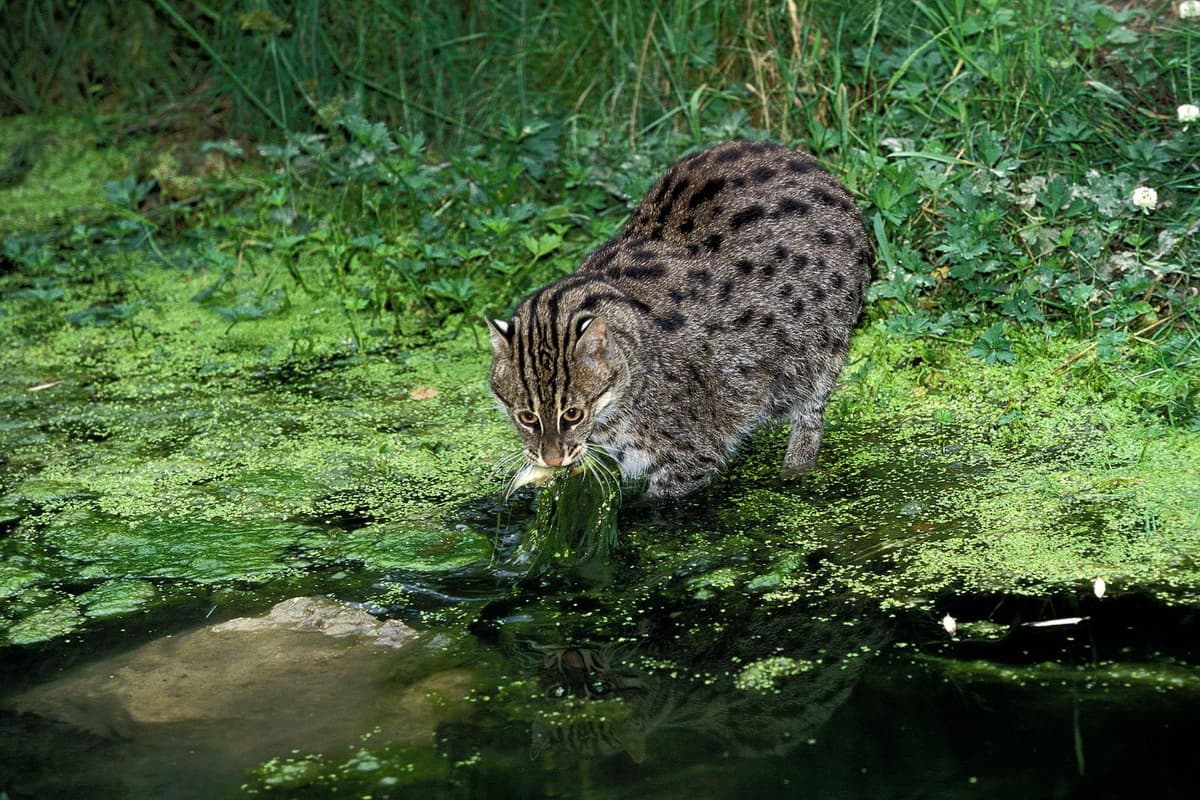
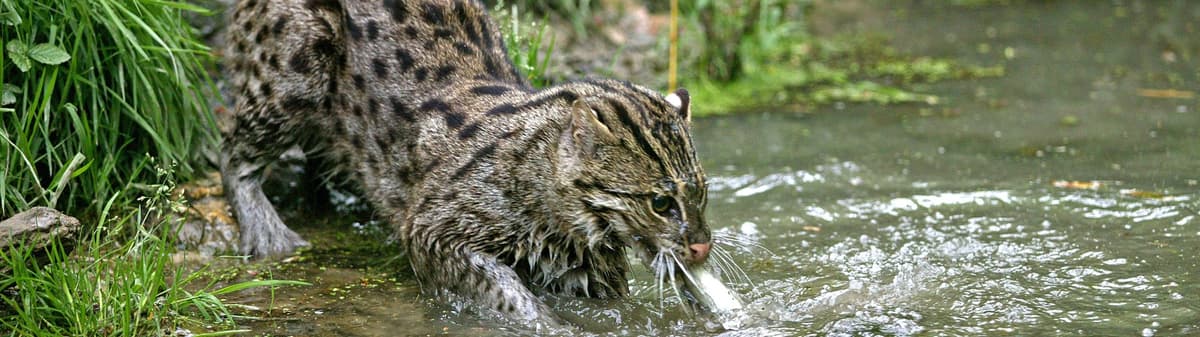
A fishing cat catching fish in a marshland.
Fishing Cat Behavior
As a highly specialized semi-aquatic feline, the fishing cat is an expert nocturnal hunter. Under the cover of darkness, they patrol the shallow edges of rivers and wetlands, perfectly adapted to hunt their aquatic prey.
Unlike most cats that hate getting wet, they don't just wait passively on the shore. They actively use their semi-webbed paws to expertly scoop fish directly from the water, and are even capable of swimming and diving completely underwater to chase their meals.
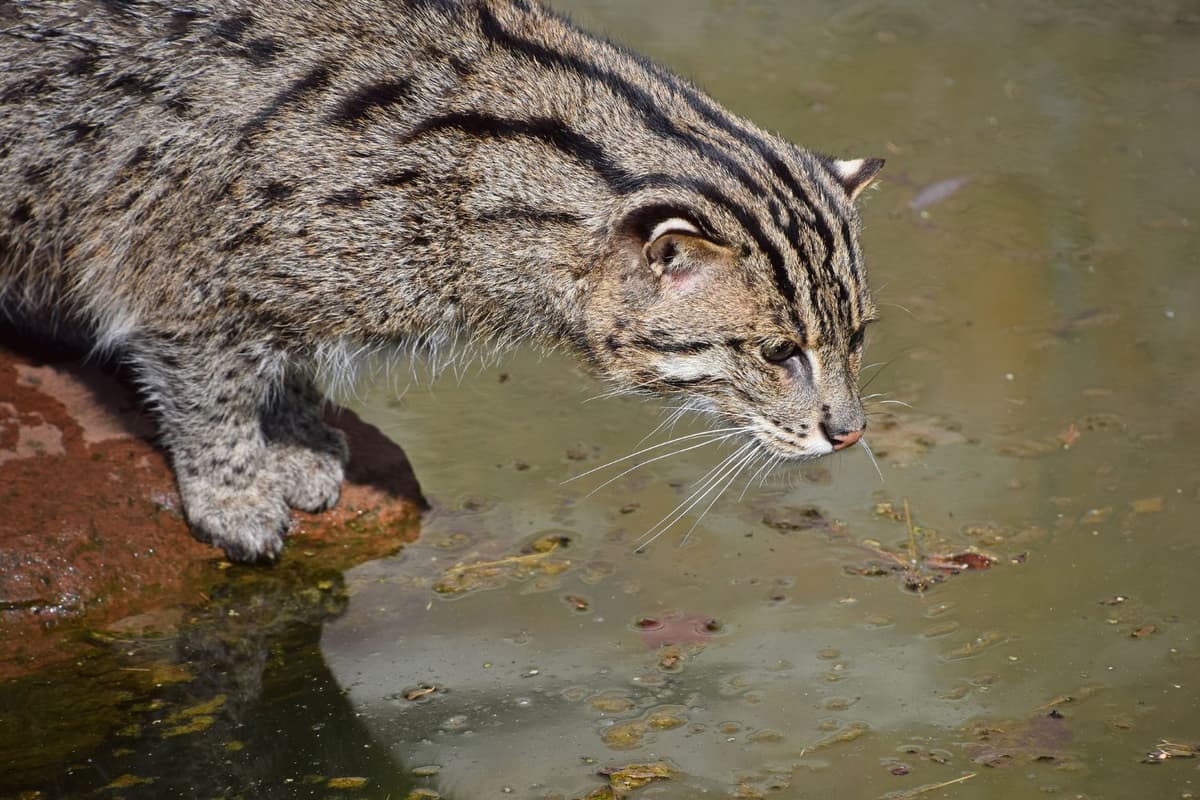
The fishing cat is quietly watching its prey beneath the water.
Their most brilliant hunting strategy is the clever water-tapping technique. The cat will gently pat the surface of the water with its paw to create light ripples, mimicking a struggling insect. When a curious fish swims close to investigate the movement, the cat instantly dives in to secure its catch.
Fascinatingly, this deep connection to water extends beyond just hunting. Even in captivity, they exhibit a unique "washing" behavior, deliberately dropping pieces of meat into the water and retrieving them before eating.
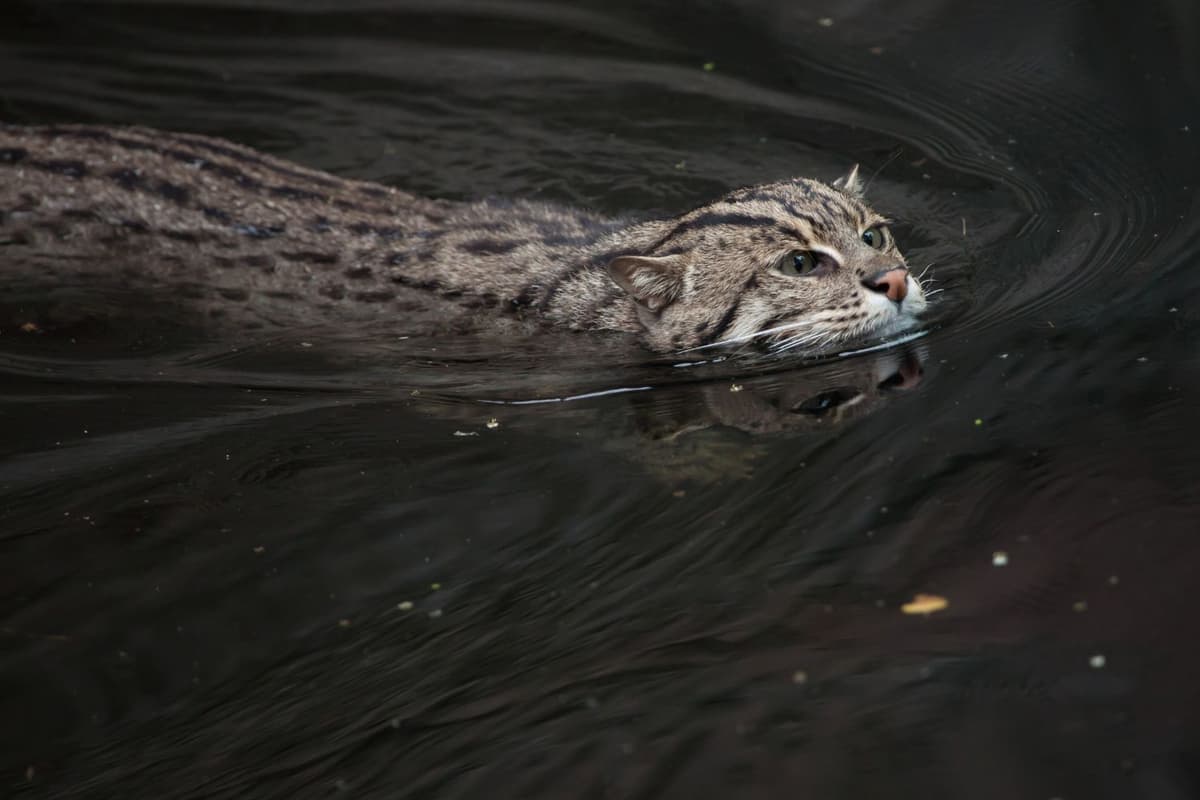
The fishing cat is an excellent swimmer.
Reproduction and Offspring
While they can mate year-round, wild fishing cats mostly breed between January and February. To protect her babies, the mother displays careful denning behavior, giving birth in hidden spots like thick reeds or hollow trees. After a fishing cat gestation period of 63 to 70 days, she usually has a small litter of two or three tiny kittens.
Thanks to excellent feline maternal care, the wild cat kittens grow up fast. They open their eyes after just two weeks. The most exciting milestone happens at two months old: their aquatic instincts kick in! At this age, they start eating meat and naturally begin playing in the water to practice their future fishing skills.
They stop drinking milk by six months and reach adult size by nine months. By the time they are 12 to 18 months old, the young cats leave their mother to live independently and find their own wetland territories. In a safe environment, fishing cats can live for up to 12 years.
Threats to and conservation of the fishing cat
Threats to the Fishing cat
Currently, the IUCN Red List classifies the fishing cat as Vulnerable (VU), meaning they face a high risk of extinction. The main reasons behind their rapid decline all point to human activity:
- Severe habitat loss: The number one threat is wetland degradation. Their natural homes - marshes, swamps, and floodplains are being rapidly destroyed to make way for agriculture and aquaculture expansion, especially commercial shrimp farming.
- Human-wildlife conflict: Because overfishing and polluted waters have destroyed their natural food sources, hungry fishing cats sometimes hunt domestic poultry. In retaliation, local farmers often trap or kill them.
- Poaching and Illegal trade: Despite being protected by law, these cats are still hunted for meat, traditional medicine, and the illegal trade of fishing cat skins.
- Road collisions: As new roads are built through remaining wetland habitats, many cats are tragically hit by cars while trying to cross.
Conservation
Saving the fishing cat means saving its home. Today, conservation efforts are strictly focused on protecting critical wetland habitats and finding ways for humans and nature to coexist:
- Protecting the wetlands: Organizations like the Fishing Cat Conservation Alliance (FCCA) work hard to stop wetland destruction. They promote eco-friendly farming and sustainable fishing practices to keep the waters clean and full of fish.
- Supporting local communities: In hotspot areas like India, conservationists help locals find alternative ways to earn a living without draining the swamps. This approach not only saves the forest but also drastically reduces human-wildlife conflict.
- Captive breeding programs: Beyond the wild, global zoos play a vital role. Institutions like the EAZA and AZA run strict breeding programs. By tracking every captive fishing cat in an International Studbook, they ensure a healthy genetic "backup" population, giving this semi-aquatic feline a much better chance at long-term survival.
Differences between the Fishing Cat and the Leopard Cat
Because they belong to the same genus, people often confuse the fishing cat with the much more common leopard cat (Prionailurus viverrinus) However, a quick wild cat identification reveals massive differences in their feline morphology, hunting skills, and habitats. Here is a quick comparison to help you tell them apart:
- Size and build: The fishing cat is a heavy, muscular powerhouse (weighing up to 16 kg) with a short, thick "rudder" tail. The leopard cat is much smaller and slimmer (only 2-3 kg), with long legs and a long tail used for balancing.
- Coat patterns: This is the easiest way to tell them apart! The leopard cat is famous for its distinct leopard-like rosettes (hollow spots, like a tiny leopard). In contrast, the fishing cat has solid black spots and stripes.
- Lifestyle (Arboreal vs. Aquatic): The leopard cat is highly arboreal (loves climbing trees) and is an agile land hunter. The fishing cat is strictly aquatic, relying on its partially webbed feet to swim and scoop fish out of the water.
- Habitat flexibility: Leopard cats are incredibly adaptable, surviving in forests, grasslands, and even near human farms. Fishing cats are highly specialized, if their wetland homes are destroyed, they disappear completely.
This difference in adaptability explains their current survival status. The leopard cat is still widely distributed across Vietnam and is frequently recorded in protected areas like Cat Tien National Park. Sadly, the fishing cat is extremely rare. With only one official record in 2008 in An Giang Province, experts fear this unique aquatic cat may already be locally extinct in Vietnam.
5 Interesting Facts of the Fishing cat
1. Fishing cat kittens begin learning how to hunt and even dive into water when they are only about one month old.
2. A fishing cat has around 32 muscles in each ear. Its ears can rotate almost 180 degrees, allowing it to hear sounds from many directions without moving its head.
3. When swimming, fishing cats use their short, flattened tail to help steer and control direction in the water, just like a rudder on a boat.
4. Fishing cats, Bengal cats, and leopard cats share common ancestors, which is why they look very similar. All have dark spots and signature stripes running from above the eyes down the head and neck. Among them, the fishing cat is the largest.
5. Even though they look like house cats, fishing cats are wild animals. They need natural mangroves and swamps to survive, can be aggressive, and are a protected species.