“I got the eyes of the tiger, a fighter”.
The sharp golden eyes, the black, orange and white stripes, the apex predator of the jungle. Across cultures and continents, the tiger has long stood as a symbol of power and courage. Today, only six tiger subspecies remain in the wild. Among them, the Indochinese tiger is one of the most elusive.
Scientifically known as Panthera tigris corbetti, the Indochinese tiger was named in honor of Jim Corbett, a tiger hunter who later became one of the world’s most influential Indochinese tiger’s conservationists and naturalists. This subspecies was officially recognized in 1968 by Czech biologist Vratislav Mazák, marking an important milestone in modern tiger taxonomy.
| Common name | Indochinese Tiger |
|---|
| Scientific name | Panthera tigris |
|---|
| Taxonomy
|
Class: Mammalia
Order: Carnivora
Family: Felidae
Genus: Panthera
Species: Panthera tigris
|
| Weight / Size | 130-250kg in weight; 8 - 9 feet in size. |
|---|
| Lifespan | 10 - 15 years. |
|---|
| Population | 3140 mature individuals; Decreasing. |
|---|
| Habitat | Tropical and subtropical moist broadleaf forests, dry forest. |
|---|
| Range | Southeast Asia. |
|---|
| Diet | Carnivore. |
|---|
| Conservation status | Endangered in IUCN Red List. |
|---|
Indochinese Tiger physical characteristics
Indochinese Tiger identifying features
The Indochinese tiger is visually distinct from other tiger subspecies, particularly the Bengal tiger (Panthera tigris tigris). Indochinese tiger has a darker overall coat, with more numerous, shorter and narrower black, white, orange stripes. Its appearance reflects adaptation to dense tropical forests and mountainous terrain across mainland Southeast Asia.
Compared to the Bengal tiger (Panthera tigris tigris), the Indochinese tiger is approximately 20 percent smaller, placing it among the medium-sized tiger subspecies. This more compact build supports stealth and agility in thick forest environments rather than open grasslands.
Indochinese Tiger average size and lifespan
On average, adult male Indochinese tigers measure around 2.7 meters (9 feet) from head to tail and weigh approximately 180 kilograms. However some have been recorded at well over 250 kilograms.
Females are noticeably smaller and lighter. An adult female typically measures about 2.4 meters (8 feet) in total length and weighs around 115 kilograms.
In the wild, the Indochinese tiger typically has a lifespan of 10 to 15 years. Survival within this range depends on factors such as prey availability, habitat quality, territorial competition, and human pressure.
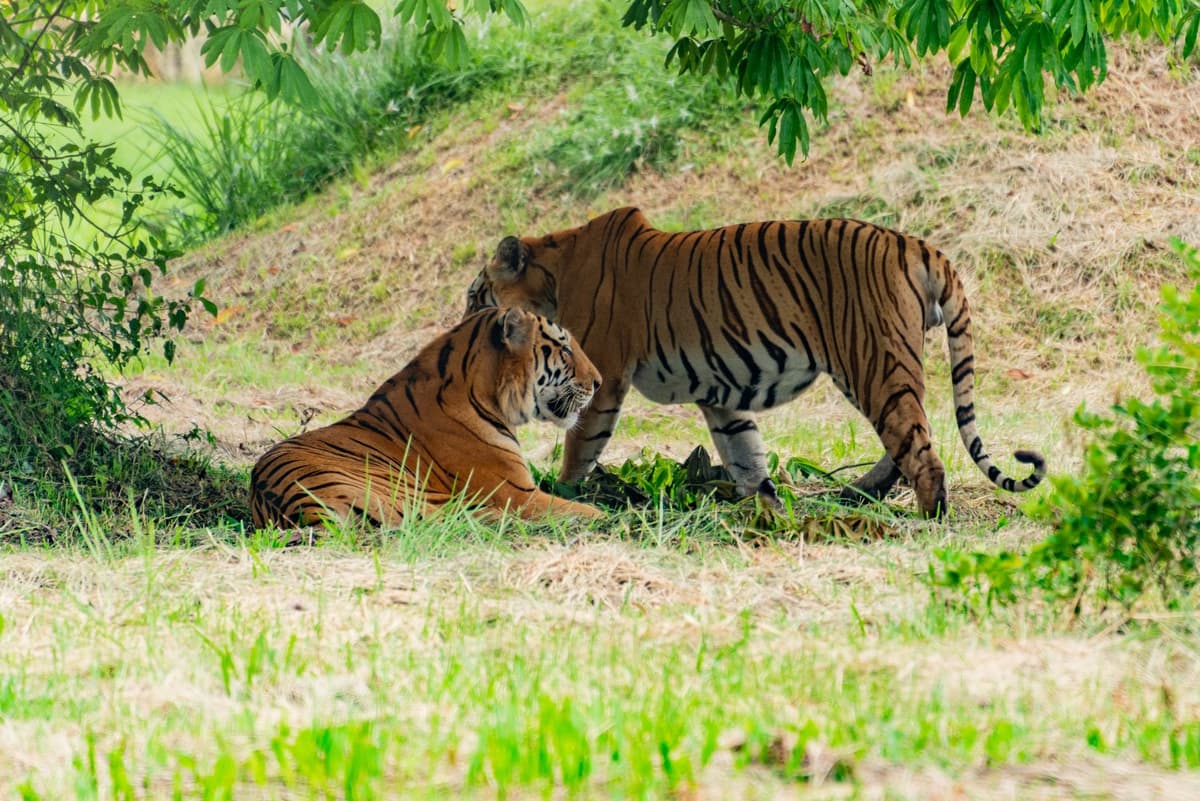
Indochinese tigers rest under the shade.
Indochinese Tiger body structure
The Indochinese tiger’s body structure reflects a balance between strength, stealth, and adaptability to dense forest environments.
They have a darker overall coat. The base fur tone tends to be deeper and more muted, helping the tiger blend into shadowed forest habitats. Its stripes are more numerous, shorter, and narrower, and they rarely form paired or double stripes. Stripe coloration typically ranges from deep black to dark brown, contrasted against a background of white and brick-orange tones.
Its fur is shorter and generally darker than that of many other tiger subspecies, with narrower black stripes running across an orange to golden coat. This coloration provides highly effective camouflage, allowing the tiger to remain concealed in forest shadows while stalking prey. In contrast, white fur is present on the belly, parts of the face, and along the neck, forming a subtle ruff of white hair that frames the head.
Male Indochinese tigers possess a distinctive sagittal crest on the skull, a pronounced ridge running lengthwise along the top of the head toward the back. This structure serves as an attachment point for powerful jaw muscles, supporting a strong bite essential for subduing large prey.
Their limbs are equipped with long, retractable claws, which can be drawn back into the paws when not in use. This adaptation keeps the claws sharp and enables secure gripping of prey, as well as safe and controlled climbing. When navigating forest terrain, these claws also allow the tiger to anchor itself against tree bark, enhancing balance and mobility in complex habitats.
Indochinese Tiger Distribution and Habitat
Indochinese Tiger habitat types
The Indochinese tiger inhabits a range of forested environments across mainland Southeast Asia, favoring landscapes that provide dense cover and reliable prey.
Its primary habitats include tropical and subtropical moist broadleaf forests, where thick vegetation, layered canopies, and abundant water sources offer ideal conditions for ambush hunting. These forests support large herbivores such as deer and wild boar, which form the core of the tiger’s diet.
In addition, Indochinese tigers are also found in dry forest ecosystems, particularly in seasonal forests where prey movements follow rainfall patterns. Here, their darker coat and narrow striping continue to provide effective camouflage amid drier foliage and open woodland.
Across both habitat types, access to water, sufficient prey density, and minimal human disturbance are critical factors shaping the distribution and survival of this elusive subspecies.
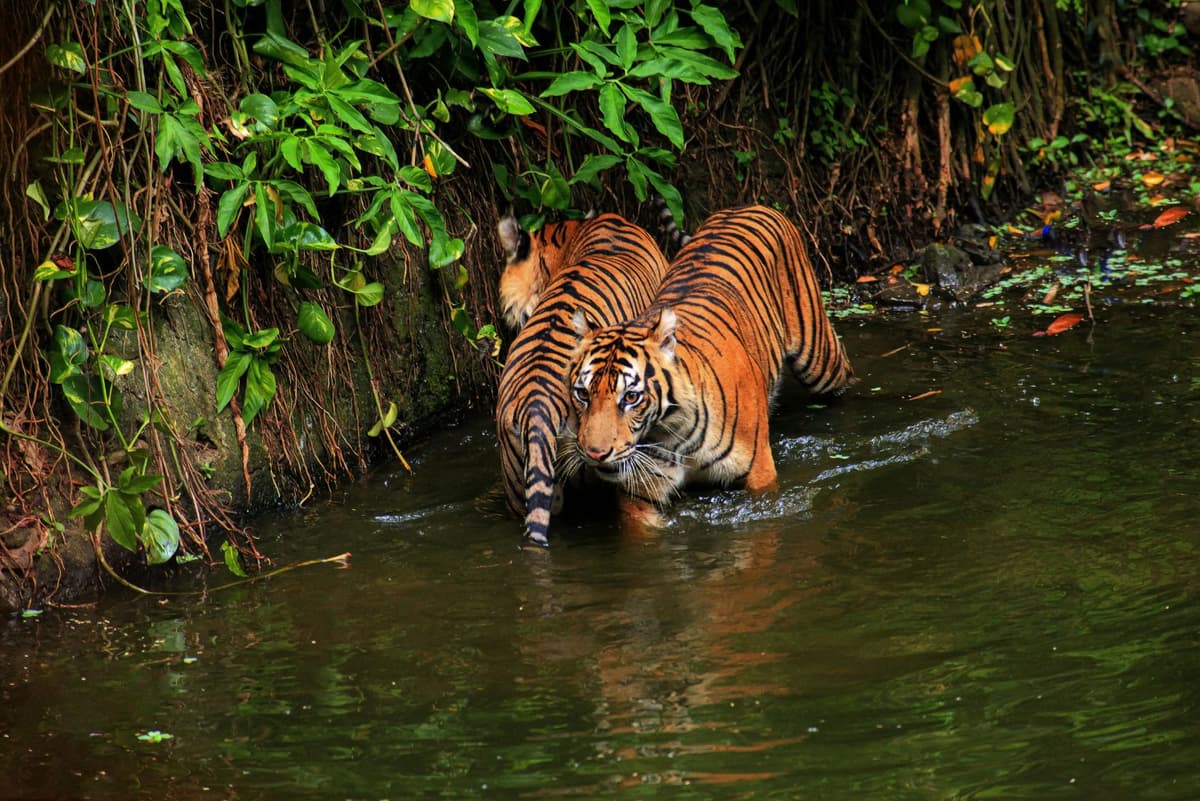
Indochinese tigers wade through a forest stream.
Global distribution of Indochinese Tiger
The Indochinese tiger is native to mainland Southeast Asia, but its geographic range has undergone a dramatic contraction over the past century.
Historically, this subspecies ranged widely across the region, inhabiting forests in Cambodia, southern China, Laos, Myanmar, Thailand, and Vietnam. Dense forests, abundant prey, and low human population densities once allowed Indochinese tigers to thrive across national borders.
By 2020, the Indochinese tiger population had declined by more than 80 percent in just over a decade. It’s believed that in Cambodia, China, the Lao People’s Democratic Republic, or Vietnam, Indochinese tigers have either disappeared entirely or persist only as isolated, non-breeding individuals.
Current estimates suggest that only around 221 individuals remain, with viable, breeding populations largely confined to Thailand and Myanmar. Thailand now represents the last stronghold for the Indochinese tiger, supporting the largest remaining population, while eastern Myanmar holds smaller but still critical numbers.
Indochinese Tiger habitat in Vietnam
Historically, the Indochinese tiger once ranged widely across Vietnam. From the early 20th century and earlier, tigers were distributed throughout the country’s mountainous regions and were even recorded in midland areas and offshore islands. Several locations were particularly well known for strong tiger population, including Ba Che (Quang Ninh), Bac Ha (Ha Giang), Doc Cun (Hoa Binh), Muong Nhe (Lai Chau), Quang Binh, Quang Ngai, Phu Yen, Khanh Hoa, K’Bang (Gia Lai), and Sa Thay (Kon Tum).
The Vietnamese tiger, scientifically classified as Panthera tigris corbetti, also known as the Indochinese tiger, was once an integral part of Vietnam’s forest ecosystems. In local culture, tigers were known by many regional names such as cọp, hùm, ông kễnh, or ông ba mươi, reflecting their deep presence in folklore and rural life.
However, this distribution collapsed rapidly during the late 20th century. According to a report presented by the Government of Vietnam at the Tiger Forum in 2004, tigers were believed to persist in only 17 provinces, surviving in highly fragmented and severely degraded forests. By 2010, estimates suggested that fewer than 50 individuals remained in the wild, and conservation experts warned that the Indochinese tiger in Vietnam could disappear sooner than any other tiger subspecies.
No confirmed records of wild tigers have been documented in Vietnam since 1997, when camera traps captured the last verified images in Pu Mat National Park. By 2016, the IUCN estimated that only around five Indochinese tigers might remain across the country, numbers too low to support a viable wild population. Today, experts widely consider tigers to be functionally extinct in the wild in Vietnam.
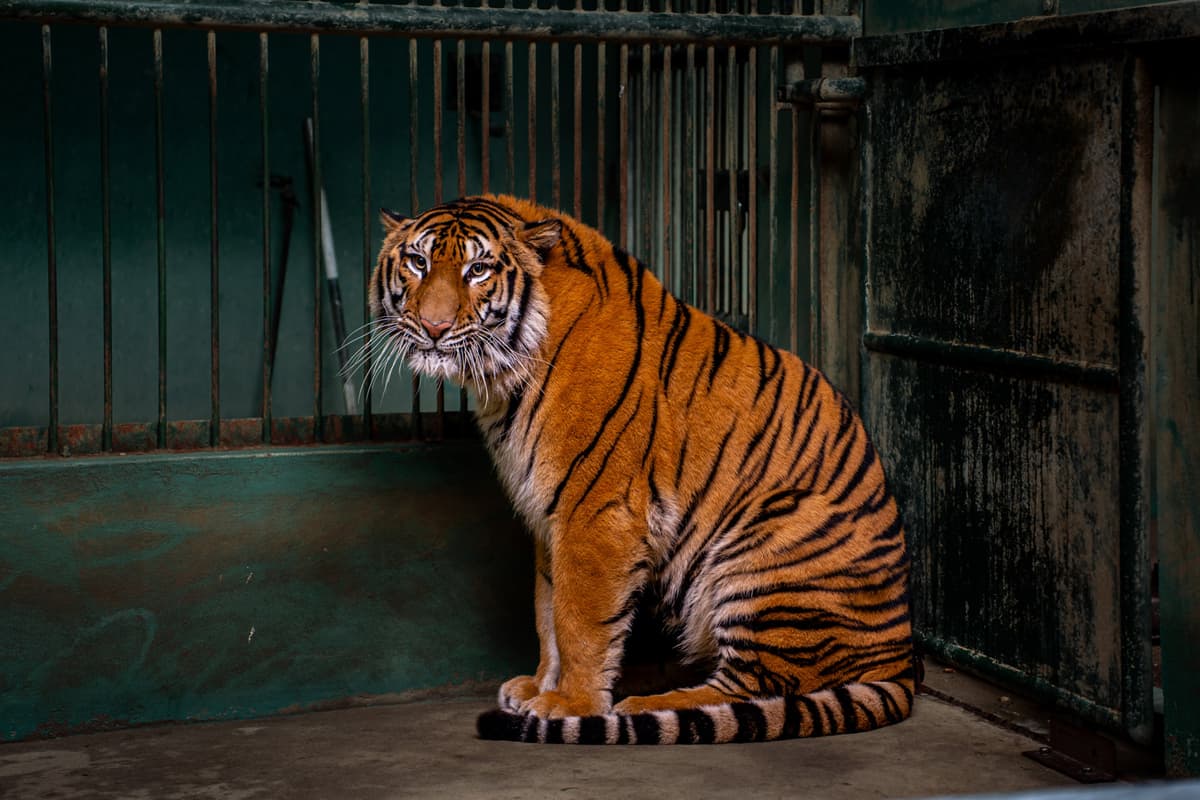
An Indochinese Tiger in Phong Nha-Ke Bang National Park. Photo credit: Oxalis Adventure
Yet, at Phong Nha - Ke Bang National Park, seven Indochinese tigers are currently kept under human care. These tigers represent the last surviving individuals of a population that once occupied forests across the country, highlighting both the scale of its decline and the urgency of conservation efforts.
Indochinese Tiger in traditional culture and mythology
Throughout Vietnamese history, the Indochinese tiger (Panthera tigris corbetti) has been deeply woven into daily life, belief systems, and artistic expression. More than a wild animal, the tiger emerged as a powerful cultural symbol, feared, respected, and revered.
In Vietnamese tradition, the tiger is one of the twelve zodiac animals, representing strength, courage, and protection against evil. Across centuries, tiger imagery appeared prominently in decorative arts and state symbolism, such as: Tiger motifs carved on Dong Son drums, stone tiger statues of the Tran dynasty, ceramic tigers from the Le dynasty, and tiger designs engraved on the Nine Tripod Cauldrons of the Nguyen dynasty.
Vietnamese folklore and literature are rich with proverbs and idioms about tigers, such as “Hổ dữ chẳng nỡ ăn thịt con” (Even a fierce tiger cannot bear to eat its own cubs) emphasize compassion and parental instinct, while “Hổ phụ sinh hổ tử” (A tiger begets a tiger cub) celebrates inherited strength and virtue. Tigers also feature prominently in fairy tales and fables passed down through generations. Many Vietnamese readers encounter the tiger early through classic literary works, including “Nhớ rừng” (Missing the Jungle) by Thế Lữ, where the tiger becomes a metaphor for lost freedom and national spirit.
Beyond Vietnam, the tiger holds powerful meaning across Southeast Asia. It is the national symbol of Malaysia and a mythological emblem of strength in Myanmar. In Thailand, the tiger is traditionally regarded as a guardian of the forest, embodying courage, authority, and spiritual protection.
However, some myths and superstitions surrounding tigers, wrongly believed to bring luck or healing, have fueled illegal hunting and trade, contributing significantly to the species’ decline. Today, the Indochinese tiger stands as both a cultural icon and a conservation symbol, reminding us that protecting wildlife also means preserving the cultural heritage intertwined with it.
Indochinese Tiger behavior
The Indochinese tiger is a solitary and territorial predator, spending most of its life alone. Adult individuals generally interact with others only during mating periods or when a female is raising her cubs.
Each resident tiger commands and patrols a large territory, which it actively defends against intruders of the same sex. The size of these territories can vary greatly.
Indochinese Tiger daily activity patterns
Indochinese tigers follow distinct daily activity patterns shaped by territorial defense, hunting efficiency, and reproductive behavior.
Tigers mark their territory boundaries using a combination of urine spraying, feces deposition, claw scratches on tree trunks, and deep, resonant roars that can carry across long distances. These signals warn rival tigers to stay away and help minimize direct conflict.
Territorial aggression is especially pronounced among males. A male tiger will react aggressively if another male enters its territory, especially during the mating season, when competition for females intensifies.
Are Indochinese Tiger nocturnal?
Yes. Indochinese tigers are primarily nocturnal animals. They hunt mainly at night, taking advantage of low light conditions and their sharp senses. Excellent night vision and acute hearing allow them to detect even slight movements or sounds in the forest.
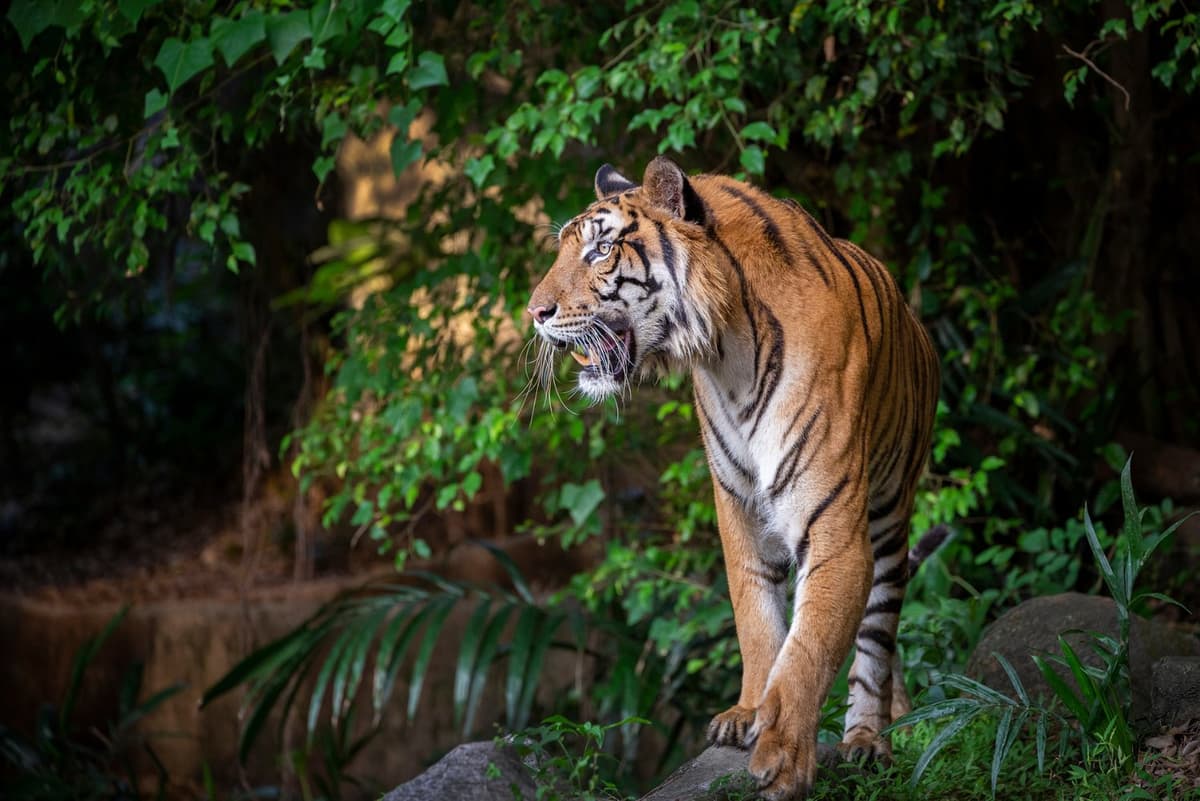
Majestic Indochinese tiger in its natural habitat
What do Indochinese Tigers eat?
The Indochinese tiger is an apex predator and the largest land-dwelling carnivorous mammal, perfectly adapted for hunting large prey in forested environments. Typically, they hunt once or twice per week and can consume up to 75 pounds (about 34 kilograms) of meat in a single feeding.
Indochinese tiger’s tongue is covered in papillae—tiny, backward-facing, spike-like structures. These papillae allow the tiger to strip meat and feathers from bones efficiently without injuring its tongue, ensuring that no part of a kill is wasted.
Indochinese tigers primarily prey on medium to large-sized mammals, including wild boar, muntjac and sambar deer, macaques, and the goat-like serow. In areas where natural prey remains abundant, these species form the core of the tiger’s diet.
Occasionally, they may also take domesticated livestock, such as cattle and goats, particularly where forests overlap with human settlements.
When large prey becomes scarce, their diet shifts toward smaller animals, including porcupines, muntjacs, monkeys, and hog badgers. This dietary flexibility helps the Indochinese tiger survive in degraded and fragmented habitats, though it often brings them into conflict with humans.
Indochinese Tiger hunting techniques
As apex predators, Indochinese tigers rely on patience, stealth, and explosive power to capture their prey. A hunt often begins with a quiet stalk that can last 20 to 30 minutes, as the tiger carefully positions itself for a decisive attack. Their striped coats break up the outline of their bodies, allowing them to blend seamlessly into trees, shadows, and dense vegetation.
When the moment is right, the tiger launches a sudden ambush, closing the distance in seconds. Using powerful jaws, large canine teeth, and razor-sharp claws, it delivers a lethal bite—often to the throat or neck, quickly overpowering its prey.
Physically, the Indochinese tiger is capable of short bursts of remarkable speed, reaching up to 60 miles per hour (about 96 km/h). This explosive acceleration, often compared to the speed of a baseball pitcher’s curveball, is used during ambush attacks, allowing the tiger to overpower prey within seconds.
Moreover, tigers are also strong swimmers and are comfortable hunting near rivers, streams, and wetlands.
Indochinese Tiger reproduction
Indochinese Tiger gestation period
Indochinese tigers are capable of breeding throughout the year, provided they have reached sexual maturity. Females typically become sexually mature at around 3.5 years of age, while males reach maturity later, at approximately 5 years. As with all tiger subspecies, males are consistently larger than females, reflecting strong sexual dimorphism.
Due to the severe fragmentation and isolation of remaining populations, inbreeding is relatively common among Indochinese tigers. As a result, cub mortality rates are high, ranging from 35 to 73 percent, particularly during the early stages of life.
The gestation period of a female Indochinese tiger lasts about 16 weeks. After this time, the cubs are born blind and entirely dependent on their mother.
Indochinese tiger litter size
A female Indochinese tiger can give birth to one to seven cubs in a single litter, though typically only two cubs survive to adulthood. This high early mortality is largely due to the immense energy demands placed on the mother, who must hunt enough prey to feed both herself and her growing cubs.
Tiger cubs are born blind and completely helpless, hidden away in a secluded den. Their eyes usually open 6 to 12 days after birth. From around one to two months old, cubs begin learning essential survival skills by observing their mother.
As they grow, cubs follow their mother on hunts and practice stalking and pouncing. After approximately two years, young tigers start to become independent, eventually leaving their mother between two and three years of age to establish their own territories.
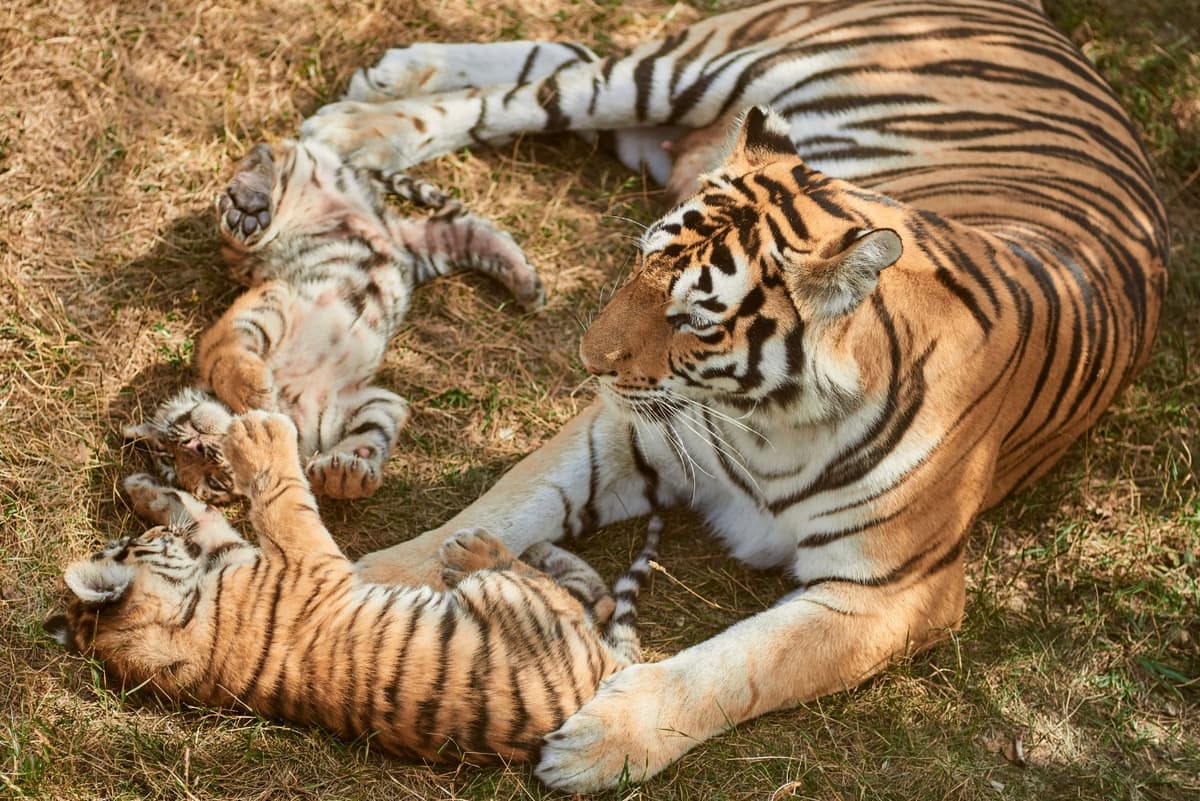
Indochinese tiger mother with cubs
Indochinese Tiger parental care
Parental care in the Indochinese tiger is provided exclusively by the mother, whose role is critical to the survival of her cubs. Tiger cubs remain with their mother until they reach independence, typically between 18 and 24 months of age.
During the early months of life, the mother nurses her cubs until they are about six months old, providing essential nutrition and immunity. As the cubs grow stronger, she gradually transitions them to solid food, bringing pieces of prey back to the den and allowing the cubs to feed.
Beyond nourishment, the mother actively teaches her cubs how to hunt, guiding them through stalking, ambushing, and timing their attacks. She is also highly protective and vigilant. If she senses danger, she will relocate her cubs to a new den or safer area, sometimes multiple times, to reduce the risk of detection.
Indochinese Tiger ecology
The Indochinese tiger plays a vital ecological role as an apex predator within the forests and mountains of Southeast Asia. By regulating populations of large herbivores, such as deer and wild pigs, it prevents overgrazing and helps maintain the structure and regeneration of forest vegetation.
The presence of tigers is widely regarded as an indicator of a healthy, balanced ecosystem. Tigers can survive only in environments with abundant prey, intact habitat, and minimal disturbance. As a result, protecting tiger populations indirectly safeguards hundreds of other plant and animal species that share the same landscape.
Conservation and threats
Threats to Indochinese Tiger survival
The Indochinese tiger has experienced a severe and prolonged population decline, driven by multiple human-related pressures. Until the 1930s, tigers were widely hunted for sport and often treated as dangerous pests, severely depleting the population.
Today, one of the most serious threats is habitat fragmentation. Expanding agriculture, infrastructure development, and human settlement have divided once-continuous forests into small, isolated patches. These barriers restrict tiger movement, limit access to prey, and prevent individuals from dispersing between territories. As a result, remaining populations are increasingly isolated and vulnerable.
Another major driver of decline is illegal wildlife trade. Tiger body parts are still used in traditional medicines, tiger bone wine, rugs, and jewelry. Although illegal, demand persists, particularly in China and Vietnam, where possession or display of tiger products is sometimes viewed as a symbol of wealth or status.
Indochinese Tiger conservation status
The Indochinese tiger was recently assessed for the IUCN Red List of Threatened Species in 2021. Under this assessment, Panthera tigris is classified as Endangered according to criteria A2abcd.
Global Indochinese Tiger conservation programs
In 2010, governments from 13 different countries, including all six that historically contained Indochinese tiger habitats, launched the Global Tiger Recovery Program (GTRP) with the aim to double the global wild tiger population by 2022.
According to WWF, countries such as Cambodia, Laos, Malaysia, Vietnam, and Thailand have struggled to maintain tiger numbers since 2010. In contrast, Nepal, India, Bhutan, and Russia have seen stronger results. Nepal, in particular, became the first country to double its tiger population, increasing from 125 to 250 individuals.
Data from the IUCN shows encouraging trends within protected landscapes. Between 2015 and 2021, tiger numbers in priority conservation areas increased by around 40 percent, rising from 770 to 966 individuals across sites covering about 1.2 million square kilometers.
In Vietnam, the Indochinese tiger is strictly protected under Decree 64 (2019) and Decree 06 (2019), and is listed under CITES, which bans international commercial trade. Hunting, capturing, keeping, transporting, selling, or advertising tigers or tiger products is illegal, reinforcing Vietnam’s commitment to preventing the species’ extinction.
Meeting Indochinese Tiger
Here are some tips for better Indochinese tigers watching:
- Observe tigers only through authorized conservation channels in other countries or reserves that allow distant viewing.
- Prioritize silence and non-intrusive behavior when in any tiger habitat.
- Use binoculars instead of approaching wildlife directly.
- Avoid actions that may stress or disturb the animals.
- Respect all local wildlife protection laws and conservation guide.
Interesting facts about Indochinese Tigers
1. The Indochinese tiger, also known as the “Corbett Tiger,” was named after Jim Corbett, a British hunter who later became an Indochinese tiger conservationist.
2. Seven Indochinese tigers are currently kept under protection at Phong Nha-Ke Bang National Park in Vietnam.
3. The Indochinese tiger has darker orange fur than other tiger subspecies, helping it camouflage better in dense tropical forests.
4. Unlike many big cats, Indochinese tigers are strong swimmers and often cool off or hunt near rivers.
5. The stripes on each tiger are unique, like human fingerprints so no two tigers look exactly the same.