In the realm of fearsome creatures, there is one “king” that even other snakes avoid — the King Cobra (Ophiophagus hannah). Not only is it the longest venomous snake on Earth, often reaching 3 to 4 meters, but it also carries a commanding presence unlike any other. When it rises 1.2 meters tall and releases its deep, low growl, both predators and humans understand the warning instantly. One bite. One minute of dizziness. Five minutes of paralysis. Thirty minutes later, the heart stops. This is the typical chain of reactions caused by the King Cobra’s neurotoxic venom, potent enough to kill an elephant.
This article explains the King Cobra’s key traits, behaviors, habitat, and the basic steps to stay safe and respond if a bite occurs.
| Common name | King Cobra |
|---|
| Scientific name | Ophiophagus hannah |
|---|
| Taxonomy
|
Kingdom: Animalia
Phylum: Chordata
Class: Reptilia
Order: Squamata
Family: Felidae
Genus: Ophiophagus
Species: Ophiophagus hannah (King Cobra)
|
| Weight / Size | 6-10 kg. 3–4 m avg; record 5.85 m. Longest venomous snake in the world. |
|---|
| Lifespan | 12–20 years in the wild. |
|---|
| Population | Exact number unknown; ≥ 30% global decline |
|---|
| Habitat | Tropical rainforests, evergreen woods, bamboo thickets, mangroves; near streams and farmland. |
|---|
| Range | South & Southeast Asia – India to Vietnam, Thailand, Malaysia, Indonesia, Philippines. |
|---|
| Diet | Mainly other snakes (cobras, kraits, rat snakes, pythons); also lizards or birds. |
|---|
| Conservation status | IUCN: Vulnerable (VU), CITES: App II |
|---|
Characteristics of the King Cobra
The King Cobra is the world’s longest venomous snake, often reaching 3 to 4m and sometimes over 5.8m in length. Adults usually weigh around 6 to 10kg, with males being larger and heavier than females. Its long, muscular body moves smoothly and flexibly, showing both strength and grace.
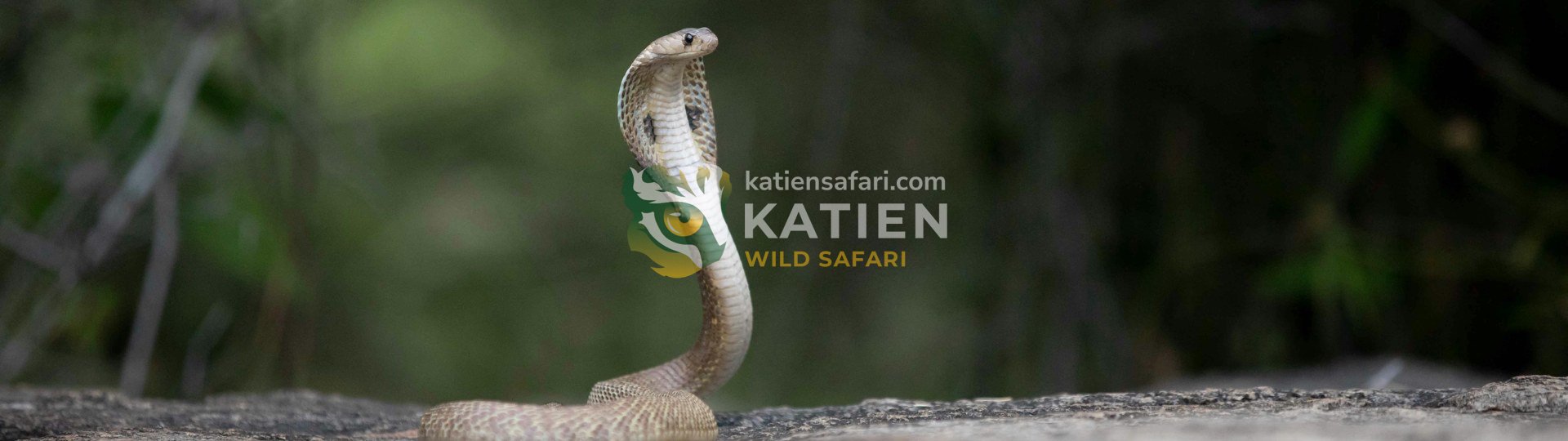
The head is large and clearly separated from the neck, which makes it easy to recognize when the snake lifts its body and spreads its hood. When threatened, it raises high and flares a wide hood that gives it a majestic, commanding look. Two dark spots appear at the base of the neck, while the throat is pale yellow or cream. Its round snout, black forked tongue, and large scales on the head give it a sharp, alert appearance.
King Cobras have a special pair of large scales at the back of the head — a key feature of their genus Ophiophagus. The scales under the tail are arranged irregularly, a mix of divided and undivided plates, unlike many other snakes. Although it can spread its hood like a true cobra, the King Cobra belongs to a separate genus, not Naja.
Color varies by age and region. Adults may be yellow, brown, olive green, or black, often with faint V-shaped or pale cross bands. Young snakes are glossy black with striking yellow or white bands along the body and head. The adult’s long, slender frame, broad head, and fierce eyes create an image of elegance and power — worthy of its title as the “King of Snakes.”
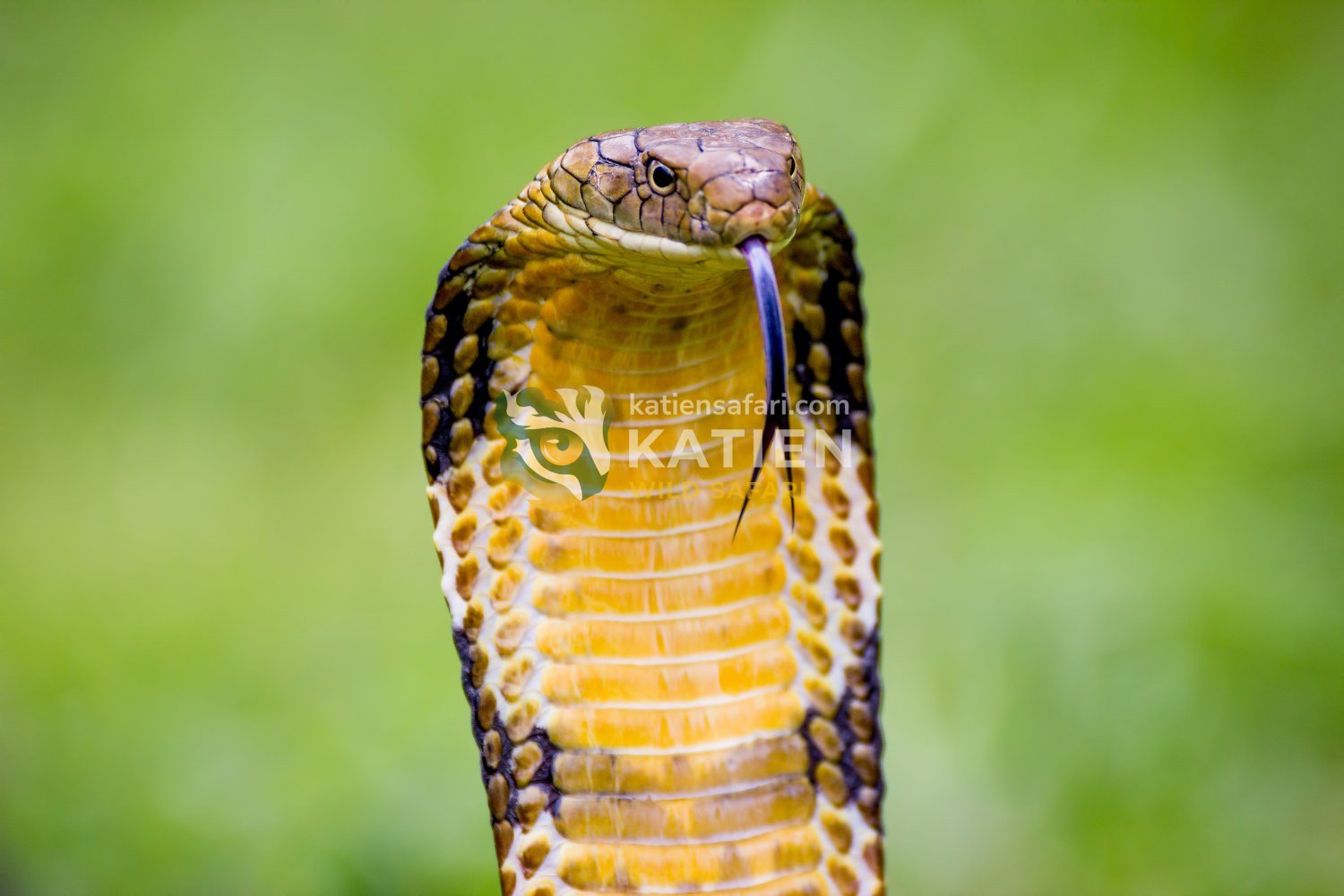
The King Cobra has a long, forked tongue.
Subspecies of King Cobra
The King Cobra was once thought to be one single species spread across Asia, but new research in 2024 proved otherwise. Scientists discovered that it is actually a group of 4 separate species, each shaped by its own land and climate.
1. Northern King Cobra (Ophiophagus hannah s. str.)
The Northern King Cobra is the “classic” form most people know. It lives across eastern Pakistan, India, Indochina, and central Thailand. Adults show pale yellow lines with dark edges running down the body, while young snakes carry 27 to 48 light bands. With 18 to 21 teeth, it has the highest count among its relatives. This is the image most people picture when they think of the King Cobra.
2. Sunda King Cobra (Ophiophagus bungarus)
Across the tropical islands of Southeast Asia lives the Sunda King Cobra. Found in the Malay Peninsula, Sumatra, Borneo, Java, Bali, and the southern Philippines, it wears warm shades of brown, gold, or red. Unlike its northern cousin, it often lacks stripes.
3. Western Ghats King Cobra (Ophiophagus kaalinga)
Deep in the misty mountains of southwestern India hides the Western Ghats King Cobra. Its world is made of dense forests and cool slopes, and its body reflects this darker environment. The name kaalinga comes from the Kannada word for “black,” matching its shadowy beauty. Its tail is shorter than in other species, only about one-fifth of its total length.
4. Luzon King Cobra (Ophiophagus salvatana)
Far away, on the isolated island of Luzon in the Philippines, lives the rarest and most mysterious of them all. The Luzon King Cobra has smooth, grayish-yellow skin with no bands at all, creating a simple yet elegant look. Juveniles, however, wear over 80 bright stripes that fade as they grow.
Geographic Distribution and Habitat
Global Distribution
The King Cobra has one of the widest ranges among venomous snakes. It can be found across South and Southeast Asia — from Pakistan, India, Nepal, and Bhutan to China, Myanmar, Thailand, Laos, Cambodia, and Vietnam. Its range extends southward through Malaysia and Singapore to Indonesia and the Philippines.
The species is listed as Vulnerable (VU) on the IUCN Red List and included in Appendix II of CITES. Global populations are estimated to have declined by more than 30% over the past three generations.
Typical Habitat
King Cobra habitats include moist evergreen forests, tropical rainforests, bamboo thickets, and mangrove swamps. They prefer areas near streams, burrows, or fallen logs at elevations between 650 and 2,000 meters. In some places, they are also found near farmlands or village edges, where they hunt rat snakes and other small prey. This adaptability helps them survive in both wild forests and human-modified landscapes.
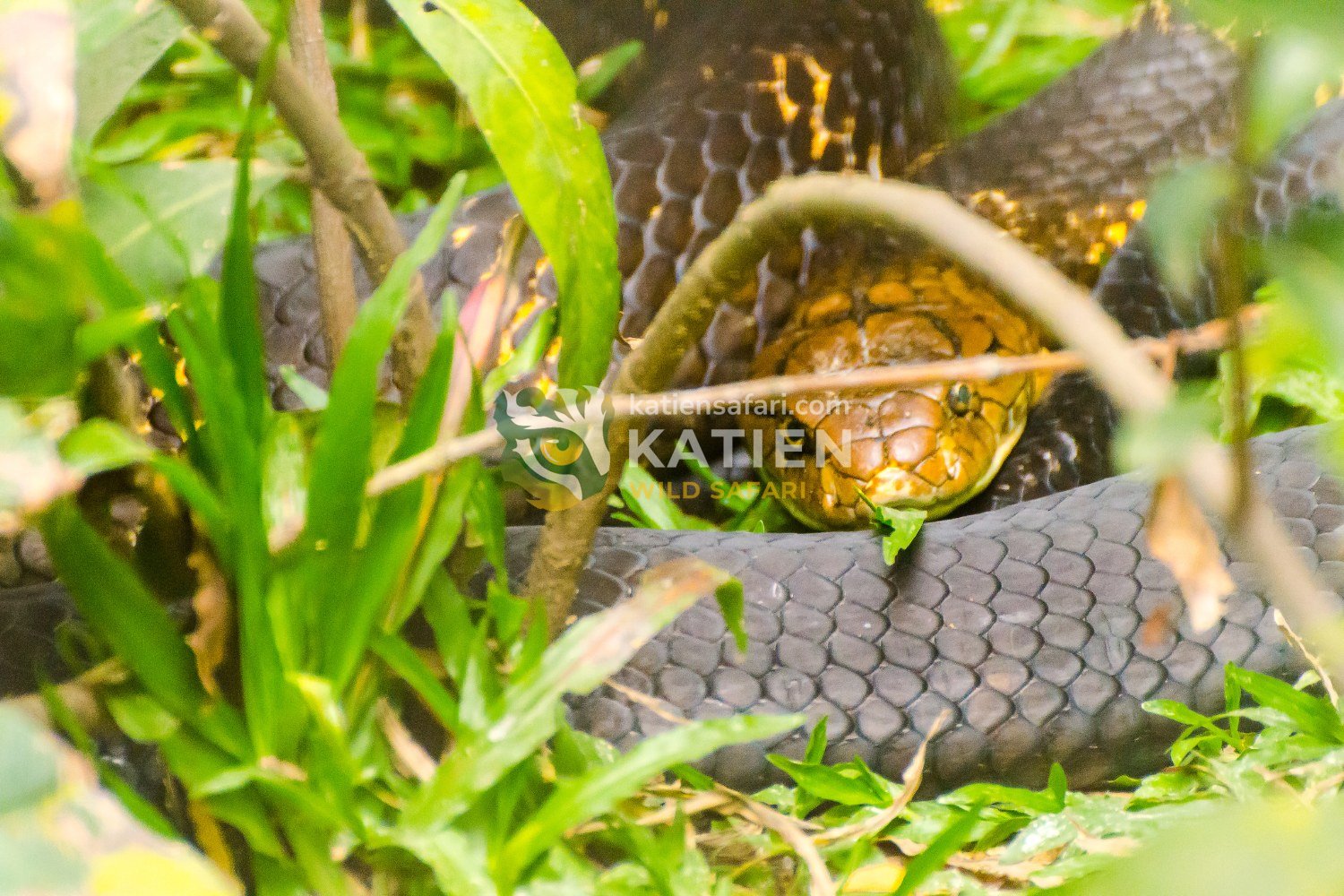
This species lives in forests, grasslands, and bamboo thickets across South and Southeast Asia.
Distribution in Vietnam
In Vietnam, the King Cobra occurs widely from Lao Cai and the North Central Region to the Central Highlands, the Southeast, and as far as An Giang Province. However, populations have dropped by more than 80% in the past two decades. It is now listed as Critically Endangered (CR) in the Vietnam Red Data Book 2023.
The species prefers lowland tropical forests with thick leaf litter and dense undergrowth. It moves across primary forests, bamboo groves, and nearby agricultural zones, showing both flexibility and a strong dependence on intact forest ecosystems.
Distribution in Nam Cat Tien
Although exact population data are lacking, King Cobras have been observed and reintroduced multiple times in Cát Tiên National Park. The park provides an ideal environment: evergreen forests, streams, and thick leaf layers. These conditions make it one of the most suitable habitats in southern Vietnam for the survival of this legendary serpent.
Diet and Predators
Diet and Hunting
The King Cobra is a top predator and one of the few snakes that specialize in eating other snakes. Its scientific name, Ophiophagus, literally means “snake eater,” a perfect description of its main diet.
It prefers cold-blooded prey, including both venomous and non-venomous snakes. Common King Cobra diets include the Indian Rat Snake (Ptyas mucosa), Indian Cobra (Naja naja), and Banded Krait (Bungarus fasciatus). It may also consume pit vipers, small pythons, or even smaller King Cobras. When food is scarce, it can switch to large lizards such as monitor lizards or occasionally small birds.
The King Cobra is mostly active during the day, but in Vietnam, it has been seen hunting from dusk until midnight. It does not strike at random. Instead, it relies on its keen senses and patience. Using its forked tongue, it “tastes” chemical particles in the air to follow scent trails left by prey. Once close enough, it waits quietly, then delivers a fast, precise bite.
Its venom is a strong neurotoxin that paralyzes the victim almost immediately. With flexible jaws and elastic ligaments, the King Cobra can swallow snakes nearly as long as its own body.
Although it is a powerful hunter, the King Cobra avoids unnecessary conflict. It attacks only when hungry or threatened. In rice fields or villages, it is often seen hunting rat snakes, which live close to people. By doing this, it helps control other venomous snakes that pose risks to humans.
Despite its deadly venom, the King Cobra rarely bites humans. Most reported cases happen when people try to catch or disturb it in the wild. It is calm by nature, striking only in defense.
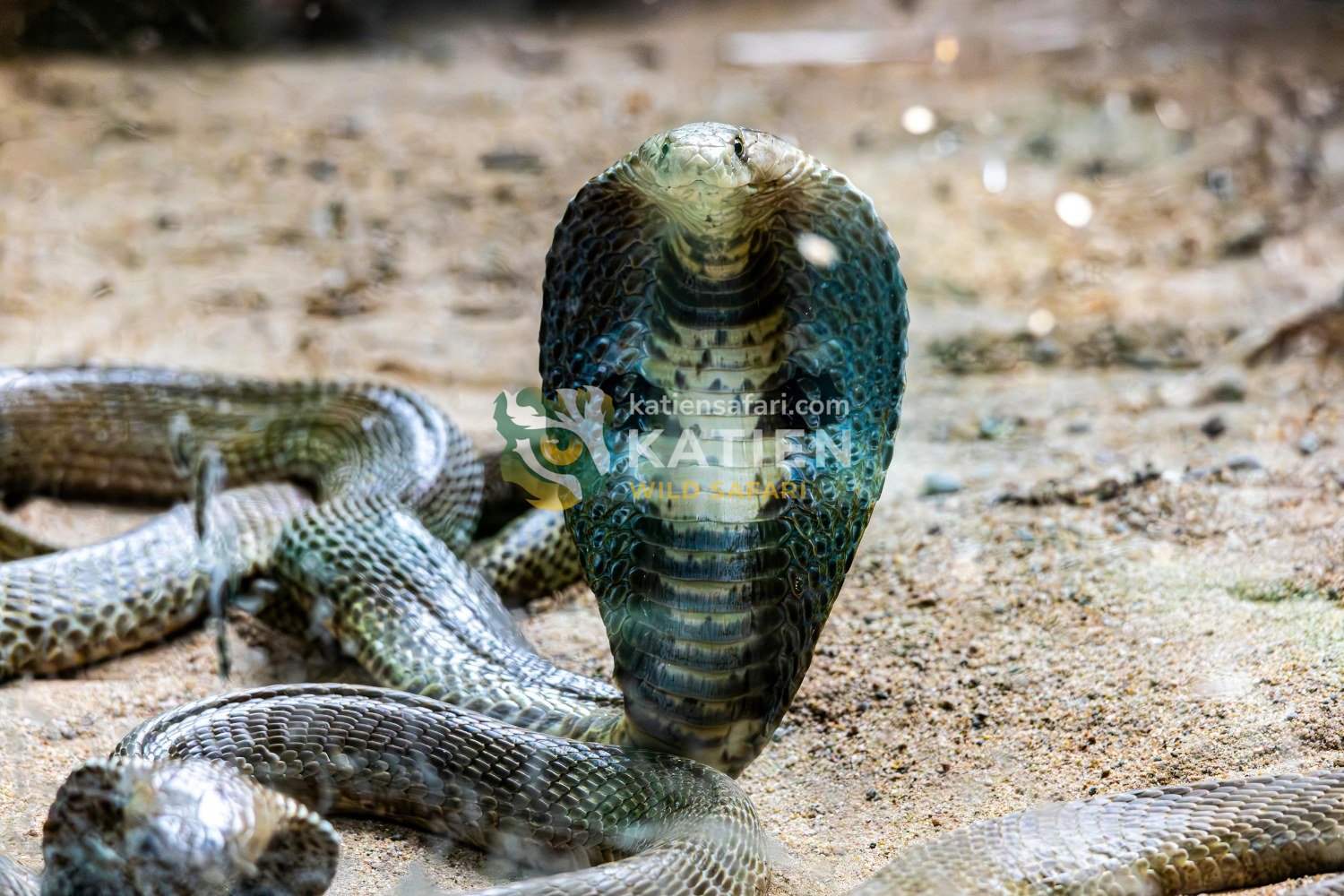
The snake follows scent trails with high accuracy using its forked tongue.
Predators and Defensive Behavior
In the wild, the King Cobra has almost no natural enemies. Only giant pythons and strong birds of prey, such as serpent eagles, may attack young individuals.
Though not aggressive by instinct, the King Cobra is brave and steady when defending itself. When it feels threatened, it raises the front part of its body up to 1.2 meters high, spreads its hood wide, and lets out a deep growling hiss. This sound is very different from the sharp hiss of most snakes. It has a lower frequency, around 2500 hertz, and can make intruders freeze in fear.
Behavior and Social Structure
The King Cobra is not only the world’s longest venomous snake but also one of the most intelligent reptiles on Earth. It shows complex behaviors rarely seen in other snakes, from strategic hunting to active temperature control.
Daily Activity
The King Cobra is mainly active during the day. Its peak hours are between 10 a.m. and 6 p.m., when it moves through forests or farmlands in search of other snakes. Unlike many cobras that hunt at night, the King Cobra prefers daylight, when it can rely on both sight and scent to track prey.
Its activity level strongly depends on temperature and humidity. When the weather becomes too hot, it retreats into shade, burrows, or hollow logs to stay cool. The King Cobra can regulate its body temperature effectively, keeping it around 30°C — ideal for hunting and digestion.
This snake is also a wide-ranging traveler. It can move across different habitats, from thick jungles and rice paddies to the edges of villages, following the scent of prey. It often shelters in old burrows, under tree roots, or in piles of leaves. Sometimes it climbs low branches or bushes to rest or watch its surroundings.
Intelligence and Communication
The King Cobra is known for its alert mind and ability to adapt. It does not attack blindly but plans its moves carefully. Observations show that it learns from experience, adjusting its behavior in future hunts. Snake keepers and researchers have noted that King Cobras can recognize familiar humans by scent. They use a special organ in the roof of their mouth, called the Jacobson’s organ, to detect and remember individual odors.
Its communication is also unique. When threatened, the King Cobra emits a deep, growling hiss that sounds more like a low roar than a snake’s hiss. This sound has a frequency between 600 and 2500 hertz. The result is a powerful, booming warning that makes even large animals hesitate.
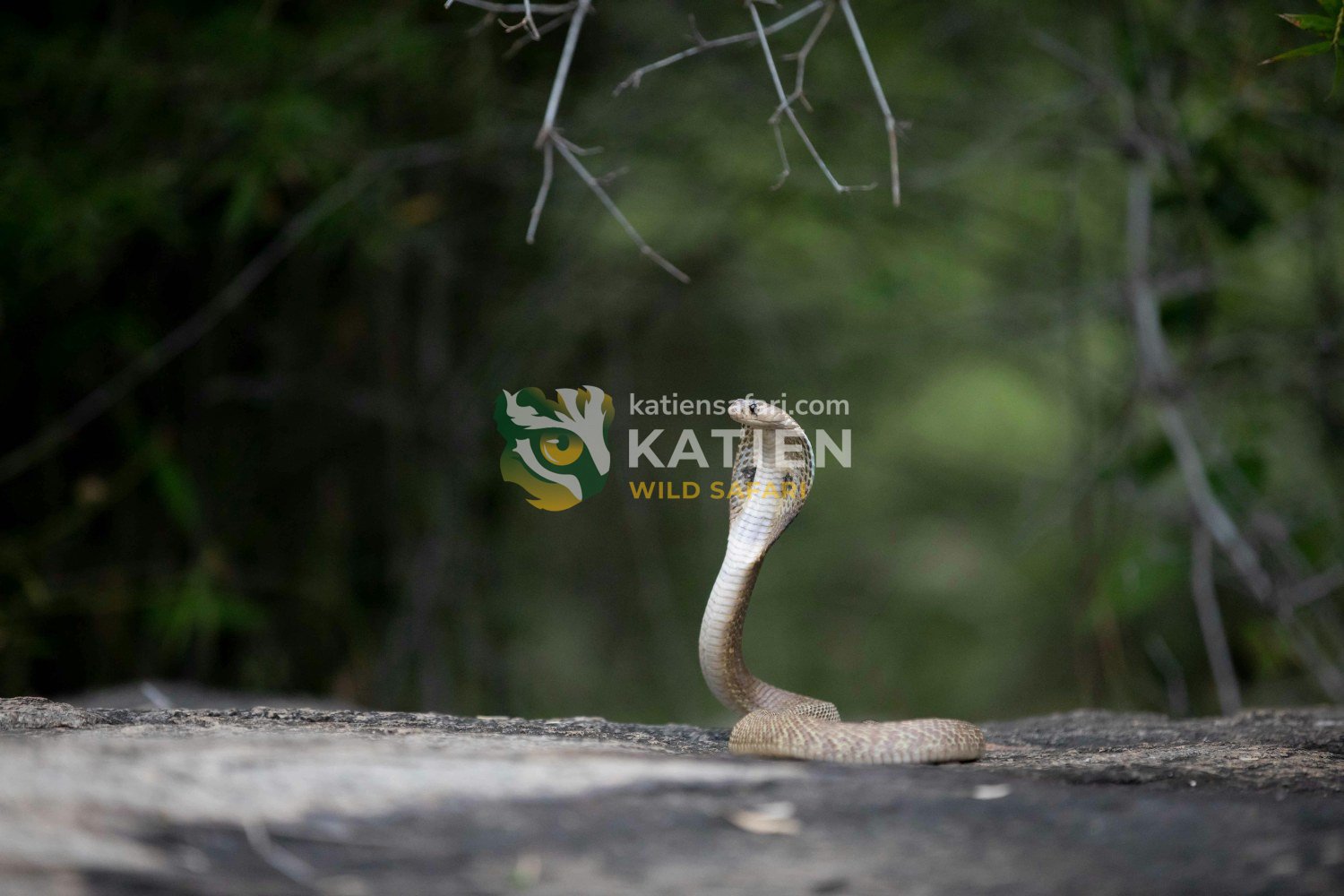
Scientists note that the snake’s hood expands widely when it feels threatened.
Reproduction of the King Cobra
During the breeding season, male King Cobras take part in ritual combats to win the right to mate. These fights are not violent but full of power and control. Instead of biting, the males wrestle by coiling their bodies around each other, trying to press the rival’s head to the ground. The winner earns the chance to mate with a female. This ritual shows a rare level of social and behavioral complexity in snakes.
The breeding season usually occurs from January to April but may extend to July or August depending on the region and climate. The female carries the eggs for about 50 to 59 days before laying. Scientists believe that some pairs may stay together for life, an almost unheard-of behavior among snakes.
Nest Building and Egg Care
The female King Cobra is the only one known to build a nest. Using dry leaves, branches, and soft soil, she forms a mound about 55cm high and up to 1.4m wide. As the leaves decompose, they release heat, naturally warming the eggs. The temperature inside the nest stays about 3°C higher than the surrounding air, helping the eggs develop safely.
Incubation lasts between 66 and 105 days, with eggs hatching in the autumn. A single clutch can contain anywhere from 7 to 43 eggs. Some nests have recorded nearly 100% hatching success, with the highest number reaching 53 eggs and 39 surviving hatchlings.
The female guards the nest for several weeks, sometimes up to two months, raising her hood and hissing loudly at any intruder. In some cases, the male has been seen staying nearby to help guard the nesting area, another unusual behavior for snakes.
When the eggs begin to hatch, the mother leaves the nest immediately. This instinct likely prevents her from attacking her own offspring, since King Cobras naturally prey on other snakes.
Newborn King Cobras are about 37 to 58 cm long and weigh between 9 and 38 g. They are alert, aggressive, and highly independent from the moment they hatch. The young snakes are active during the day and are often seen drinking water and resting together in small groups at night. This brief time together is the only period of companionship before they begin their solitary lives in the wild.
Conservation Status and Threats
The King Cobra (Ophiophagus hannah) is listed as Vulnerable (VU) by the IUCN and included in Appendix II of CITES. Its global population has dropped by over 30% in the past three generations (about 15–18 years). The main causes are habitat loss, hunting, and illegal trade. The population continues to decline across most of its natural range in South and Southeast Asia.
Major Threats to the King Cobra
The greatest danger to the King Cobra is the rapid loss of habitat. Expanding farms, deforestation, and road construction have destroyed large parts of its forest home. Without cover or prey, these snakes are often forced into villages and fields, where they are killed out of fear.
Illegal hunting and trade add further pressure. King Cobras are taken for meat, traditional medicine, skin, and the exotic pet market. In recent years, pollution has also emerged as a threat — a King Cobra in northeast Thailand reportedly died after swallowing a plastic bag. Road accidents and entanglement in fishing nets are common causes of death in agricultural areas.
Conservation Efforts and Strategies
Global protection measures are in place, but challenges remain. The King Cobra’s inclusion in CITES Appendix II limits international trade, and some populations live within protected reserves. However, because these snakes roam over large areas, most parks are too small to support them fully.
Conservation efforts now focus on raising public awareness, reducing snake killings, and protecting connected forest corridors. Continued research on genetics and habitat needs will also help identify key populations. Stricter trade control and community-based conservation are essential for the species’ survival.
Across Asia, many countries are working to protect the King Cobra and its natural home.
In Nepal, teams in Chitwan National Park study the King Cobra’s behavior and teach locals how to avoid danger, reducing fear and conflict.
In India, old traditions that respect snakes as sacred animals are now part of conservation work. In Mizoram, experts collect eggs from risky nests, hatch them safely, and release the young snakes into the wild.
In Vietnam, the Vinh Son center in Vinh Phuc Province has successfully bred King Cobras in captivity. This is an important step for protecting the species and brings hope for restoring wild populations in the future.
What to Do If You’re Bitten by a King Cobra
A King Cobra bite is very dangerous and needs quick medical help. The snake’s venom works fast and can stop breathing within minutes. Staying calm and doing the right things can save a life.
If someone is bitten, they will feel strong pain and swelling right away. Soon after, they may feel dizzy, sleepy, weak, and have trouble breathing. Without treatment, the person could faint or die in less than 30 minutes.
What to do:
- Stay calm and move as little as possible.
- Keep the bitten part still and lower than the heart.
- Do not tie a tight band, cut the wound, or try to suck out the venom.
- Do not wash the bite. Doctors can use venom traces for treatment.
- Get to a hospital immediately and try to remember what the snake looked like.
At the hospital, doctors will give oxygen, fluids, and antivenom to fight the poison. The patient’s breathing and heartbeat will be closely watched.
To stay safe, clear tall grass or piles of leaves around your home, wear shoes in wet areas, and never try to catch or tease snakes, especially during breeding season (January–April). Remember, King Cobras help nature by eating smaller snakes and rodents.
Interesting Facts of the King Cobra
- King Cobra babies have venom as strong as adults.
- King Cobra's venom contains a very high amount of protein, from 11.9% to 24.4%, much more than other cobras.
- King Cobra snake can reproduce without a male, a process called parthenogenesis.
- King Cobras can cross busy roads safely by using drains and bridges, reaching a success rate of about 98.8%.
Reference
- Das, I., Gowri Shankar, P., Swamy, P., Williams, R. C., Lalremsanga, H. T., Prashanth, P., Sahoo, G., Vijayakumar, S. P., Höglund, J., Shanker, K., Dutta, S. K., Ganesh, S. R., & Wüster, W. (2024). Taxonomic revision of the king cobra Ophiophagus hannah (Cantor, 1836) species complex (Reptilia: Serpentes: Elapidae), with the description of two new species. European Journal of Taxonomy, 961(1), 1–51. https://doi.org/10.5852/ejt.2024.961.2681
- Hrima, V. L., Sailo, V. H., Fanai, Z., Lalronunga, S., Lalrinchhana, C., Zothansiama, J., & Lalremsanga, H. T. (2014). Nesting ecology of the King Cobra, Ophiophagus hannah (Reptilia: Squamata: Elapidae), in Aizawl District, Mizoram, India. In Lalnuntluanga et al. (Eds.), Issues and Trends of Wildlife Conservation in Northeast India (pp. 268–274). Mizo Academy of Sciences.
- Nguyễn Quảng Trường. (2023). Ophiophagus hannah. Danh lục Đỏ Việt Nam. RT59.
- Rao, C., Talukdar, G., Choudhury, B. C., Gowri Shankar, P., Whitaker, R., & Goode, M. (2013). Habitat use of King Cobra (Ophiophagus hannah) in a heterogeneous landscape matrix in the tropical forests of the Western Ghats, India. Hamadryad, 36(2), 69–79.
- Smithsonian's National Zoo and Conservation Biology Institute. (n.d.). King cobra. Smithsonian's National Zoo and Conservation Biology Institute.
- Strine, C. T., Silva, I., Crane, M., Nadolski, B., Artchawakom, T., Goode, M., & Suwanwaree, P. (2014). Mortality of a wild King Cobra, Ophiophagus hannah Cantor, 1836 (Serpentes: Elapidae), from Northeast Thailand after ingesting a plastic bag. Asian Herpetological Research, 5(4), 284–286. https://doi.org/10.3724/SP.J.1245.2014.00284
- Stuart, B., Wogan, G., Grismer, L., Auliya, M., Inger, R. F., Lilley, R., Chan-Ard, T., Thy, N., Nguyen, T. Q., Srinivasulu, C., & Jelić, D. (2012). Ophiophagus hannah. The IUCN Red List of Threatened Species 2012: e.T177540A1491874. https://dx.doi.org/10.2305/IUCN.UK.2012-1.RLTS.T177540A1491874.en