Have you ever imagined a bear weighing over 100 kilograms making a sound like a clucking hen?
Surprisingly, that soft “chuffing” noise is how the moon bear (Ursus thibetanus) greets others or signals it means no harm. Also known as the Asiatic black bear, this species belongs to the family Ursidae and is instantly recognized by the pale, crescent-shaped mark on its chest.
Behind this almost playful behavior lies a remarkably adaptable forest survivor. It is an expert climber, an intelligent forager, and a powerful symbol in Asian folklore. In this article, we explore the moon bear’s biology, behavior, and the deep cultural meanings carried by the bear with the “moon on its chest.”
| Common name | Asian Black Bear, Moon Bear |
|---|
| Scientific name | Ursus thibetanus |
|---|
| Taxonomy
|
Kingdom: Animalia
Phylum: Chordata
Class: Mammalia
Order: Carnivora
Family: Ursidae
|
| Weight / Size | Body length: 120–190 cm. Males: 60–200 kg; females: 40–125 kg. Shoulder height 70–100 cm; standing height up to ~180 cm. |
|---|
| Lifespan | Wild: 25–30 years. Captive: 35–39 years (maximum recorded 44 years). |
|---|
| Population | Fewer than 60,000 individuals worldwide. |
|---|
| Habitat | Broadleaf, mixed, evergreen, tropical and subtropical forests; quiet old-growth mountain forests with dense tree cover. |
|---|
| Range | Southeastern Iran; Himalayas; East and Southeast Asia, including China, India, Japan, Korea, Russia, and Vietnam. |
|---|
| Diet | Omnivorous – mainly fruits, nuts, berries, roots, shoots, and leaves; also insects, honey, birds, eggs, small animals, fish, and carrion. |
|---|
| Conservation status | Vulnerable (IUCN); listed in CITES Appendix I. |
|---|
Physical Appearance of the Moon Bear
The Asian black bear, or moon bear, is easily recognized by its distinctive physical characteristics and robust build. Adult bears measure around 120–190 cm in length, with a body that tapers slightly toward the back.
In terms of size and weight, males typically range from 60–200 kg, while females are lighter at 40–125 kg, depending on the region. Standing on all fours, they reach a height of 70–100 cm but can rise on their hind legs to nearly 180 cm, giving them a striking presence in the forest.
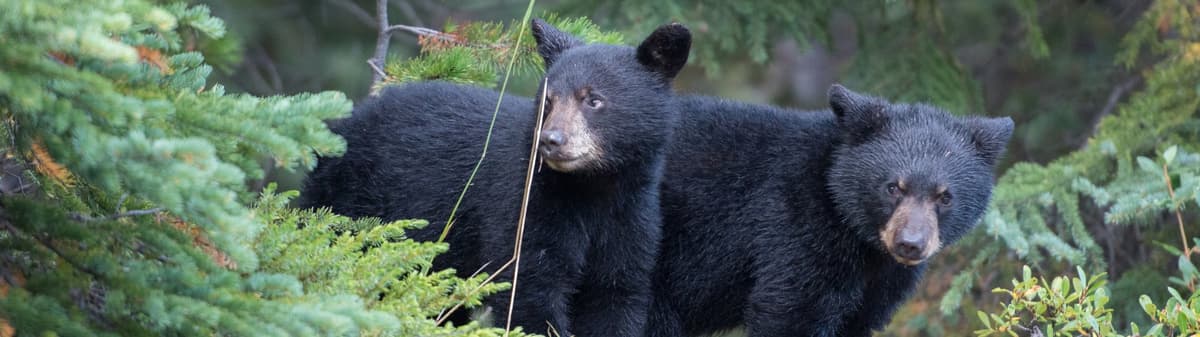
Their dense, glossy black coat is one of their signature characteristics, sometimes showing brown or pale golden tones in certain subspecies. Around the shoulders and neck, the fur grows long and thick, forming a prominent mane, especially noticeable in populations living in colder climates. The most iconic feature of moon bears is the crescent chest marking, a cream or white patch shaped like a V or half-moon, unique to each individual.
Moon bears have broad heads, a pale brown muzzle, large mobile lips, and a powerful lower jaw that enhances their strong facial profile. Their rounded, upright ears give them an alert, curious expression. Strong forelimbs with curved claws measuring 30–45 mm make them excellent climbers, while their short 10–12 cm tail is almost hidden beneath the thick fur.
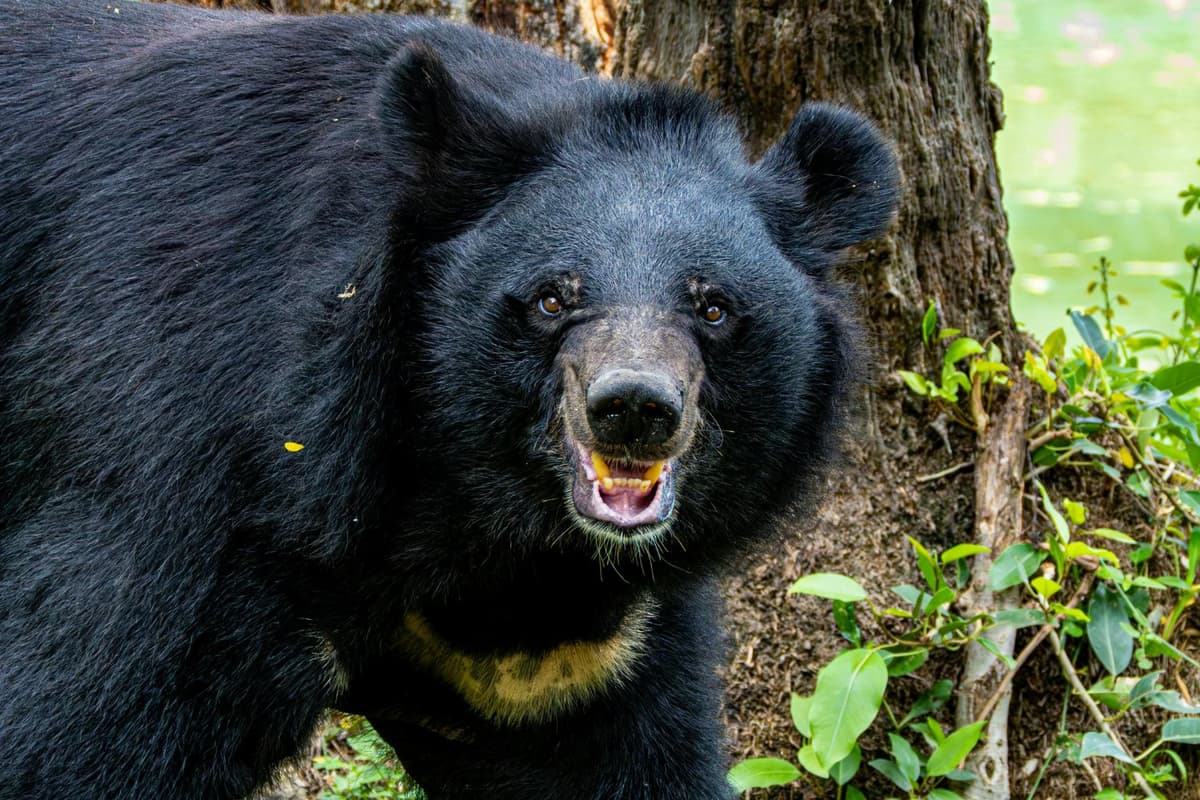
The moon bear has a black coat and a bright crescent chest mark.
Habitat and Distribution of the Moon Bear
The Moon Bear lives mainly in broadleaf forests, mixed forests, tropical forests, and areas with thick shrubs. It prefers quiet, old forests that are not disturbed by people. These bears usually live in mountain regions with dense tree cover.
In summer, some populations move up to 3,600–3,700 m in the Himalayas to avoid the heat. During winter, they travel down to lower areas below 1,500 m to find food or to rest.
Global Distribution
Moon bear's global distribution ranges from southeast Iran, across Afghanistan and Pakistan, through the Himalayas, and into Southeast and Northeast Asia. Today, Moon Bears are found in 18 countries, including China, India, Japan, both Koreas, Taiwan, Thailand, Laos, Myanmar, Nepal, Russia, and Vietnam.
In Northeast Asia, they survive in small, separate groups in China, Russia’s Far East, and North Korea. They live on Honshu and Shikoku in Japan, and as the Formosan subspecies in Taiwan. Fossils also show that, in the Pleistocene, the species once lived as far west as Iberia, the Balkans, and the Ural Mountains.
Distribution in Vietnam
In Vietnam, Moon bears once lived across many forests from north to south, especially in the Truong Son Range and northern highlands. Today, their numbers have dropped sharply because of hunting and deforestation, so they only appear in scattered areas.
They are recorded in major forests such as Hoang Lien, Vu Quang, Pu Mat, Cuc Phuong, Yok Don, and Cat Tien. Sightings are rare, and most evidence comes from tracks or camera traps.
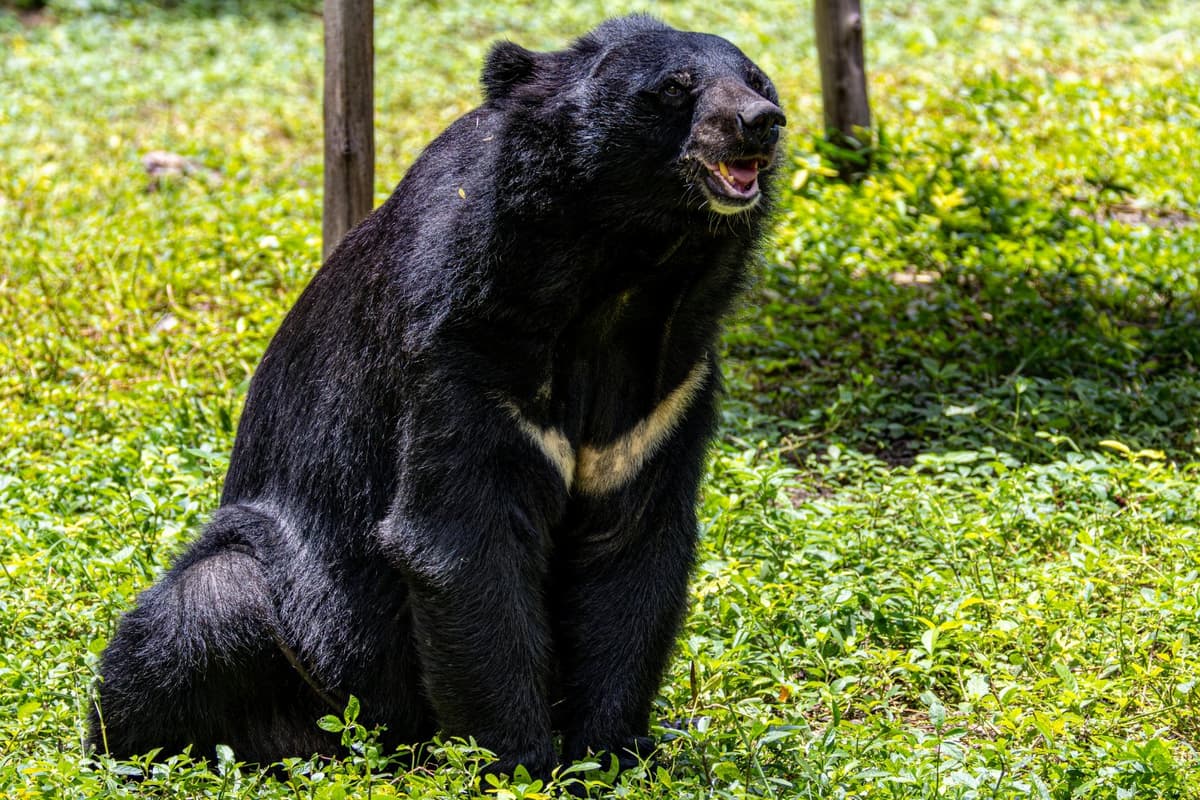
These bears live in dense forests across East and Southeast Asia.
Moon Bear in Cat Tien National Park
In Cat Tien National Park, local people believe the bears are still present, although very few have seen them directly. Camera trap images and tracks show that the population has decreased compared to 20 years ago.
The Cat Tien Bear Rescue Center, run by Free the Bears and the park authorities, is caring for more than 30 rescued bears, including both moon bears and sun bears. Cat Tien is now one of the last places in southern Vietnam where wild moon bears can still be found.
Subspecies of Moon Bear
Because moon bears live in many different climates, elevations, and forest types, several subspecies have developed over time. These subspecies show clear differences in size, coat color, and body structure. Below is a simple overview of 7 subspecies that still exist today, as well as 2 extinct subspecies known from the fossil record.
- U. t. formosanus lives only in Taiwan, in mountains 1,000–3,500 m high.
- U. t. gedrosianus from Balochistan and Iran is one of the smallest subspecies.
- U. t. japonicus lives on Honshu and Shikoku in Japan.
- U. t. laniger from the Himalayas has very long, thick fur for cold weather.
- U. t. mupinensis lives in Indochina and parts of China.
- U. t. thibetanus is found in India, Nepal, Myanmar, Thailand, and central Vietnam.
- U. t. ussuricus from Siberia, northeastern China, and Korea is the largest subspecies with a strong body and thick black fur.
Fossils show that moon bears once lived much farther west. Two subspecies disappeared at the end of the Pleistocene: Ursus thibetanus mediterraneus and Ursus thibetanus permjak.
Diet, Feeding Habits, and Predators of the Moon bear
Diet
The Moon Bear is an omnivore, and its diet changes with the seasons and the food that is available in the forest. Most of its meals come from plants, including fruits, berries, nuts like acorns and chestnuts, roots, tubers, young shoots, leaves, herbs, and even tree bark.
When it reaches farmland, the moon bear may also eat crops such as corn, watermelon, and pumpkins. It adds protein to its diet by eating insects and small animals, including ants, termites, larvae, birds, eggs, and sometimes fish or crabs.
Honey is one of moon bears’ favorite foods, and they often break into beehives to eat honey, pollen, and larvae. Like many wild animals, it will also feed on carcasses when it finds them.
Feeding Habits
Moon Bears are excellent climbers, using their strong front legs and curved claws to move high into the trees where they can look for fruit, honey, and insects. They spend a large part of their lives in the treetops, making them the most arboreal bear in Asia.
When feeding in trees, they often break branches and build a small platform to sit more safely. Their sense of smell is extremely strong and helps them find food from far away, especially ripe fruit or beehives. Their behavior also changes with the seasons; in autumn, they eat many high-energy nuts to build up fat for the colder months.
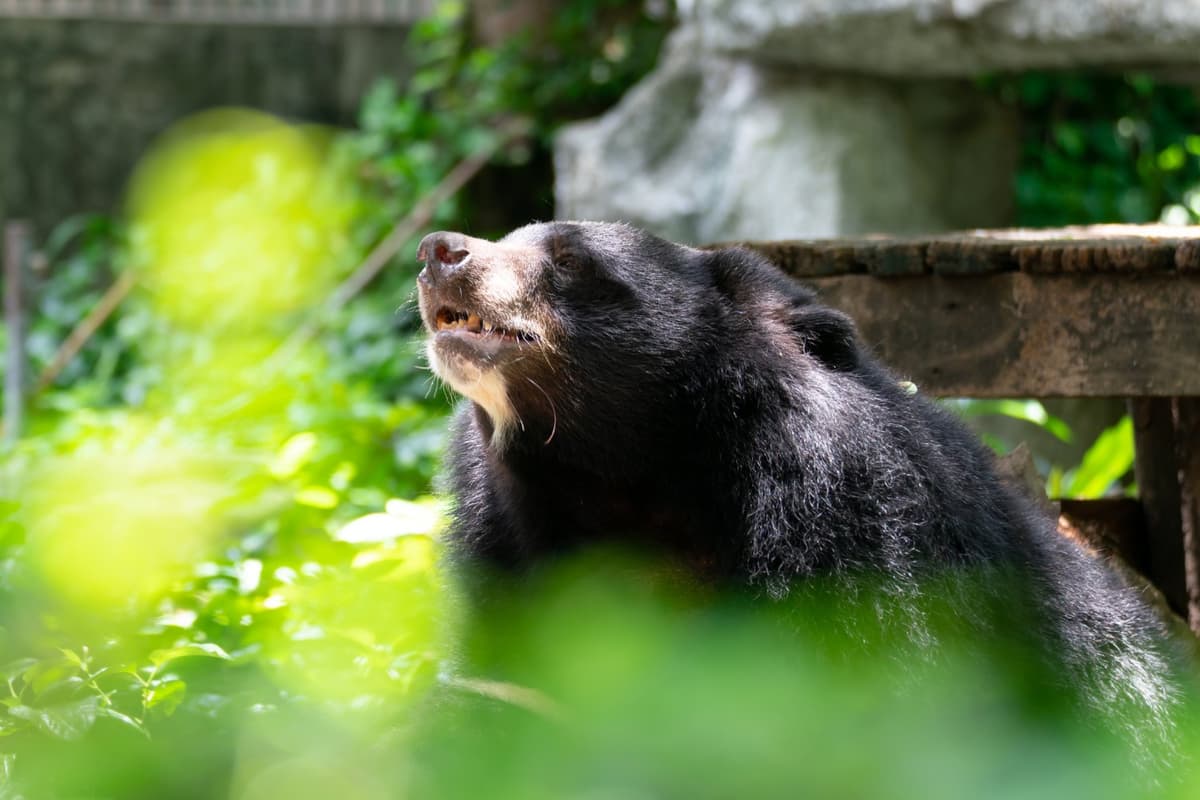
It forages for fruit, insects, and honey, often climbing trees.
Predators
The tiger is the most dangerous predator to the moon bear, especially to cubs, although adult bears can also be attacked. To escape danger, moon bears often climb trees. In Russia’s Far East, brown bears may also attack them or steal their food because they are larger and stronger.
Wolves and Eurasian lynxes sometimes prey on young cubs under two years old. However, humans remain the greatest threat to this species, as hunting, snaring, and habitat loss continue to reduce their numbers in many parts of Asia.
Habit and Behavior of the Moon bear
The Moon Bear is mainly a solitary animal. It spends most of its life alone and usually meets other bears only during the breeding season or when a mother is caring for her cubs. In places with plenty of food, several bears may gather for a short time, but they still keep a distance from one another.
This species is intelligent and can learn, remember, and show different emotions such as playfulness, sadness, or even gentle social behavior. It communicates with many sounds, including grunts, rumbles, growls, hisses, and a “tut tut” tongue-click when approaching another bear.
A soft “clucking” sound is used for greeting or courtship. Bears also rub their bodies against trees to leave scent marks that help set territory or attract mates. Its activity pattern depends on where it lives. In colder regions, the bear hibernates from November to March, and pregnant females often give birth during this time. In warm countries like Vietnam, it stays active all year.
The Moon Bear is one of the best climbers among large mammals in Asia. It may spend up to half of its life in trees, using its strong front legs and curved claws to climb for fruit, insects, or honey. The bear can walk upright for long distances, up to 400m, and is also a strong swimmer. Its plantigrade walking style, placing the whole foot on the ground, helps it move steadily across steep, uneven forest terrain.
Moon Bear Reproduction and Life Cycle
Reproductive
Moon Bears reach sexual maturity at about 3 to 4 years old, and females usually have their first litter at around age 3. The mating season lasts from June to October, and pregnancy can last between 200 and 240 days.
Like many other bear species, the female has delayed implantation, meaning the fertilized egg stays “asleep” for a while and attaches to the uterus only when conditions are suitable. This timing helps the cubs be born in late winter or early spring, when food becomes easier to find. Because raising a cub takes a long time, females usually breed only once every 2 to 3 years.
Cub Development
Most cubs are born in winter or early spring, usually in January or February. The mother chooses a safe den, such as a rock cave or a hollow tree. In cold regions, she gives birth while hibernating; in warm countries like Vietnam, she stays active but still uses a protected shelter for giving birth.
A typical litter has two cubs, but there can be one to four. Newborn cubs are extremely small, only about 370 grams, and they cannot open their eyes or walk. They begin to walk after 4 days and open their eyes about a week later. Their growth is slow; by 5 months old, they weigh only around 2.5 kilograms.
Cub care is entirely the mother’s responsibility. The young bears nurse for about 6 months but may continue to drink milk for up to 2 years. They stay with their mother for 2 to 3 years before becoming independent. During this period, the mother is very protective and can be aggressive if she senses danger.
In the wild, Moon Bears live around 25 to 30 years, but in captivity they can reach 35 to 39 years, with the oldest known individual living to 44.
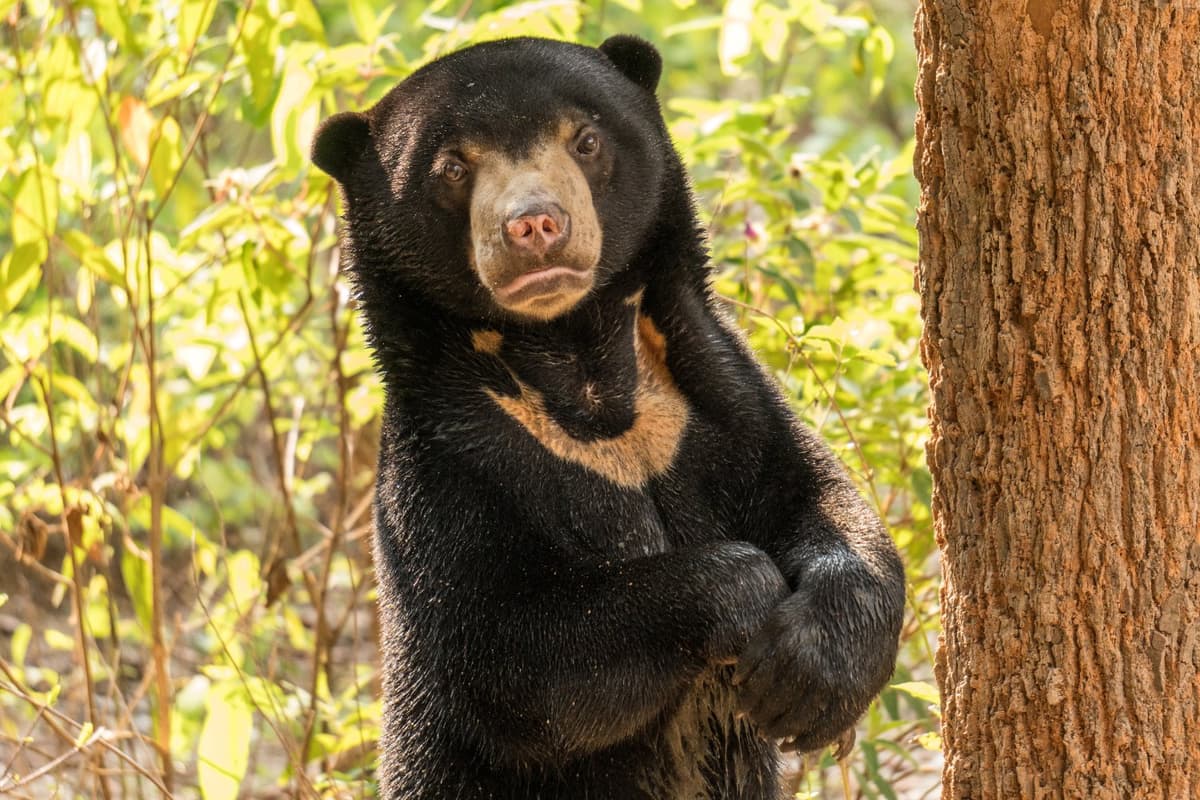
Newborn cubs usually stay close to their mother for warmth and safety.
Threats and Conservation of the Asian Black Bear
The Moon Bear is listed as Vulnerable by the IUCN and is in CITES Appendix I, which bans international trade. Fewer than 60,000 bears remain worldwide, and the global population has dropped by more than 30% in the last 30 years.
In Vietnam, the species is classified as Endangered, and wild numbers fell sharply from the 1990s to the early 2000s. One rare exception is Japan, where the population grew from about 15,000 in 2012 to roughly 44,000 in 2023.
Threats
Habitat loss is a major issue. Deforestation, farming, hydropower projects, and new roads break their forest home into small, isolated patches. This reduces food sources and weakens the genetic health of the population.
Hunting remains the biggest danger. Bears are often trapped or killed for meat, paws, skin, and especially their gallbladders, which are used in traditional medicine. High demand keeps the illegal market active and makes the species even more vulnerable.
Bile farming aims to extract UDCA, a compound found in bear bile. This practice does not support conservation. Instead, it encourages poachers to capture wild bears to replace sick or dying farmed individuals.
When food is scarce, bears may move toward farms or villages. They sometimes destroy crops like corn or watermelons, break beehives, or attack livestock.
Bears can also injure people if surprised or threatened. In Japan, reports of bears entering towns have increased as climate change reduces natural food sources such as acorns and chestnuts.
Moon Bear Conservation
Many countries, including Vietnam, enforce strict laws against hunting, trading or transporting bears. Penalties apply to anyone keeping bears illegally or extracting bile. Strong enforcement is essential to protect remaining wild populations.
Groups such as ENV and Animals Asia work to reduce the use of bear bile. They promote safe alternatives, including herbal medicine and synthetic UDCA, which offer similar effects without harming wildlife.
Scientists use camera traps, DNA analysis from scat, and interviews with local communities to track bear presence. These methods help identify population trends and important habitat corridors for bear movement.
Several centers care for rescued bears in Vietnam, including:
- Vietnam Bear Rescue Center (Tam Dao – Animals Asia), which has saved more than 160 bears.
- Cat Tien Bear Rescue Center (Free the Bears), caring for over 30 confiscated animals.
- Cu Chi and Hon Me centers (WAR), which rescue many wildlife species including bears.
Other countries such as Laos, Cambodia, India, and Pakistan also run rehabilitation programs. Pakistan has made notable progress in ending bear-baiting and rescuing abused bears.
Moon Bear Observation in Cat Tien with Katien Safari
Moon bears (Ursus thibetanus) in Cat Tien are best observed through rescue-based tourism, not wild tracking. With Katien Safari, visitors learn about bears while respecting conservation limits.
The key site is the Cat Tien Bear Rescue Centre inside Cat Tien National Park. Here, rescued moon bears live in semi-natural forest enclosures after being saved from bile farms or illegal trade. Seeing wild moon bears in the forest is now extremely rare due to population decline.
Notes for responsible observation:
- Do not expect wild sightings; wild moon bears here are extremely rare.
- Keep quiet and observe from a distance to avoid stressing the animals.
- Follow guide instructions at all times inside rescue areas.
- No flash photography or loud noises near enclosures.
- Respect viewing limits; bears need rest and privacy.
Interesting Facts about Moon bear
1. Moon bears are the best two-legged walkers among all bear species, able to walk more than 400 m upright.
2. Biologists consider moon bears the least derived of all Old-World bear species, meaning they changed the least over time.
3. Their strongest sense is smell, which is 2,000 to 3,000 times stronger than that of humans.
4. Despite their chunky look, moon bears can run at speeds of 25 to 30 km/h when needed.
5. If a moon bear fought a sun bear 1-on-1, the Moon Bear would likely win. It is much bigger, about three times heavier, and more aggressive.
Reference
- Dang, N. X. (2006). The current status and conservation of bears in Vietnam. In Japan Bear Network (Ed.), Understanding Asian bears to secure their future (pp. 61–65). Japan Bear Network.
- Ahmad, F., Rehan, M., Bosso, L., & Kabir, M. (2025). Asiatic black bear in Pakistan: A comprehensive review and conservation indications. Mammalian Biology, 105(5), 657–674. https://doi.org/10.1007/s42991-025-00479-x
- Bu, H., & Shen, Y. (2023). Identify local limiting factors of species distribution using min-linear logistic regression. arXiv. https://arxiv.org/abs/2302.10881
- Crudge, B., Wilkinson, N. M., Do, V. T., Cao, T. D., Cao, T. T., Weegenaar, A., & Hunt, M. (2016). Status and distribution of bears in Vietnam, 2016 (Technical report). Free the Bears & Animals Asia.
- Knight, C. (2008). The moon bear as a symbol of Yama: Its significance in the folklore of upland hunting in Japan. Asian Ethnology, 67(1), 79–101.
- Glatz, K. (2025, March 3). Moon bear vs. sun bear: What are the differences? A-Z Animals. https://a-z-animals.com/blog/moon-bear-vs-sun-bear-what-are-the-differences/
- Restorasi Ekosistem Riau. (2024, December 2). Sun & moon: Two bears, a world of difference. https://www.rekoforest.org/
- Spadoni, S. (2025, December 18). Exclusive: Dr Jane Goodall’s final act of kindness was to be a proud guardian of a beloved rescue bear. The Mirror.
- TOI Trending Desk. (2025, October 31). Sun bear vs. moon bear: Understanding the physical, behavioural, and ecological differences that shape their survival. The Times of India.