Unlike the plain white look of many storks, the Painted Stork stands out as an elegant wetland bird with refined colors. Scientifically known as Mycteria leucocephala, this species belongs to the stork family Ciconiidae. Its white body is crossed by a bold black chest band, while the wings show striking black-and-white patterns. Most eye-catching are the soft pink tertial feathers on the lower back, glowing like lotus petals in the marsh. This unique feature gives the bird its English name, “Painted Stork,” and the poetic Vietnamese name “Giang sen”.
| Common name | Painted Stork |
|---|
| Scientific name | Mycteria leucocephala |
|---|
| Taxonomy
|
Kingdom: Animalia
Phylum: Chordata
Class: Aves
Order: Ciconiiformes
Family: Ciconiidae
Genus: Mycteria
Species: M. leucocephala
|
| Weight / Size | Height: 93–102 cm; wingspan: 150–170 cm; weight: 2–3.5 kg; bill length: >24 cm. |
|---|
| Lifespan | Captive: up to ~28 years. |
|---|
| Population | Increasing in some regions globally; local declines recorded in Vietnam. |
|---|
| Habitat | Freshwater wetlands, marshes, lakes, riversides, floodplains; also rice fields, irrigation canals; occasionally mangroves and mudflats. |
|---|
| Range | South & Southeast Asia – India, Sri Lanka, Nepal, Bangladesh, Myanmar, Thailand, Cambodia, Vietnam; rare in Pakistan. |
|---|
| Diet | Mainly fish; also shrimp, crabs, frogs, insects, worms, reptiles; occasionally carrion. |
|---|
| Conservation status | Least Concern (IUCN); listed in the Vietnam Red Data Book. |
|---|
Physical Characteristics of Painted Stork
The painted stork is a large and striking waterbird of Asia. Its size alone makes it easy to notice. An adult stands about 93–102 cm tall, with a wide wingspan of 150–170 cm. Most adults weigh 2–3.5 kg, giving the bird a strong but balanced look. These details form the core of the painted stork's physical characteristics.
One key feature is the long, heavy bill, often longer than 24 cm. The bill is yellow to orange and curves slightly downward, similar to an ibis. Adult birds have a bare head with red or orange skin, which becomes brighter during breeding season.
The painted stork plumage pattern is bold and clear. The body is mostly white, crossed by a black chest band with white scale marks. The wings are black with a green shine. Long pink flight feathers at the rear wings give the bird its name.
If you wonder how to identify a painted stork, look for this mix of white, black, and pink, plus the bare red head. These traits explain the differences between the painted stork and other stork species.
The features of juvenile and adult painted storks are easy to distinguish. Young birds have grey bills, darker faces, and brown tones. They need 2–3 years to gain full adult colors.
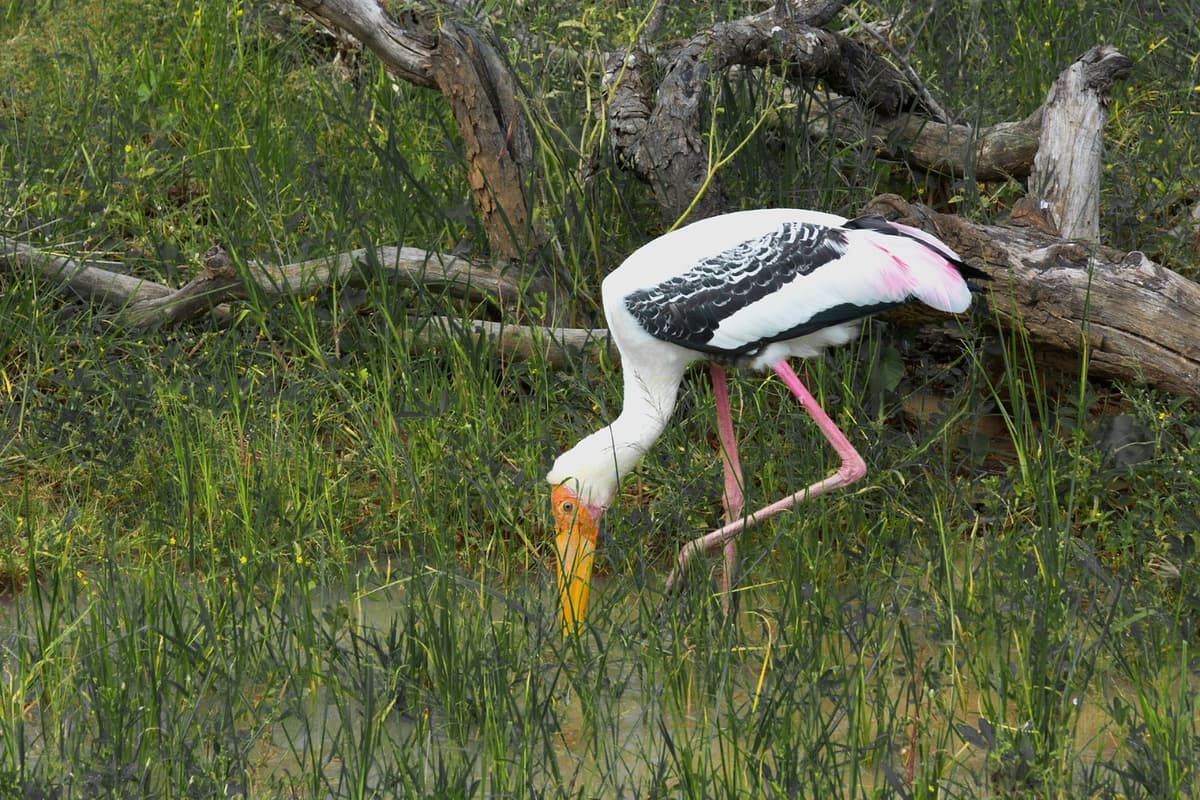
Bright pink wings and a long yellow bill define this bird.
Painted Stork Habitat and Distribution
Habitat Types
The painted stork is a large waterbird that lives mainly in freshwater wetlands. Common painted stork habitat types include marshes, ponds, lakes, riversides, and floodplains.
The species prefers shallow water, usually less than 25cm deep, where it can feel for prey with its long bill. Painted storks also adapt well to human-made habitats. They are often seen in irrigation canals, farmland, and flooded rice fields during the rainy season.
In some regions, including Vietnam, they also use coastal habitats such as mangroves, mudflats, and eco-shrimp ponds, even though freshwater areas remain their main choice.
Global Distribution
The painted stork's global distribution range covers the tropical lowlands of Asia, south of the Himalayas. Its range stretches from the Indian subcontinent to Southeast Asia, with an estimated area of about 8.7 million km².
In South Asia, it is common in India, Sri Lanka, Nepal, and Bangladesh, while it is rare along the Indus River in Pakistan. The painted stork range in Southeast Asia includes Myanmar, Thailand, Cambodia, and Vietnam, though populations in Thailand have declined sharply.
Painted Stork Distribution in Vietnam
The painted stork habitat in Vietnam spans both northern and southern regions, but the largest populations occur in the Mekong Delta. Key sites include seasonally flooded grasslands and Melaleuca forests at Tram Chim National Park, U Minh Thuong Nature Reserve, and wetlands around Ha Tien.
Along the coast, the species uses mudflats and mangroves in Dat Mui and Bai Boi (Ca Mau). In northern Vietnam, painted storks are recorded at Xuan Thuy National Park, feeding in tidal flats and eco-shrimp ponds around Con Ngan and Con Lu.
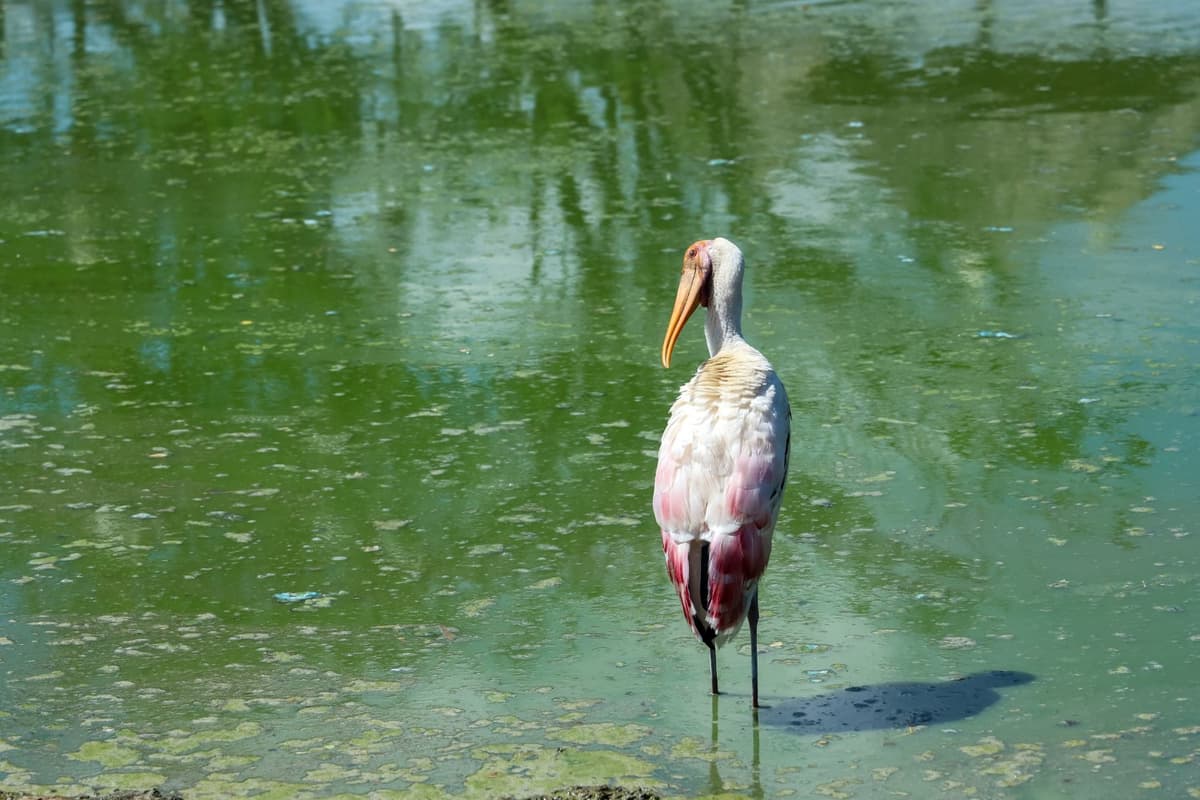
Shallow wetlands and warm marshes form the painted stork's main home.
Painted Stork in Cat Tien National Park
According to the bird checklist of Cat Tien National Park, the Painted stork (Mycteria leucocephala) is listed as a Rare species. Its presence here is irregular and strongly linked to wetland conditions.
In Cat Tien, the species is recorded as either a passing migrant or a resident, depending on seasonal water levels, food availability, and broader regional movements. Sightings usually occur in wetland habitats, which match the species’ preference for shallow freshwater areas.
Although specific observation points are not assigned to individual records, Bau Sau Wetland is considered the most suitable habitat within the park. This large freshwater lake is a Ramsar-listed wetland located in the core area of South Cat Tien.
Painted Stork Diet and Predators
Diet
The painted stork is mainly a fish-eating waterbird, but its diet is flexible and highly opportunistic. The species also feeds on shrimp, small crabs, frogs, tadpoles, insects, worms, and small reptiles.
Painted storks also eat snakes and even newly hatched crocodiles. In disturbed habitats, they may scavenge carrion or search for leftover food, showing strong adaptability. This broad diet reflects how painted storks adjust to changing wetland conditions.
By regulating fish, insect, and amphibian numbers, Painted storks help maintain balance. They are also considered an indicator species; changes in their feeding success often signal wetland pollution, habitat loss, or climate stress.
Foraging Behavior and Technique
Foraging behavior and technique are highly specialized. Instead of hunting by sight, painted storks rely on touch. While wading in shallow water below 25 cm, they sweep their slightly open bill side to side.
Once prey is touched, the long bill snaps shut instantly. Birds often stir mud with their feet or flash their wings to flush hidden prey.
Feeding usually happens in groups of 1–18 birds, sometimes up to 50. They forage mostly by day but may feed at dusk or night in special conditions. Painted storks may also steal fish from cormorants, herons, or egrets, showing bold and competitive feeding behavior.
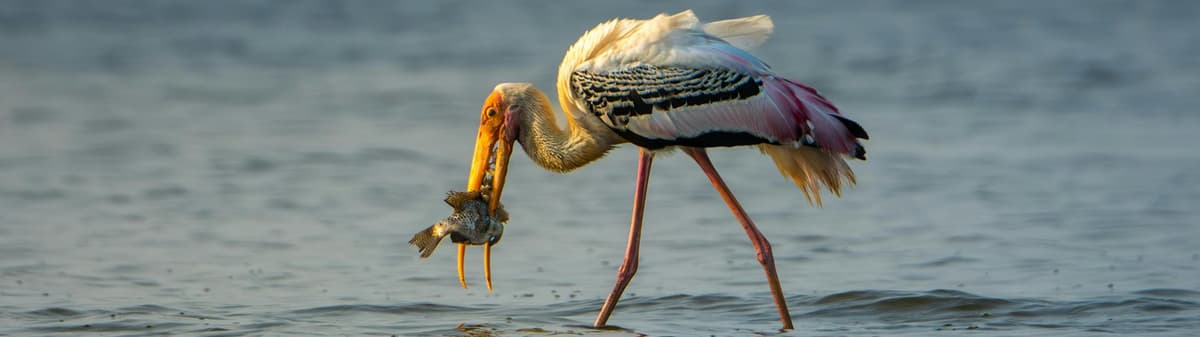
It wades slowly while sweeping water to catch small fish.
Predators
Despite their size, Painted storks face many predators. Adult birds may be attacked by tigers, leopards, jungle cats, hyenas, and crocodiles. Eggs and chicks are more vulnerable to birds of prey such as black kites, house crows, spotted eagles, and Pallas’s fish eagles.
When threatened, chicks may vomit food and lie still to avoid detection. Human activities, including hunting and egg collection, remain a serious threat.
Painted Stork Habits and Behavior
Painted stork daily activity patterns are closely linked to light and temperature. The species mainly forages during the day. In special conditions, it may also feed in late afternoon or even at night. After feeding, painted storks often stand still on riverbanks or wetland edges for long periods to rest.
By late morning, they frequently ride rising warm air currents, or thermals, to glide and search for new feeding areas. During hot midday hours, adults at the nest spread their wings to shade chicks. A key cooling behavior is urohidrosis, where birds excrete watery urine onto their legs; evaporation helps reduce body heat.
Migration and Movement
The painted stork migration or movement patterns show that this species is not a long-distance migrant. It is mainly resident, making short local movements in response to weather, food supply, or breeding needs.
At Tram Chim National Park, painted storks are described as “wandering birds,” moving between wetlands as conditions change. In northern Vietnam, such as Xuan Thuy National Park, they shift short distances to warmer areas in winter.
Young birds can disperse far; banded juveniles from India have been recorded up to 800 km away.
Social Behavior
The Painted stork is a highly social bird, and most of its daily life takes place in groups. When feeding, individuals are often seen together in small flocks of 1 to 18 birds, and in rich wetlands or flooded rice fields, these groups can grow to 50 or more.
During the breeding season, painted storks gather in large nesting colonies, sometimes called “bird sanctuaries,” where a single colony may hold up to 200 individuals. They often share nesting trees with other waterbirds, including ibises, darters, herons, and egrets, showing a strong tolerance for mixed-species colonies.
In terms of sound, the painted stork is mostly silent and does not sing. However, communication still plays an important role in social life. At the nest, adults and chicks may produce soft moaning sounds or rough, croaking calls.
The most important form of painted stork communication is bill clattering. Males use this sound during courtship displays, while during mating, the male creates rhythmic noises by striking the female’s bill with his lower mandible.
For safety and rest, painted storks usually sleep and roost together on tall trees or islands surrounded by water, reducing the risk from predators.
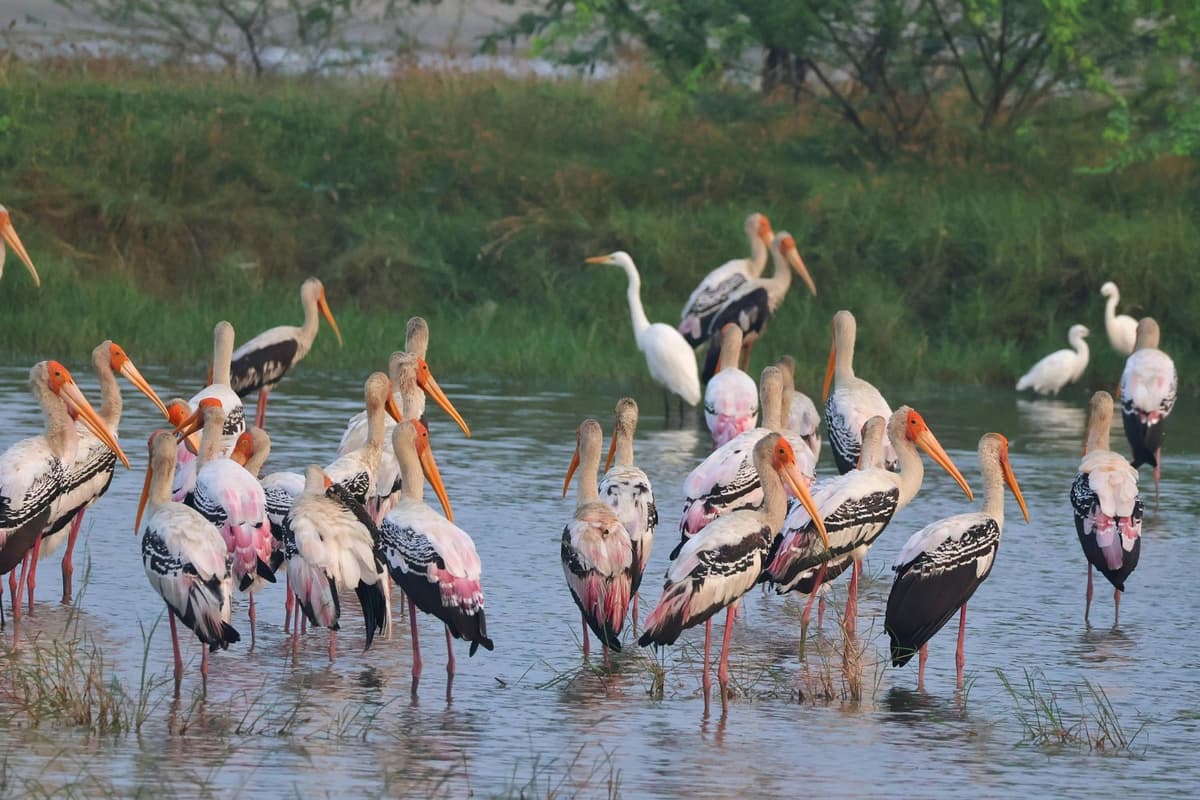
Large flocks gather to feed and nest together.
Reproduction of Painted Stork
The breeding season of the painted stork varies by region and is closely tied to monsoon patterns and food availability. In northern India, breeding usually begins in mid-August and may last until October or even January. In southern India, the season starts later, often from November to March.
The timing depends strongly on rainfall and water accumulation, as rising water levels increase fish supply, which is critical for raising chicks.
Large breeding colonies may include up to 200 birds and are often shared with other waterbirds such as cormorants, herons, ibises, pelicans, and egrets.
Painted storks are colonial breeders and usually nest on tall trees near wetlands. Nest sites include trees on lake islands, riverbanks, and sometimes villages. Favored tree species include Acacia, Ficus, Tamarind, and Eucalyptus.
The nest is a large platform of sticks, lined with leaves and soft grass. Both parents build and repair the nest throughout the season. The species is monogamous. Males select and defend the nest site and attract females through head movements, preening displays, and loud bill clattering. A typical clutch contains 2–5 eggs, and early breeders often lay more.
Parental Care
Painted storks show strong bi-parental care. Both parents incubate the eggs for about 30 days. After hatching, adults feed chicks by regurgitating small fish, usually under 20 cm long.
During hot midday periods, parents shade chicks with spread wings and cool themselves using urophidrosis. Chicks fledge after 2–3 months and reach breeding age at 2–3 years.
Threats and Conservation of Painted Storks
Globally, the painted stork is now listed as Least Concern by the IUCN, as populations have increased in some regions. However, this does not mean the species is safe everywhere.
In Vietnam, it is still listed in the Red Data Book, and local declines remain serious. These pressures highlight ongoing threats to painted stork populations, especially at key wetland sites.
Threats to Painted Storks
The painted stork faces threats from habitat loss, hunting, pollution, and human disturbance. Hunting and egg theft are among the most direct human threats. Eggs and chicks are taken from nests for food or trade, while adult birds are sometimes hunted for meat.
Painted stork habitat loss and pollution are the most serious long-term problems. Wetlands are converted into rice fields, shrimp ponds, and urban areas. In the Mekong Delta, seasonally flooded grasslands and Melaleuca forests are disappearing rapidly.
Agricultural chemicals enter the food chain, and because painted storks mainly eat fish, toxins build up in their bodies. This can thin eggshells and reduce breeding success. Invasive species such as water hyacinth and non-native fish further reduce food availability.
Human impact on painted stork nesting sites is also significant. Tree cutting removes suitable nesting trees, while noise, artificial light, traffic, and tall buildings near colonies cause stress and lower breeding success.
Conservation
Across Asia, painted stork conservation projects focus on wetland protection and colony safety. In Vietnam, protected areas like Tram Chim, U Minh Thuong, Dat Mui, and Bau Sau help safeguard key habitats.
In India, major nesting sites are protected in national parks and community-managed villages. In Malaysia, painted stork breeding programs in captivity followed by reintroduction have been successful, helping the population grow by 10–13% per year.
Painted Stork Watching in Cat Tien National Park
At Cat Tien National Park, Painted Stork watching is closely linked to eco-tours and wildlife photography around Bau Sau Wetland, a Ramsar-listed wetland in South Cat Tien. The species is recorded here as rare, appearing as a passing migrant or local resident depending on water levels.
In the near future, Katien Safari will coordinate with the park management to run small-group safari tours, focusing on low-impact birdwatching and nature photography in this sensitive wetland ecosystem.
Responsible observation tips:
- Stay strictly on designated trails or guided routes.
- Keep quiet and avoid sudden movements.
- Use binoculars or long lenses; do not approach birds.
- Never disturb nesting or feeding areas.
- Follow the ranger and guide instructions at all times.
Interesting Facts of Painted Stork
1. The name “Painted Stork” comes from its bright pink feathers on the lower back, which cover the white body when the bird rests, making it look as if it has been carefully painted.
2. Painted storks release watery waste onto their legs to cool their bodies. Evaporation lowers body temperature, making the legs look white instead of yellow or red.
3. When threatened, chicks may vomit food and lie still in the nest, pretending to be dead to avoid predators.
4. Painted stork chicks eat a lot. Each chick requires 500–600 g of food per day, equivalent to roughly nine medium-sized fish, to grow properly.
5. During hot afternoons, adult storks stand over the nest with wings spread wide, creating shade to protect their chicks from overheating.
Reference
- Bhawnani, R., Sharma, A. K., Tripathi, A. K., & Choudhary, N. L. (2025). Insights into the population status, distribution, feeding ecology, and breeding biology of painted stork (Mycteria leucocephala) in India: A comprehensive review. Indian Journal of Applied & Pure Biology, 40(2), 963-972.
- Gantaloo, U. S., & Dongare, S.B. (2014). Impact of climate change effecting decline on migration birds of Bhadalwadi Lake Indapur Taluka M.S India. American Journal of Engineering Research (AJER), 3(5), 16-20.
- Syed, S. (n.d.). Nesting behaviour of Painted storks. International Journal of Creative Research Thoughts (IJCRT).
- Buckton, S. T., Nguyen, C., Nguyen, D. T., & Ha, Q. Q. (1999). The conservation of key wetland sites in the Mekong Delta (Conservation Report No. 12). BirdLife International Vietnam Programme.
- Bird Society of Singapore. (n.d.). Milky Stork. Singapore Birds Project. Retrieved December 17, 2025, from https://singaporebirds.com/species/milky-stork.
- Nguyen, H. H. (2020). Danh lục chim tại Vườn Quốc Gia Cát Tiên (Birds recorded in Cát Tiên National Park) (Version 30 June 2020).