Leopard cat facts show that this small wild cat is an excellent climber and a strong swimmer. Belonging to the Felidae family, the leopard cat (Prionailurus bengalensis) is much more agile than it looks. These skills help it survive in different environments, from dense forests to wetlands. To discover more interesting facts about the leopard cat and its life in the wild, read the full article here.
| Common name | Fishing Cat |
|---|
| Scientific name | Prionailurus viverrinus |
|---|
| Taxonomy
|
Kingdom: Animalia
Phylum: Chordata
Class: Mammalia
Order: Carnivora
Family: Felidae
Genus: Prionailurus
|
| Weight / Size | 5 - 16kg. |
|---|
| Lifespan | ~12 years |
|---|
| Population | Approx 3,000 individuals |
|---|
| Habitat | Wetland habitats, mangroves, marshlands, rivers and streams. |
|---|
| Range | Patches across South and South East Asia. Countries include India, Thailand, Sri Lanka and Nepal. |
|---|
| Diet | Predominantly fish but also include rodents and birds. |
|---|
| Conservation status | IUCN Status: Vulnerable. |
|---|
Physical Characteristics of Fishing Cat
The fishing cat, whose scientific name is Prionailurus viverrinus, is one of the largest wild cats in the Prionailurus genus. It is about twice the size of a domestic cat and has a strong, muscular body. When describing fishing cat size and weight, adults usually weigh between 6 and 12 kilograms, while males can be much larger, sometimes reaching up to 16 kilograms. The length of the head and body ranges from 57 to 78 centimeters, and the tail is short, measuring only about 20 to 30 centimeters. Female fishing cats are clearly smaller than males.
The fishing cat has a large, broad head with a slightly elongated muzzle. Its skull is long and supports powerful jaw muscles. The eyes have greenish pupils, giving the cat a sharp and alert look. Two dark stripes run from each eye across the cheeks to below the ears. Above the eyes, several dark stripes continue over the top of the head and reach the back of the neck, forming a clear and recognizable facial pattern.
The ears are small, rounded, and set low on the sides of the head. The back of each ear is dark in color and has a distinct white spot in the center, which is a common feature in many wild cats and may help with communication.
The fur of the fishing cat varies in color from yellowish brown to brownish grey or ashy grey. The coat is covered with a mix of dark spots and stripes that provide excellent camouflage in wetland habitats. Six to eight dark stripes run from the forehead to the neck and break into shorter bars and spots on the shoulders. The spots on the shoulders are long and arranged in lines, while the spots on the sides, legs, and tail are rounder. The belly fur is lighter in color, longer, and also spotted. Around the throat, two rows of dark spots can be seen clearly.
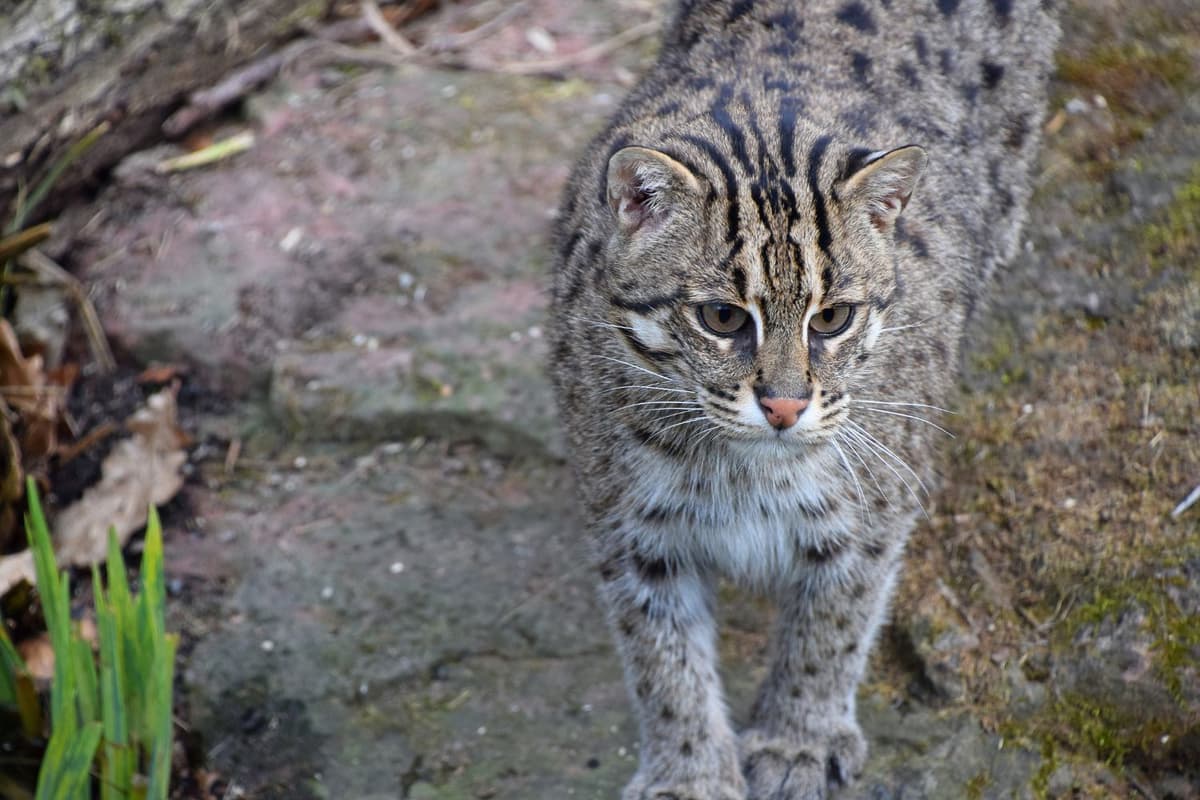
Its fur features a mix of dark spots and stripes, providing excellent camouflage in wetland habitats.
The tail of the fishing cat is short and thick, measuring about one-third to less than half the length of the head and body. It has five to six incomplete black rings, and the tip of the tail is completely black.
One of the most important adaptive features for aquatic life in the fishing cat can be seen in its legs, paws, and fur. The legs are short and strong, helping the cat move easily through water and dense vegetation. Dark bands are often visible around the elbows of the front legs. The paws have partially developed webbing between the toes, which help them swim and catch prey in water. The claws do not fully retract and remain slightly visible, giving the cat a better grip on slippery fish.
Another key adaptation is the fishing cat’s double-layered coat. The inner layer is very short and extremely dense, forming a water-resistant barrier that keeps the skin dry and warm. The outer layer consists of longer guard hairs that create the coat’s color pattern and a slightly glossy look. Together, these features allow the fishing cat to stay warm, dry, and well protected while hunting in cold water.
These fishing cat physical characteristics clearly show how well this species is adapted to life near rivers, swamps, and wetlands.
Global Distribution and Habitat
Fishing Cat Distribution
Fishing cats are distributed across South and Southeast Asia, but their population density and total numbers differ strongly between regions.
South Asia holds the largest share of the global population, with an estimated 1,768 - 5,088 individuals in India and Bangladesh and about 1,392 - 2,187 individuals in Sri Lanka. In inland protected areas such as Chitwan National Park in Nepal and the Indian Terai, fishing cats occur at low densities of around 3 - 6 individuals per 100 km². Coastal regions support much higher densities, as seen in eastern India and the Sundarbans, where densities range from 44 to over 50 individuals per 100 km², and may reach up to 70 individuals per 100 km² in some areas.
In Southeast Asia, fishing cats are far less numerous. Thailand shows moderate densities, for example about 14 individuals per 100 km² in Khao Sam Roi Yot National Park, while Thailand and Cambodia together are estimated to support only around 131 - 200 individuals.
In Vietnam, the fishing cat was first officially recorded in 2008 in U Minh Thuong National Park, located in An Giang Province. This discovery confirmed the presence of the species in the Mekong Delta region after many years without reliable records. However, there are currently no reliable population density or total population estimates, suggesting that the species is rare. Based on available and extrapolated data from across its range, the global fishing cat population is estimated at approximately 3,194 - 7,527 individuals.
Fishing Cat Habitat
The fishing cat mainly lives in wetland areas, especially marshes and swamps. These places are typical swamp and marsh land feline habitats for the species. The fishing cat depends strongly on areas with a steady water source. It is often found in wetlands such as reed beds, scrub areas, tidal creeks, and mangrove forests. It can also live in forested areas that are close to rivers or near jungle environments. Most records of fishing cats come from lowland wetlands. However, the species is not limited to low areas only. Fishing cats have been recorded in Himalayan forests at elevations of about 1,525 metres. In Sri Lanka, they have also been found in wetland habitats in hilly and mountainous areas at elevations of up to 2,100 metres. In the lowlands of Nepal, some fishing cats have been observed spending long periods in dense grasslands far from open water.
Fishing Cat Diet and Behavior
Fishing Cat Diet
What do fishing cats eat? The fishing cat mainly feeds on fish and shellfish, which is why it is often described as a piscivore. However, do fishing cats only eat fish? The answer is no. Their teeth are not specially adapted only for catching fish, so they are able to eat many different kinds of food. In the wild, fishing cats hunt a wide range of small to medium-sized animals. Their diet includes frogs, snakes, insects, rodents, small civets, fawns, wild pigs, and birds such as ducks, coots, and sandpipers. Fishing cats are also known to prey on domestic animals, including poultry, goats, calves, and even dogs. In some cases, they feed on leftover food from human activities or remains left by larger predators, such as scraps from tiger kills. They have also been observed eating dead cows, which shows that they may consume carrion when it is available. Because they are not picky eaters and can feed at different times of the day, fishing cats have a very flexible diet. In zoos, they are mainly fed fish such as salmon, cod, herring, and tilapia, with small amounts of meat like chicken and rabbit.
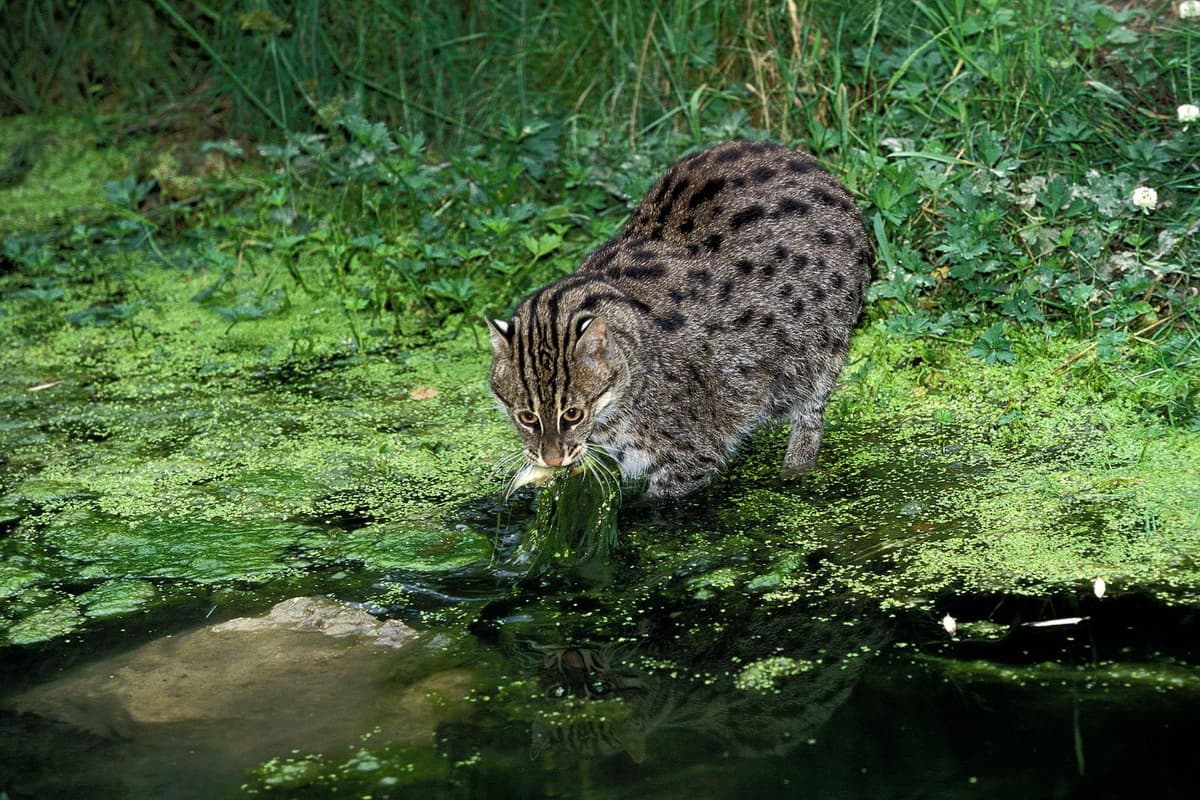
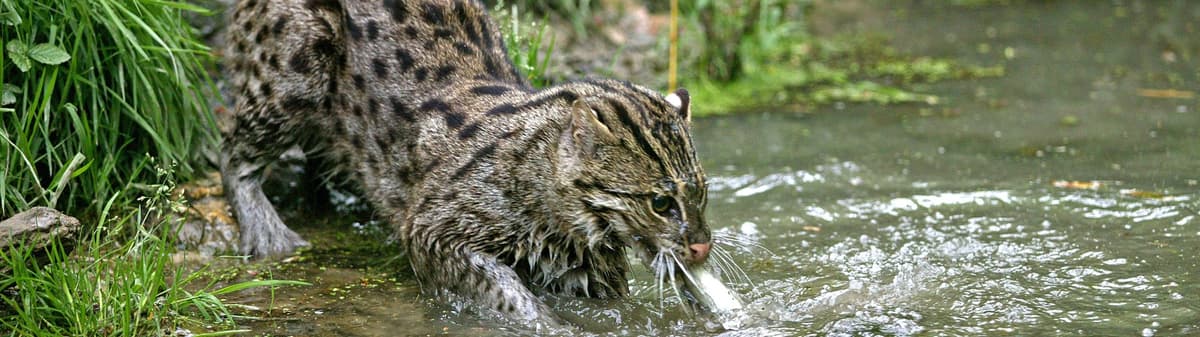
A fishing cat catching fish in a marshland.
Fishing Cat Behavior
Fishing cats are mainly nocturnal and solitary animals, meaning they are most active at night and usually live alone. Very little is known about their behavior in the wild because they are secretive and difficult to observe.
Males and females maintain separate territories, with males having larger home ranges of about 16-22 km², while females usually occupy smaller areas of around 4-6 km². They mark their territories using strong-smelling urine and also leave scent marks by rubbing their cheeks, head, chin, neck, and body against objects.
Fishing cats have white rings around their eyes, which reflect light and help them see better when hunting in low-light conditions at night. They communicate using hisses, guttural growls, and low, demanding meows, and during courtship both males and females produce special sounds known as “chittering.”
Fishing cats are excellent swimmers and are strongly adapted to hunting in water, especially in marshy environments. In the wild, they have been observed “fishing” along the edges of rivers, lakes, and wetlands. They often use their partially webbed paws to scoop prey from the water and are capable of swimming and diving to catch fish underwater.
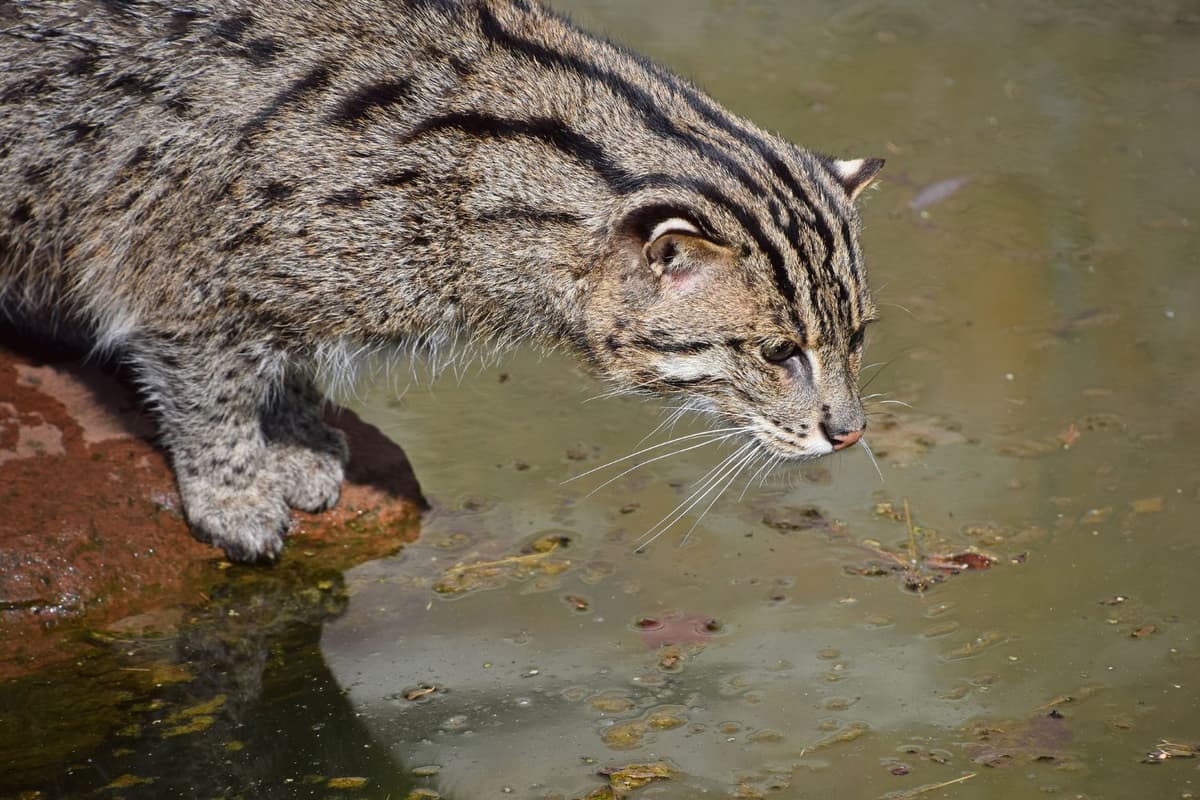
The fishing cat is quietly watching its prey beneath the water.
One observed hunting technique involves tapping the surface of the water with their paws to create ripples, which attract fish that mistake the movement for insects; once the fish comes close, the cat dives in to capture it. Fishing cats have also been seen playing with fish in shallow water.
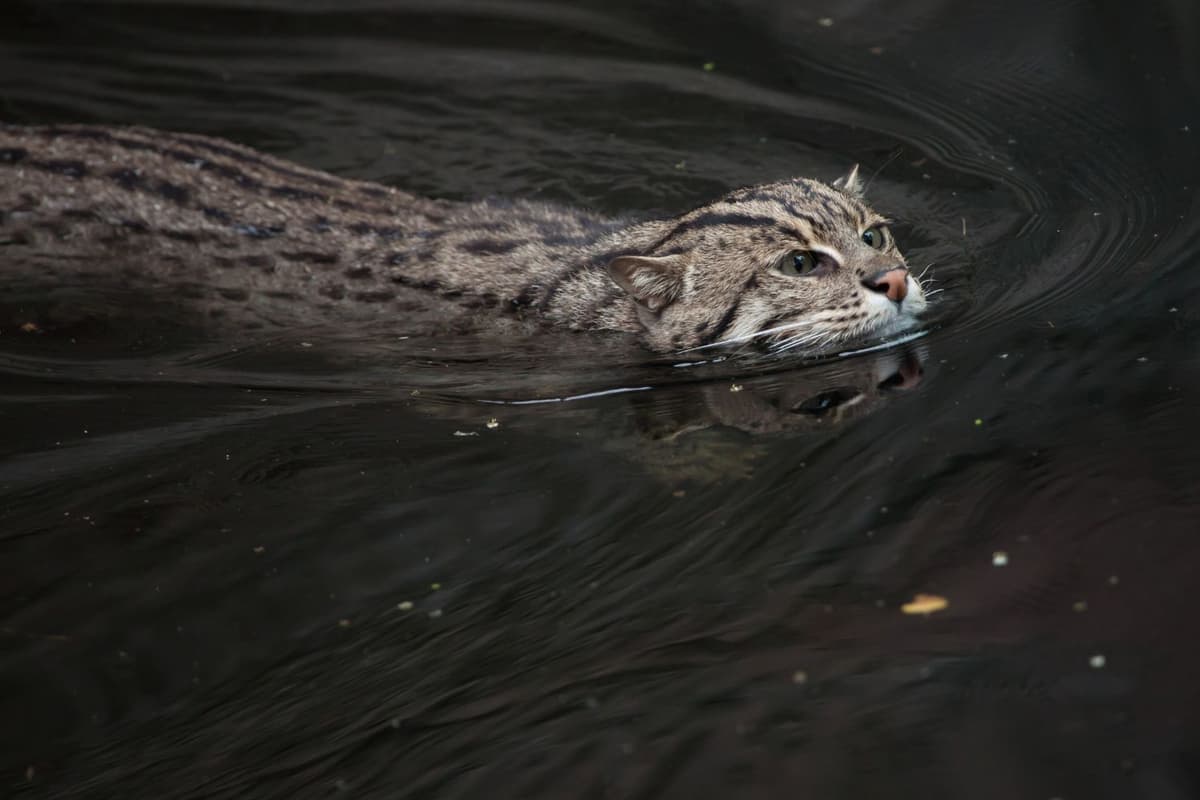
The fishing cat is an excellent swimmer.
In captivity, they show a unique washing behavior, in which they drop pieces of prey into water, retrieve them, and then eat them. Like many other small wild cats, fishing cats also sharpen their claws regularly and display flehmen behavior, which helps them detect and process scent information.
Reproduction and Offspring
Fishing cat reproduction and mating are believed to take place throughout the year, although in the wild fishing cats most likely mate during January and February. A special mating call is thought to exist, but it has not yet been clearly described. Females give birth in hidden dens, which are usually found in thick bushes, reed beds, hollow trees, rock crevices, or other quiet and sheltered places. The fishing cat gestation period lasts about 63 to 70 days. After this time, the female gives birth to one to 4 kittens, most commonly 2 or 3. Newborn kittens weigh around 170 grams at birth. In the wild, kittens have been observed mainly between March and June, while in captivity births have been recorded in March and August.
The kittens’ eyes open at around 16 days of age, and they begin to move actively when they are about one month old. At around two months of age, they start eating solid food and playing in water, but they are not fully weaned until they are four to six months old. Fishing cat kittens reach adult body size at about eight to nine months and develop their adult canine teeth by around 11 months. They become sexually mature at approximately 15 months of age and usually become independent between 12 and 18 months. It is believed that adult males may help watch over or care for the kittens in the wild, but this behavior has not been confirmed. In captivity, fishing cats have been recorded living for up to 10 to 12 years.
Threats to and conservation of the fishing cat
Threats to the Fishing cat
The fishing cat conservation status IUCN currently lists the fishing cat as Vulnerable, meaning the species is facing a high risk of extinction in the wild. One of the main answers to why fishing cats are endangered is the rapid loss of wetlands across Asia. These cats depend heavily on marshes, swamps, floodplains, and mangrove areas, but threats to wetland ecosystems such as agricultural expansion, shrimp farming, pollution, and drainage are destroying these habitats. This process leads to severe habitat loss for Asian wild cats, breaking large wetland areas into small, isolated patches where fishing cats struggle to find food, mates, and safe shelter.
Another serious problem is prey decline caused by overfishing and polluted water, which reduces fish and aquatic animals that fishing cats rely on. As natural food sources disappear, human-wildlife conflict fishing cats becomes more common. Fishing cats may hunt poultry, ducks, or small livestock near villages, leading farmers to kill them in retaliation. In addition, poaching remains a major threat. In some regions, fishing cats are hunted for meat, traditional medicine, or targeted through the Illegal trade of fishing cat skins, despite legal protection. Road construction through wetlands has also increased traffic collisions, further reducing wild populations. Together, habitat destruction, pollution, poaching, and human conflict continue to push fishing cats closer to extinction if wetland conservation is not strengthened.
Conservation
Conservation efforts are very important to protect fishing cats and the wetland habitats they depend on. One effective way people can help is by choosing products that support responsible land use, such as eco-friendly farming and sustainable fishing. Reducing water pollution, limiting chemical fertilizers, and using environmentally friendly agricultural methods help keep wetlands clean and healthy, ensuring fishing cats can continue to live and hunt along wetland banks.
In areas where habitat loss is severe, such as coastal Andhra Pradesh in India, conservation NGOs work closely with local communities to slow down wetland destruction. These projects often focus on creating alternative livelihood programs, helping villagers earn income without harming natural ecosystems. This approach not only protects fishing cat habitats but also reduces conflict between people and wildlife.
In captivity, fishing cat conservation is supported through carefully managed breeding programs. The European Association of Zoos and Aquaria (EAZA) and the American Association of Zoos and Aquariums (AZA) run captive breeding programs to maintain healthy populations. All fishing cats kept in zoos worldwide are recorded in the International Studbook of the World Association of Zoos and Aquariums, which helps track genetics and supports long-term species survival.
Differences between the Fishing Cat and the Leopard Cat
Although the fishing cat (Prionailurus viverrinus) and the leopard cat (Prionailurus bengalensis) belong to the same genus and look similar, they differ clearly in size, body structure, hunting skills, habitat adaptation, and conservation status.
The fishing cat is much larger and heavier, with a stocky, muscular body designed for life in wet environments. It has short, strong legs, partially webbed feet, and a short, thick tail that works like a rudder when swimming. These features allow the fishing cat to hunt efficiently in water by scooping fish with its paws or diving after prey. In contrast, the leopard cat is smaller and lighter, with a slim body, long legs, and a long tail that helps it balance while climbing. It is an agile land hunter that catches rodents, birds, reptiles, and insects, using stalking and jumping techniques similar to a domestic cat.
The two species also differ greatly in their level of adaptation and habitat flexibility. Fishing cats are highly specialized and depend strongly on wetlands, such as swamps, marshes, mangroves, and riverbanks. When these wetland areas are polluted or destroyed, fishing cats quickly disappear.
Leopard cats, on the other hand, are highly adaptable and can live in a wide range of environments, including forests, grasslands, agricultural areas, and even places close to human settlements. Because of this flexibility, leopard cats are still relatively widespread, while fishing cats face a much higher risk of population decline.
In terms of behavior, both species are mainly nocturnal and solitary, but their lifestyles reflect their environments. Fishing cats are powerful swimmers and spend much of their time near or in water, while leopard cats rely more on speed, agility, and climbing ability.
In Vietnam, the leopard cat is still widely distributed and has been recorded in several protected areas, including Hoàng Liên National Park (Lao Cai), Pu Hoat Nature Reserve (Nghe An), and Cat Tien National Park (Đong Nai) and among others.
The fishing cat, by contrast, is extremely rare. It has been recorded only once, in 2008 in An Giang Province, and no confirmed records have been reported since. Overall, fishing cats are also much less widely distributed across Southeast Asia compared to leopard cats.
5 Interesting Facts of the Fishing cat
1. Fishing cat kittens begin learning how to hunt and even dive into water when they are only about one month old.
2. A fishing cat has around 32 muscles in each ear. Its ears can rotate almost 180 degrees, allowing it to hear sounds from many directions without moving its head.
3. When swimming, fishing cats use their short, flattened tail to help steer and control direction in the water, just like a rudder on a boat.
4. Fishing cats, Bengal cats, and leopard cats share common ancestors, which is why they look very similar. All have dark spots and signature stripes running from above the eyes down the head and neck. Among them, the fishing cat is the largest.
5. Even though they look like house cats, fishing cats are wild animals. They need natural mangroves and swamps to survive, can be aggressive, and are a protected species.