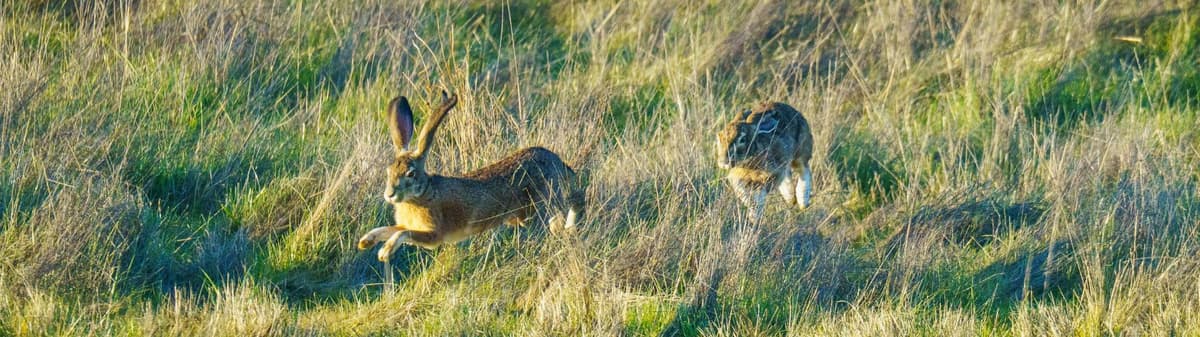
The Burmese hare (Lepus peguensis), also known as the Indochinese or savanna hare, is a true hare native to Southeast Asia. Unlike domesticated rabbits, these wild hares are fast runners with long hind legs, large ears tipped in black, and a lean build perfectly suited for open grasslands and scrublands.
Though listed as Least Concern globally by the IUCN (with stable populations), local numbers face pressure from habitat loss and hunting. At Katien Safari, our night tours and live cameras offer exciting chances to spot these elusive animals dashing through the shadows.
Read on to explore its physical traits, habitat, behavior, diet, reproduction, and conservation in detail!
| Common name | Hare |
|---|
| Scientific name | Lepus spp. |
|---|
| Taxonomy |
Kingdom: Animalia
Phylum: Chordata
Class: Mammalia
Order: Lagomorpha
Family: Leporidae
|
| Weight / Size | Weight: 2–5.5 kg. Body length: 35–68 cm. Tail: 3–8 cm. |
|---|
| Lifespan | Wild: 5–8 years. Captive: Can exceed 10–12 years. |
|---|
| Population | Unknown; some species threatened locally. |
|---|
| Habitat | Grasslands, meadows, forests, steppes, deserts, tropical lowlands. |
|---|
| Range | Worldwide – Europe, Asia, Africa, North America (invasive in others). |
|---|
| Diet | Herbivorous: grasses, twigs, leaves, fruits, and shrubs. |
|---|
| Conservation status | Least Concern globally. |
|---|
Physical Characteristics
Hares are larger and more athletic than most rabbits. Adult weight typically ranges from 2 to 5.5 kg, with some individuals reaching 7 kg. Females are usually slightly larger than males. Body length varies from 35 to 68 cm, with a short tail of 3–8 cm.
The hind legs are long and powerful, allowing bursts of speed up to 80 km/h (50 mph) in some species. The ears are large, often longer than the head, and help both hear predators from a distance and cool the body in hot climates. Many species have black tips on the ears.
Coat color and thickness change with habitat and season. Arctic and mountain hares turn white in winter for camouflage, while tropical species keep brown or gray coats year-round. The fur is generally coarse and provides excellent insulation. Compared to rabbits, hares have a more slender build, longer limbs, and larger ears relative to body size.
Newborn hares, called leverets, are precocial: they are born fully furred, with eyes open, and can hop within minutes. This is the opposite of domestic rabbits, which are born naked and blind.
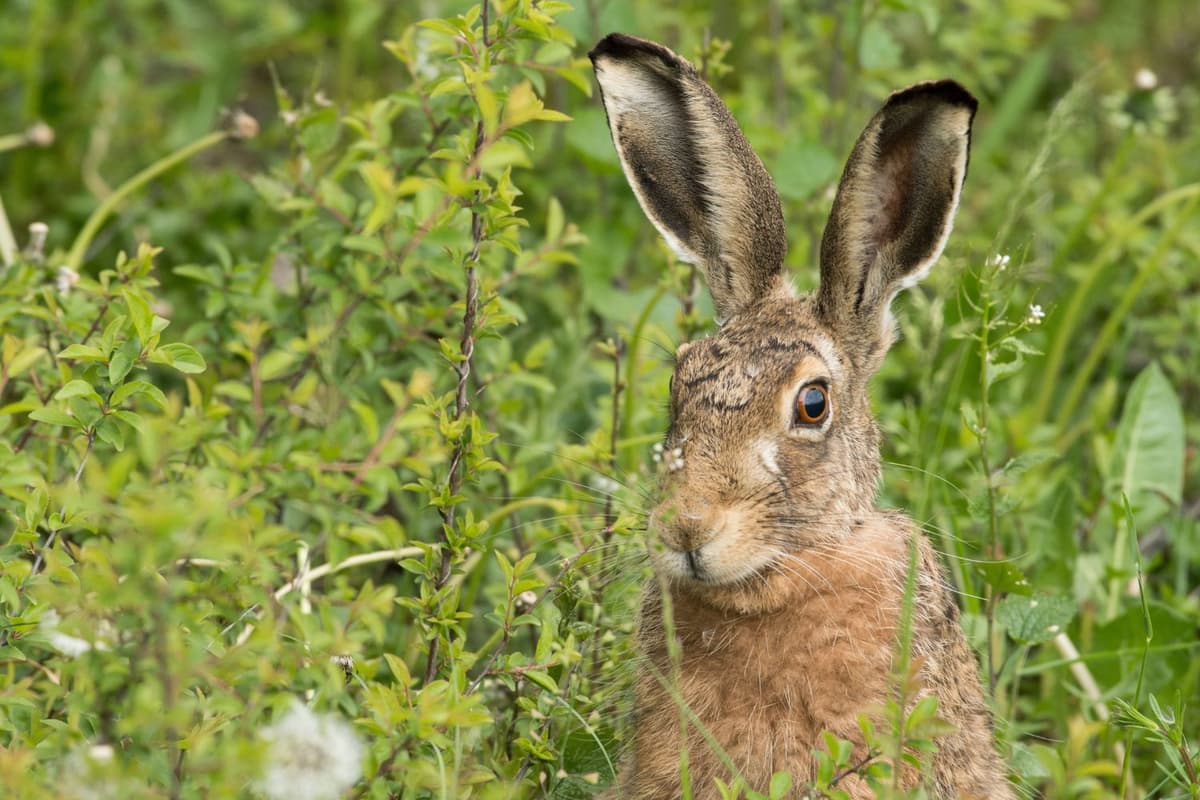
Hares have long ears, powerful hind legs, and a sleek body for speed.
Taxonomy and Number of Hare Species (Genus Lepus)
The genus Lepus includes about 32 recognized species of true hares, distinct from rabbits and other leporids like the hispid hare or red rock hare.
Species are grouped into subgenera such as Macrotolagus, Poecilolagus, Lepus, Proeulagus, Eulagos, Indolagus, and others. The subgenus Indolagus includes Lepus peguensis (Burmese hare), the only hare species recorded in Vietnam, with three subspecies.
Notable species include the Arctic hare (L. arcticus), mountain hare (L. timidus), European hare (L. europaeus), snowshoe hare (L. americanus), and antelope jackrabbit (L. alleni).
Hares originated in Asia during the early Eocene (~50 million years ago) and diversified as C4 grasslands expanded in the Miocene-Pliocene, spreading to Europe, Africa, and North America.
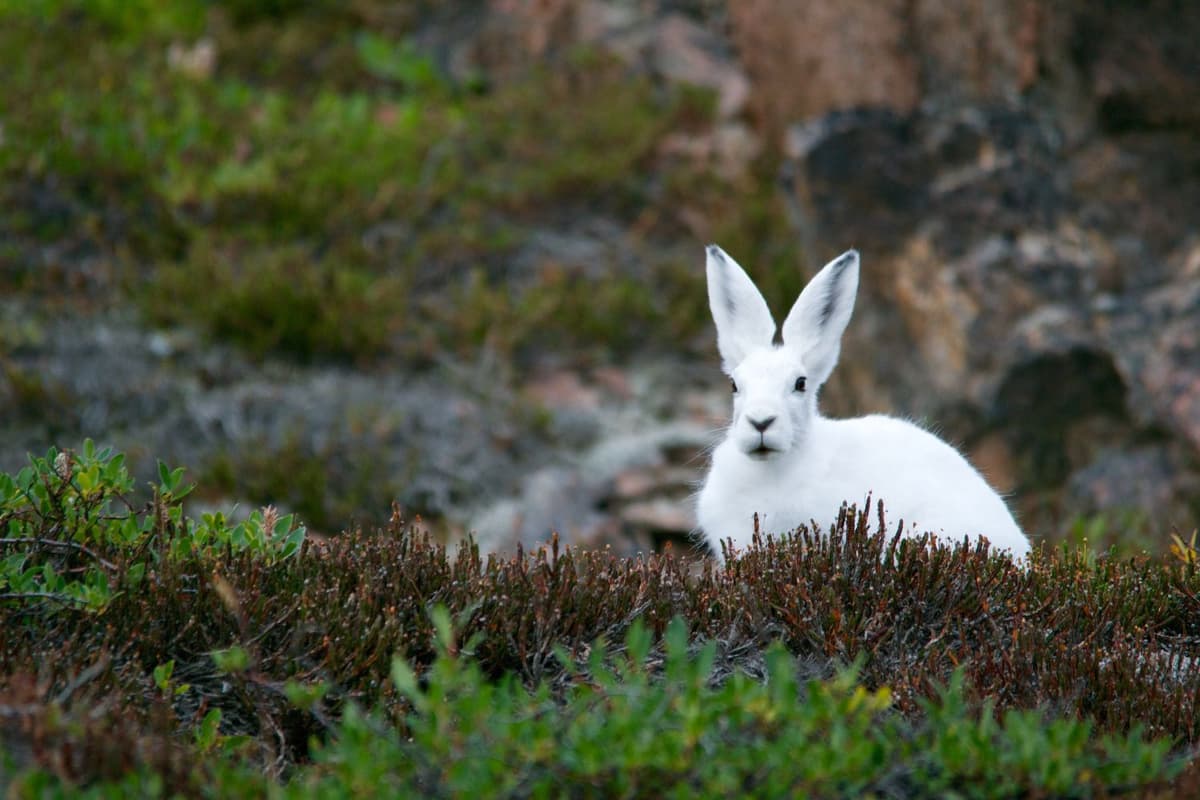
The Arctic hare has thick white fur, helping it survive extreme cold.
Habitat and Distribution
Habitat and Global Distribution
Hares are highly adaptable and occupy diverse environments, from Arctic tundra and high mountains to temperate grasslands, savannas, deserts, wetlands, and tropical lowlands. They prefer open or semi-open landscapes, such as meadows, steppes, plains, and agricultural fields, where their speed provides an advantage over hiding in dense cover.
In cold regions, Arctic hares dig shallow forms under snow to shelter from wind. Mountain hares live at elevations of 1,300–3,500 m in alpine forests or low shrubs. The Burmese hare in Vietnam inhabits low-elevation dry fields, abandoned farmland, forest clearings, seasonal wetlands, and coastal sandy areas.
Globally, hares are native to Europe, Asia, Africa, and North America. Some species have been introduced to Australia and southern South America, where they have become invasive pests.
In Vietnam
Vietnam has only one hare species: the Burmese hare (Lepus peguensis). It is found mainly in the southern lowlands, plains, and low hills, including dry croplands, wasteland, forest edges, seasonal floodplains, and coastal sands. Hunting for food and habitat loss from intensive irrigated rice farming are the main local threats. Globally, the IUCN lists it as Least Concern, with stable populations overall, though local declines occur due to human pressure.
In Cat Tien National Park
Cat Tien National Park records the Burmese hare (Lepus peguensis) in open grasslands, sparse forests, melaleuca stands, and riverbank meadows, particularly around Bàu Sấu, Đá Bàn, Suối Đá, and areas near the headquarters. The park's seasonal tropical forests, grasslands, and wetlands provide suitable habitat.
Numbers are modest and not precisely known, but the species is present and occasionally seen by rangers or night-tour guides bounding across roads at dusk or dawn. Sightings are rare during the day because hares rest motionless in tall grass or thickets. They are not endemic to or rare in Cat Tien, but they contribute to the park's small-mammal diversity. Local pressures include feral dogs, leopard cats, civets, and nighttime vehicle traffic.
Diet and Predators
Diet and Feeding Habits
Hares are strict herbivores, feeding mainly on fresh grasses, young leaves, twigs, shoots, and low shrubs. They forage at dawn, dusk, and night to avoid predators, always selecting the tenderest, most nutritious parts.
They prefer C4 tropical grasses, which expanded in the late Miocene and helped hares diversify. In Vietnam, Burmese hares eat grasses and herbs in fields, wasteland, and wetlands. In arid areas, they get most water from food and rarely drink directly.
Like rabbits, hares practice coprophagy: they produce soft cecotropes at night and re-ingest them for extra nutrients from gut bacteria. Arctic hares eat grasses, mosses, lichens, and dwarf willow in summer, digging through snow in winter.
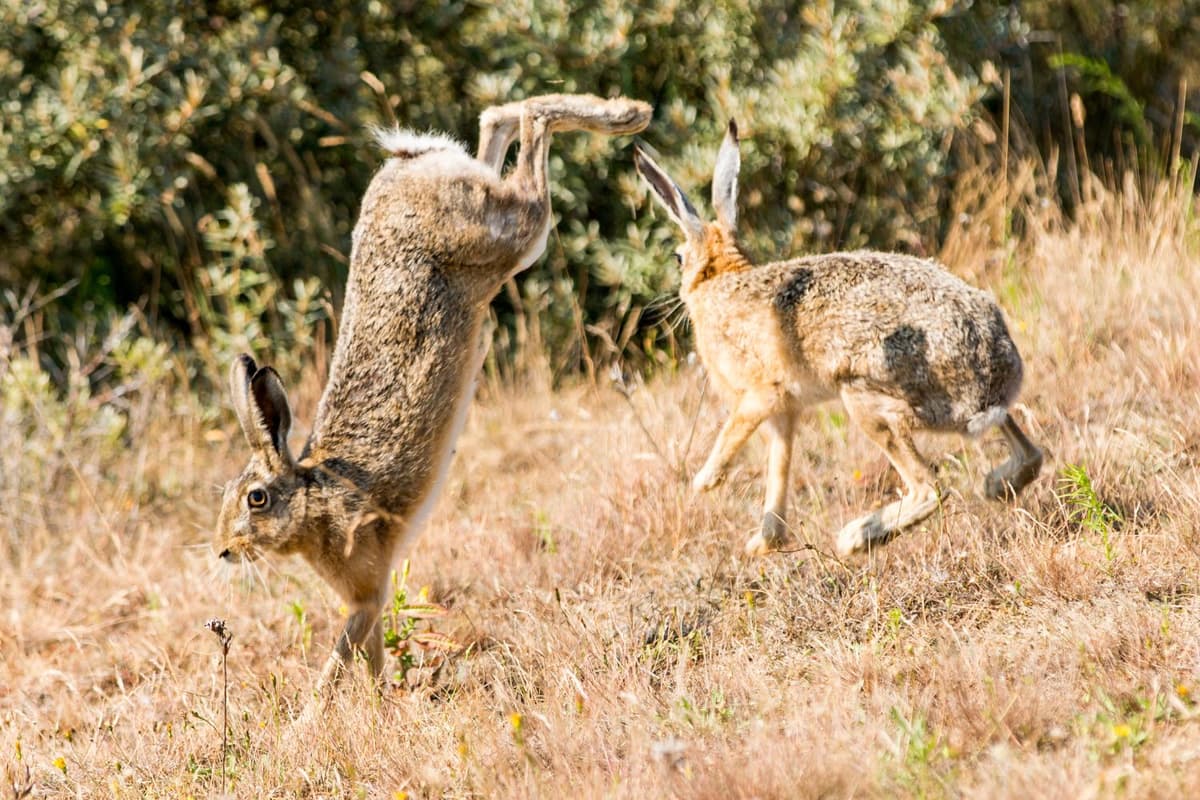
When threatened, hares fight by using their strong hind legs to kick.
Natural Predators and Defense Mechanisms
Hares face many predators: foxes, wolves, lynx, wild cats, eagles, hawks, owls, and in Vietnam, leopard cats, civets, jackals, and feral dogs.
Primary defense is extreme speed (60–80 km/h in bursts), long leaps, and zigzag running to evade pursuit. They use "static camouflage": lying flat in a form (shallow depression) with fur blending into the surroundings, bolting only when danger is very close.
Seasonal molting provides camouflage, white in winter for Arctic species, brown-gray in deserts. When threatened, they thump their feet loudly or emit warning calls to alert others. Most live solitary or in pairs to minimize detection risk.
Habit and Behaviour
Hares are mostly solitary or in loose pairs, less social than rabbits. They do not dig permanent burrows but rest in forms, simple scrapes in grass or soil. They are nocturnal or crepuscular, active at twilight and night, hiding in vegetation during daylight to avoid predators.
The famous "March madness" of European hares stems from females "boxing" males with forepaws to reject unwanted advances during breeding, not male fights. Arctic hares are exceptional: they form large winter flocks (dozens to thousands) for warmth and vigilance, dispersing in spring to breed.
Communication relies on body language (chasing, boxing, ear positions), foot-thumping alarms, and occasional soft calls during agitation. Hares excel in open environments, fleeing rapidly rather than burrowing, with some species molting seasonally for camouflage.
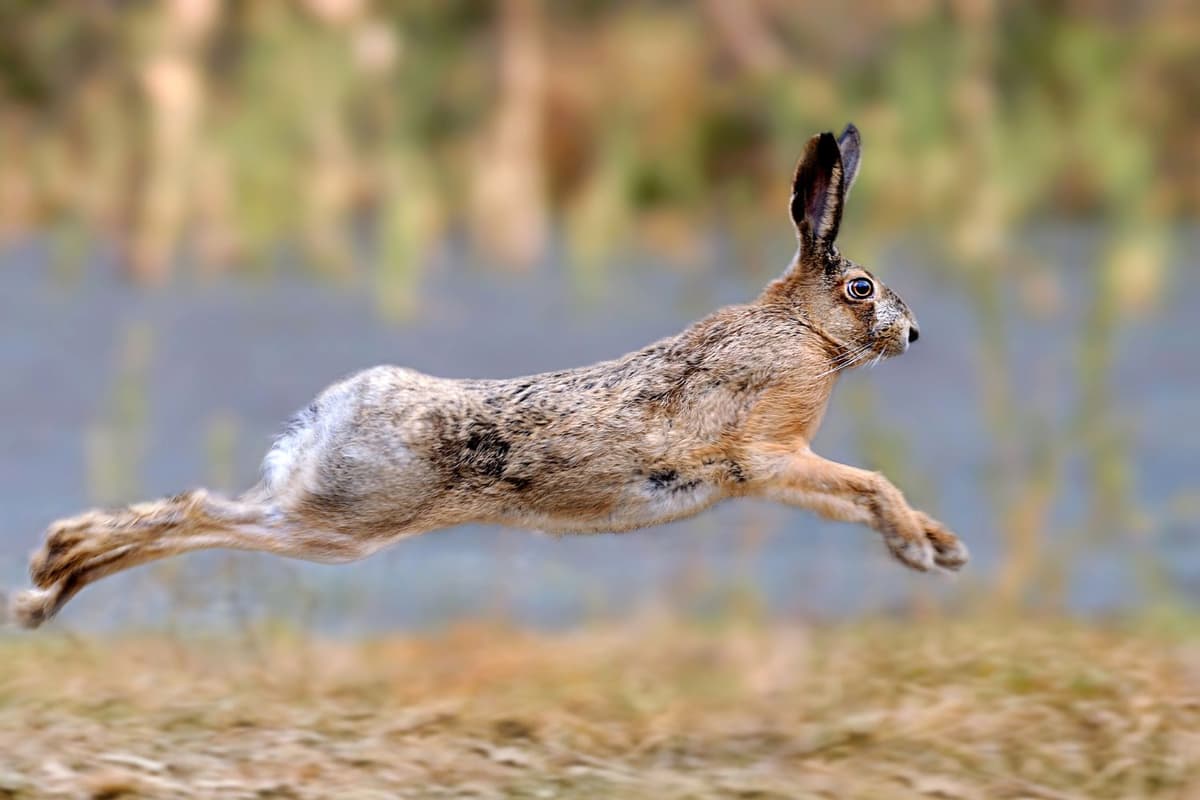
Known for their incredible speed, hares can reach up to 45 mph while running.
Reproduction of Hares
Hare reproduction is adapted to diverse climates and habitats, with breeding seasons varying widely across species. In tropical regions like Vietnam, the Burmese hare (Lepus peguensis) breeds year-round and can produce multiple litters annually. Arctic hares (Lepus arcticus) mate from April to September, while European hares (Lepus europaeus) have a strong peak in spring, leading to the famous expression "mad as a March hare" due to their energetic courtship displays.
Gestation is remarkably short, lasting 35–42 days depending on the species (approximately 37 days for Burmese hares). Litter sizes also vary: Burmese hares average 3–4 leverets per litter, Arctic hares typically 5–6 (with 1–2 litters per year), and European hares usually 2–5 leverets per litter.
Unlike domestic rabbits, which give birth to altricial (helpless, blind, and naked) young, hare leverets are precocial, they are born fully furred, with eyes open, and able to hop and move independently within hours. Birth takes place in a simple form (a shallow depression in grass or soil) rather than a burrow. Arctic hares often line their forms with moss, fur, and grass, sometimes behind rocks or in sheltered spots.
To minimize attracting predators, mothers leave leverets alone for most of the day, returning only briefly to nurse, sometimes just once every 18–24 hours in Arctic hares. The young begin feeding on vegetation early, are weaned in about 8–9 weeks, and grow rapidly. Many reach sexual maturity and breed in their first full year, allowing quick population recovery in suitable habitats.
Threats and Conservation
Threats to Hares
The biggest threat is habitat loss from intensive agriculture, especially irrigated rice fields that replace dry fields and open land preferred by Burmese hares in Vietnam. Poaching for meat and fur continues, often with snares or homemade guns, though hares are not the main target in places like Cat Tien.
Climate change causes problems for species that change coat color seasonally (snowshoe, mountain, Arctic hares): early snowmelt makes white winter fur stand out on brown ground, raising predation risk. In Europe, herbicides and farmland changes reduce European hare numbers. Northern hares face low-level subsistence hunting, which remains sustainable but could increase.
Some populations also deal with livestock competition or disease, though data for Burmese hares is limited. IUCN data shows declining trends in many lagomorphs, but most Lepus species remain Least Concern globally.
Conservation Status
Most hare species in the genus Lepus are listed as Least Concern on the IUCN Red List, reflecting stable or healthy global populations. The Burmese hare (Lepus peguensis) is also Least Concern worldwide, and in some parts of Southeast Asia, local populations may even increase where selective logging creates more open, scrubby habitats suitable for them.
The Arctic hare remains Least Concern, with widespread and robust populations that fluctuate naturally with environmental cycles.
Conservation actions are often indirect but effective. In Cat Tien National Park, rangers have removed over 6,000 snares, confiscated illegal hunting weapons, and prevented forest encroachment and land invasion. These measures protect hares by safeguarding open habitats and reducing poaching pressure across the ecosystem.
There are no hare-specific reintroduction, captive breeding, or dedicated monitoring programs in Cat Tien or Vietnam, but ongoing anti-poaching patrols, habitat preservation, and community awareness efforts help maintain small-mammal diversity, including hares. Stronger enforcement against snares, sustainable land-use planning to retain dry open areas, and climate-adaptive monitoring for northern species will be key to long-term hare conservation.
See Burmese Hares in Cat Tien National Park
Cat Tien National Park offers good chances to spot the Burmese hare (Lepus peguensis), Vietnam’s only hare species. They live in open grasslands, sparse forests, melaleuca areas, and river meadows, especially near Bàu Sấu, Đá Bàn, Suối Đá, and headquarters zones. Numbers are modest and hard to count, but they add to the park’s small-mammal diversity.
Katien Safari partners with Cat Tien National Park management to run small-group night tours. These low-impact safaris focus on nocturnal wildlife and increase the chances of seeing hares, civets, lorises, and deer while minimizing disturbance. Remote viewers can use Katien Safari’s live cameras. Real-time streams show nighttime activity in grasslands and edges, including hares, deer, gaurs, and civets, an ethical way to watch from anywhere.
Tips for observing Burmese Hares
- Best times: dawn (5–6 a.m.) and dusk (5–7 p.m.), or join night safaris for highest success.
- Move slowly and quietly.
- Use dim red lights at night.
- Avoid noise or sudden moves.
- Keep distance to prevent stress.
- Use guided tours for safety and better results.
Interesting Facts about Hare
1. Hares possess kinetic skulls with movable joints, a rare feature among mammals, and have 48 chromosomes, compared to 44 in domestic rabbits.
2. Like all lagomorphs, hares practice cecotrophy: they produce soft, nutrient-rich fecal pellets (cecotrophs) at night and re-ingest them to maximize nutrient absorption.
3. North American jackrabbits (true hares) can sustain speeds of up to 65 km/h (40 mph) over long distances and leap 3 meters (10 feet) in a single bound.
4. No species of true hare has ever been domesticated. The so-called "Belgian hare" is actually a selectively bred variety of domestic rabbit.
5. In harsh Arctic winters, Arctic hares sometimes gather into massive flocks of dozens to thousands of individuals, huddling together for warmth and better predator detection.
Reference
- Avelle, N. (2025). Hare vs. Rabbit Differences: Ears, Speed, and Social Behavior. HowStuffWorks.
- Buck, H. (2011). VIETNAM: Endemic birds and endangered primates in the heart of Indo-China. Buckbird Journeys Ltd.
- Carter, P. (2024). Cat Tien NP mammal records (Vietnam, 2024). PacaPIX.
- Cool Antarctica. (n.d.). Arctic Hare Facts and Adaptations - Lepus arcticus.
- Ferreira, M. S., et al. (2020). Transcriptomic regulation of seasonal coat color change in hares. Ecology and Evolution, 10(3), 1180–1192.
- Fitzpatrick, A. (2018). Bones That Look Like Other Bones: A MiniPost About Rabbits and Hares. Animal Archaeology.
- Ge, D., et al. (2013). Evolutionary history of lagomorphs in response to global environmental change. PLoS ONE, 8(4), e59668.
- Polet, G., & Ling, S. (2004). Protecting mammal diversity: Opportunities and constraints for pragmatic conservation management in Cat Tien National Park, Vietnam. Oryx, 38(2), 186–196.
- Rehnus, M., et al. (2013). Seasonal changes in habitat use and feeding strategy of the mountain hare (Lepus timidus) in the Central Alps. Hystrix.