Among the birds of tropical forests, pittas are often described as the “moving jewels” of the jungle. Members of the Pittidae family are admired for their striking beauty and mysterious lifestyle on the forest floor. Hidden beneath dense vegetation, these birds are rarely seen, which makes every encounter a special moment for birdwatchers and researchers.
One of the most fascinating species in this family is the Bar-bellied Pitta, often called the “muse of the forest floor.” This species is widely recognized as one of the Indochinese endemic birds, meaning it is naturally found mainly in the forests of mainland Southeast Asia, especially in Vietnam, Laos, and Cambodia.
The scientific name Hydrornis elliotii also carries an interesting story. The genus name Hydrornis comes from Greek words meaning “water bird,” while the species name honors the American ornithologist Daniel Giraud Elliot, who made important contributions to bird research in the 19th century.
In Vietnam, the species has attracted special attention from bird photographers. Cat Tien National Park is widely known in the birding community as one of the best places to observe this elusive bird, making it a popular destination for those hoping to encounter one of the region’s most iconic forest birds.
| Common name | Bar-bellied Pitta |
|---|
| Scientific name | Hydrornis elliotii |
|---|
| Taxonomy
|
Phylum: Chordata
Class: Aves
Order: Passeriformes
Family: Pittidae
Genus: Hydrornis
Species: Hydrornis elliotii
|
| Weight / Size | Weight: 85 to 97 grams; Body length: 19 - 21 cm. |
|---|
| Lifespan | 6 - 8 years. |
|---|
| Population | No exact total number for all Bar-bellied Pitta. |
|---|
| Habitat | Lowland moist evergreen & seasonal tropical forest. |
|---|
| Range | Southeast Asia: Vietnam, Laos, Campuchia, Thailand. |
|---|
| Diet | Insects, earthworms, small invertebrates |
|---|
| Conservation status | IUCN Red List: Least Concern. |
|---|
Physical Characteristics of the Bar-bellied Pitta
Size and Shape of the Bar-bellied Pitta
The Bar-bellied Pitta is a medium-sized passerine with a compact, stocky body, a short tail, strong legs, and large feet. Its body shape helps it move quietly across the forest floor while searching for insects, worms, and other small prey.
The bird has a body length of about 19 - 21 cm and usually weighs around 85 - 97 grams. Its bill structure is well suited for picking food from leaf litter and soft ground. Compared with other pittas, the Bar-bellied Pitta is medium to medium-large in size, smaller than the Giant Pitta but slightly larger than the Blue-banded Pitta.
Sexual Dimorphism in the Bar-bellied Pitta
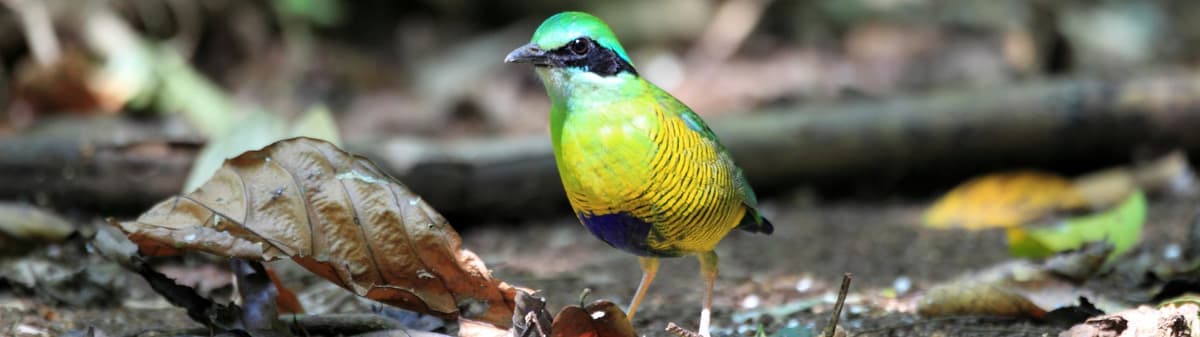
The Bar-bellied Pitta shows clear sexual dimorphism, meaning males and females have different colors. The male is more colorful, with a bright aquamarine-blue crown, a black facial mask, green upperparts, and a yellow belly with bold black bars. A small violet-blue patch in the middle of the belly is another distinctive feature.

The male has a bright turquoise crown.
The female has softer, more muted colors. Her crown is pale rufous-brown instead of blue, the facial mask is less clear, and the belly shows lighter barring without the purple-blue patch. These duller tones help the female blend into the forest floor and stay hidden among leaf litter.
Habitat and Distribution of the Bar-bellied Pitta.
Habitat of the Bar-bellied Pitta
The Bar-bellied Pitta mainly lives in humid lowland tropical forests across mainland Southeast Asia. It is often found in primary rainforest, evergreen forest, and semi-evergreen forest with dense undergrowth, bamboo thickets, and thick leaf litter. These habitats give the bird good shelter and plenty of food on the forest floor.
The species can also live in secondary forest or lightly disturbed woodland if the ground vegetation stays dense. It prefers moist areas, especially near streams, small rivers, or shaded valleys where insects and earthworms are common. It usually occurs from sea level to about 800 meters, with most records below 600 - 700 meters.
Global Distribution
The global distribution of the Bar-bellied Pitta is relatively limited. The Bar-bellied Pitta is considered one of the Indochina endemic birds, meaning its natural range is largely restricted to mainland Southeast Asia. The species has been recorded in only 4 countries: Cambodia, Laos, eastern and southeastern Thailand, and Vietnam. There are no confirmed records from nearby countries such as Myanmar or Malaysia, making its distribution quite narrow compared with many other tropical birds.
Distribution in Vietnam
Within Vietnam, the Bar-bellied Pitta is mainly found from the north-central region to the south. The species is especially common in forests of southeastern Vietnam near the Cambodian border. It has been recorded in Dong Nai, Binh Phuoc, Hue, Ha Tinh and Quang Tri Province.
Distribution of the Bar-bellied Pitta in Cat Tien National Park
Cat Tien National Park is one of the best places to see the Bar-bellied Pitta in Vietnam. For many visitors interested in Cat Tien birding, the park’s humid lowland forest, dense understory, and deep leaf litter create ideal habitat for this ground-dwelling bird.
Inside the park, the species is often found in quiet areas with thick vegetation, especially near small streams, forest rivers, and shaded forest trails. Some of the best bird watching hotspots are around the park headquarters and along the route to Crocodile Lake, where many Nam Cat Tien wildlife observations are recorded.
A good way to watch this bird is at licensed feeding stations with bird hides. These managed sites allow birdwatchers and photographers to wait quietly and observe the Bar-bellied Pitta at close range.
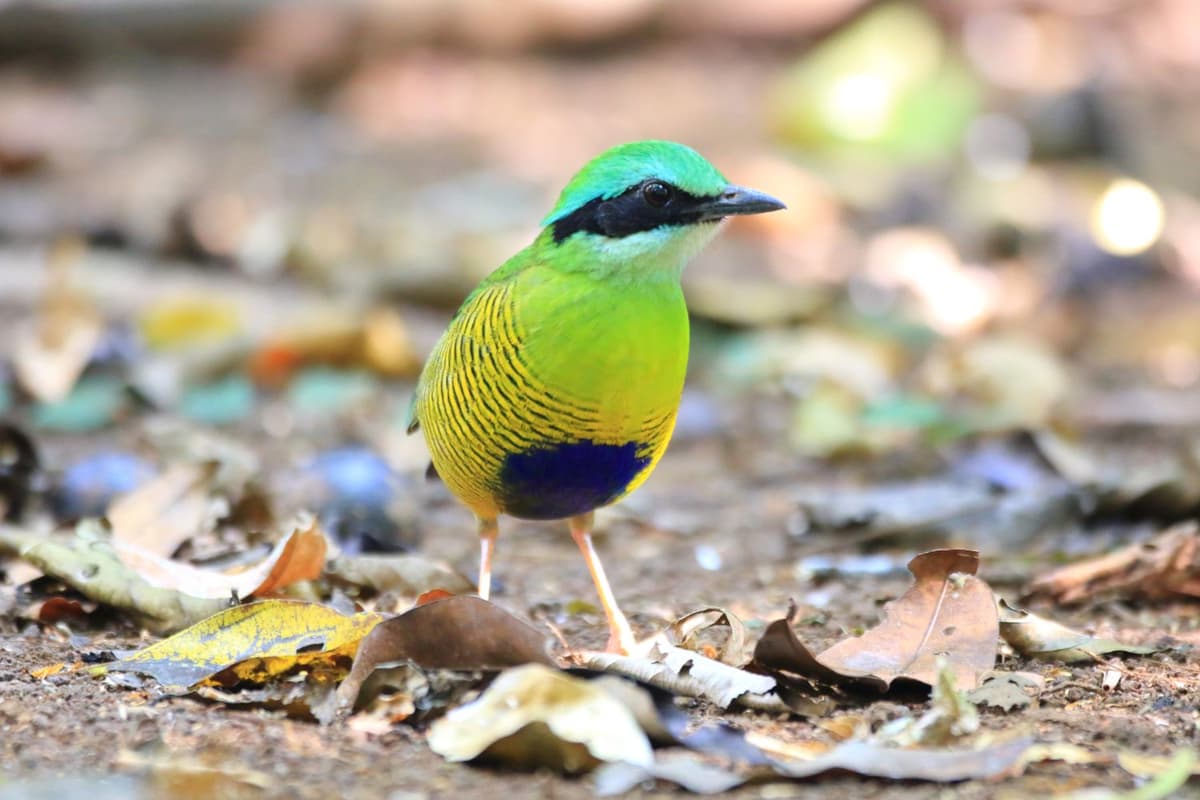
Because of its colorful appearance, the Bar-bellied Pitta attracts birdwatchers in Cat Tien National Park.
Diet and Foraging Habits of the Bar-bellied Pitta
The Bar-bellied Pitta diet mainly consists of small invertebrates found on the forest floor. This bird eats earthworms, especially during the wet season when the soil is moist and rich in prey. The species also feeds on many types of insects and larvae, including termites, caterpillars, beetles, and ants, snails, slugs, spiders, centipedes, and millipedes that live among fallen leaves and damp soil. By eating these animals, the bird helps control their numbers and keeps the forest food web balanced.
The foraging behavior of Bar-bellied Pitta is closely linked to life on the ground. This bird spends much of its time searching for food among thick leaf litter and low vegetation. It usually moves with quick hops across the forest floor, occasionally stopping to flip over leaves or probe into soft soil with its bill to uncover hidden prey. Such feeding activity often takes place in humid areas with abundant leaf litter, where small invertebrates are easy to find.
The species also supports nutrient cycling in tropical forests. While searching for food, it flips leaves and disturbs the soil on the forest floor. This activity helps organic material break down faster and returns nutrients to the soil.
Behavior of the Bar-bellied Pitta
The Bar-bellied Pitta is a terrestrial bird that is active during the daytime, especially in the early morning and late afternoon. It spends most of its time on the forest floor, moving with quick hops through fallen leaves and low plants instead of flying long distances. When it stops, it often stands upright and looks around carefully.
For most of the year, this bird lives alone. A male and female usually stay together only during the breeding season. It is known as a shy and elusive species, so it can be hard to see in the wild. When it senses danger, it usually slips quietly into thick vegetation and may give a short alarm call before hiding.
The Bar-bellied Pitta bird calls are often the best way to find this species in tropical forests. Its vocalization is usually heard from hidden places near the ground or from low branches. The main song is a short three-note phrase, often written as “chowee-wu,” “chawee-wu,” or “tu-wi-whil.” This call can travel far through the forest and plays an important role in territorial defense and attracting a mate.

People often hear the song of the Bar-bellied Pitta before they see the bird.
Besides its main song, the bird also makes several other sounds. Alarm calls are short and sharp, sometimes described as “skew,” “jeeow,” or “jow.” These calls sound like a quick whistle. The bird can also produce softer sounds when communicating at close range, such as gentle “coo”-like notes near the nest. During the breeding season, the birds call more often, which helps birdwatchers locate them even when they remain hidden in the forest understory.
Breeding and Life Cycle
Breeding Season
The Bar-bellied Pitta breeding season usually begins at the start of the rainy season in Indochina, often from April to July or May to August. During this time, the forest becomes wetter and food such as earthworms and insects becomes easier to find. This helps the birds raise their young successfully. In the dry months, from about December to April, breeding activity is less common because food is not as abundant.
Courtship and territorial behavior
Most of the year, these birds live alone. During the breeding season, however, a male and female form a temporary pair. The male may perform simple courtship displays to attract a mate. These displays can include small hops, gentle wing fluttering, and raising the head to show the bright blue crown. After pairing, the two birds protect their nesting area and use loud calls to warn other birds to stay away.
Nest and eggs
The Bar-bellied Pitta nest is usually placed on or very close to the forest floor, concealed beneath thick leaf litter, dense shrubs, or low vegetation that provides natural camouflage. According to observations of the nesting habits of Hydrornis elliotii, the structure is built from dry leaves, small twigs, roots, and surrounding forest debris. It often forms a rounded or dome-like shape with a side entrance, similar to nests of other pittas. A typical clutch contains 3 - 5 Pitta bird eggs. These eggs are usually light cream in color with small brown or dark spots.
Incubation and chick development
Both parents help incubate the eggs, which usually takes about 16 - 18 days. When the chicks hatch, they are blind and have no feathers, so they depend completely on their parents. The adults bring food such as insects and earthworms to the nest many times each day. The chicks stay in the nest for about 2 - 3 weeks before they are ready to leave.
Life cycle overview
The Bar-bellied Pitta life cycle continues after the chicks leave the nest. Young birds slowly learn how to find food on the forest floor and become independent after several weeks. They usually reach breeding age after 1 or 2 years. In the wild, birds in this group may live about 6 to 8 years. Under good conditions, a pair may raise more than one brood in a year, but many pairs produce only one brood during the main breeding season.
Threats and Conservation
Conservation Status of Bar-bellied Pitta
The Bar-bellied Pitta conservation status is currently listed as Least Concern (LC) by the International Union for Conservation of Nature. According to the IUCN Red List Bar-bellied Pitta assessment on the IUCN Red List, the species has a wide distribution across mainland Southeast Asia, with an estimated range of about 940,000 square kilometers. In several protected areas, local populations are still considered relatively stable.
Threats to the Bar-bellied Pitta
The main threats to the Bar-bellied Pitta are linked to habitat loss and forest degradation. Lowland tropical forests across Indochina are being reduced by logging, farming, road building, and hydropower projects. In many areas, forests are cleared for crops such as rubber or coffee. This causes deforestation and habitat fragmentation, making it harder for the bird to find safe feeding and breeding areas.
In some places, the species may also be affected by poaching and the illegal bird trade, although it is not targeted as heavily as some other pitta species. Climate change may bring further risks by changing rainfall patterns, which can affect food availability and breeding success.
Natural predators such as snakes, hawks, owls, civets, and weasels may also threaten this bird, especially eggs and young chicks.
The Bar-bellied Pitta Conservation
Protected areas are very important for the survival of this species. One of the best-known locations is Cat Tien National Park, where the bird is regularly observed within a well-preserved forest ecosystem. Other sites such as Bu Gia Map National Park and Binh Chau - Phuoc Buu Nature Reserve also protect suitable habitats for the species.
At a broader level, organizations such as BirdLife International and the International Union for Conservation of Nature continue to monitor the species and promote habitat protection. Protecting lowland tropical forests remains the most important step to ensure the long-term survival of the Bar-bellied Pitta and many other forest birds in Southeast Asia.
Birdwatching and Photography Tips: How to Spot the Bar-bellied Pitta
Birdwatching and photographing the Bar-bellied Pitta is a rewarding experience, but it takes patience. This bird has bright plumage, yet it is hard to spot because it often stays in dense, shady forest and blends into the leaf litter.
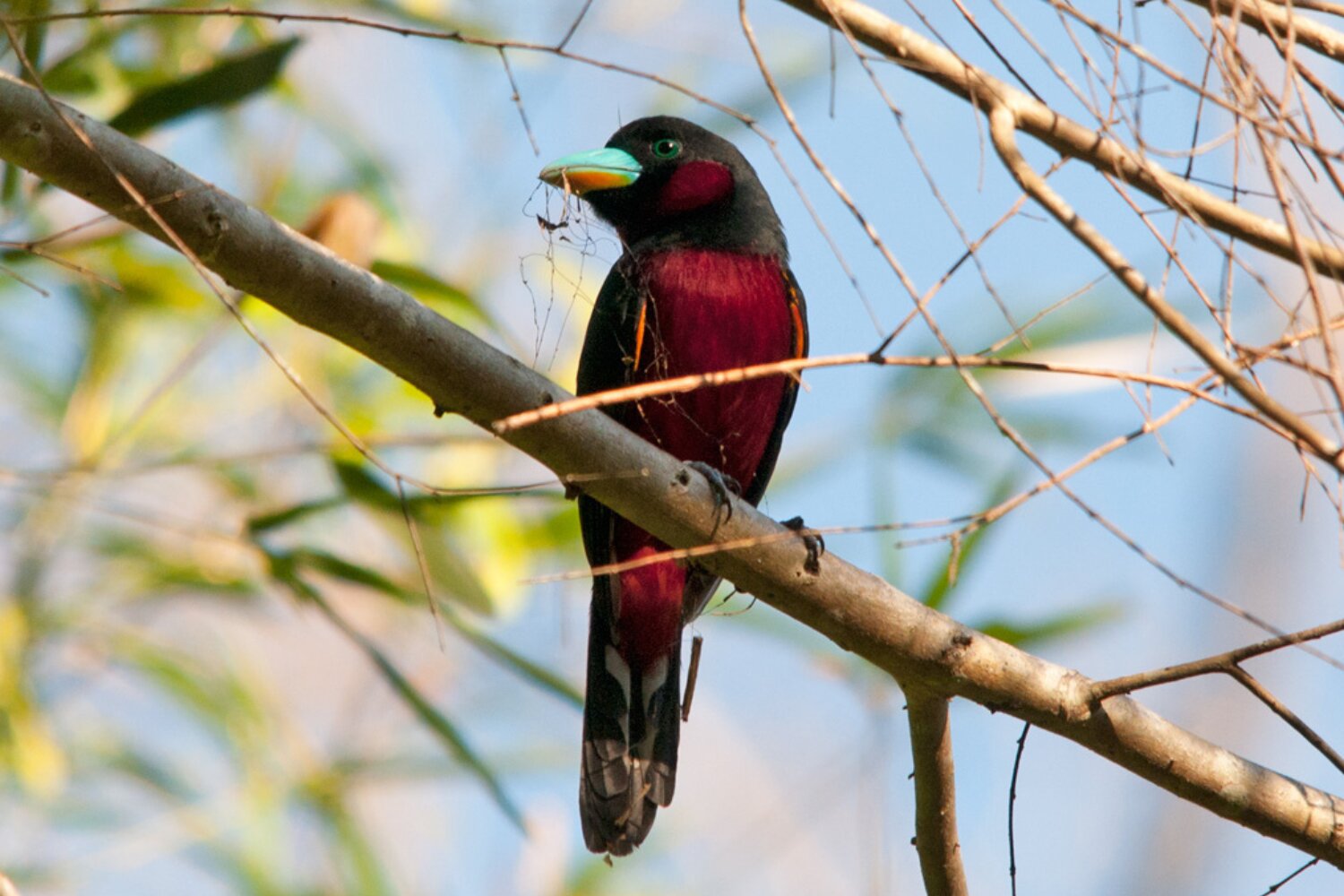
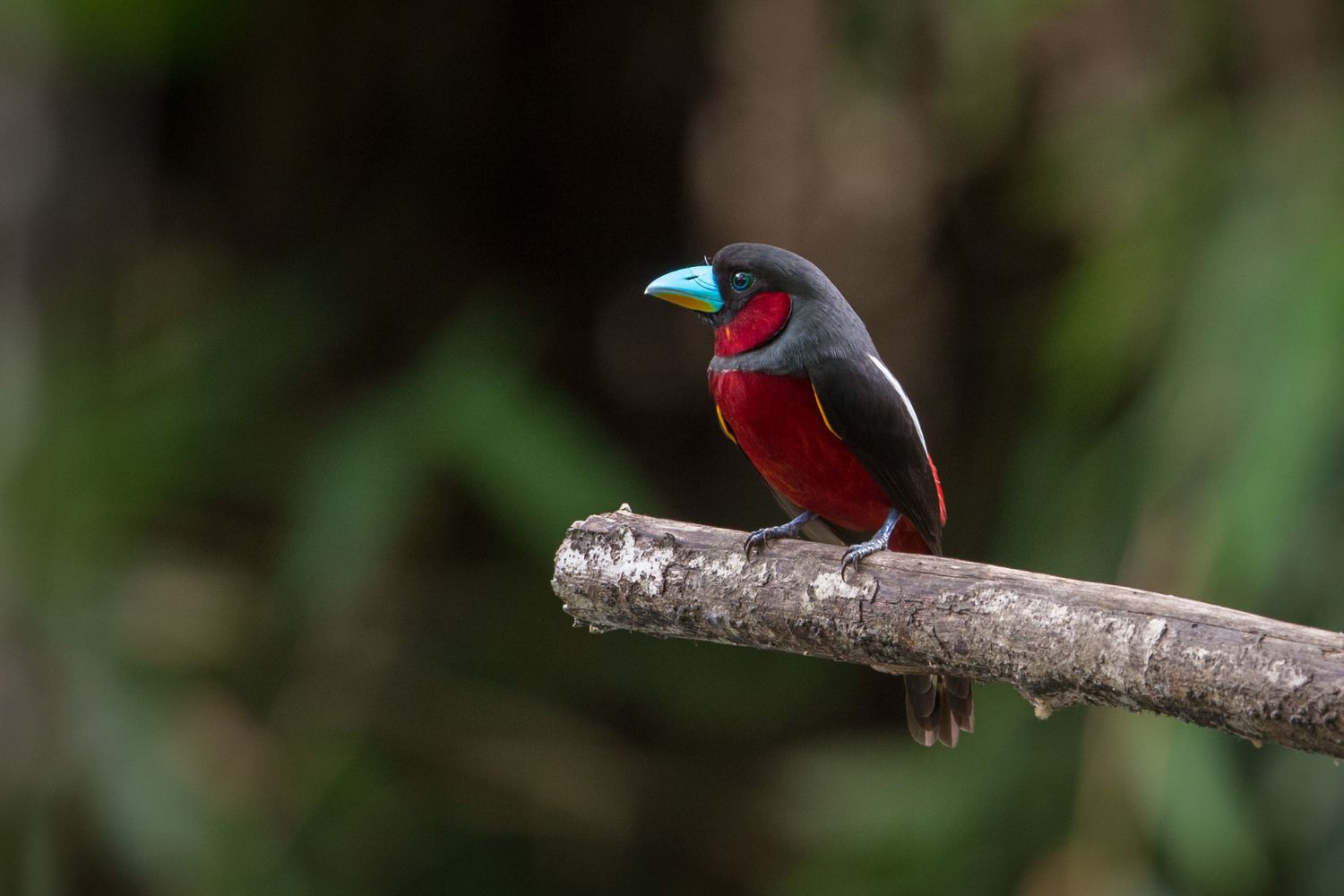
In Vietnam, Cat Tien National Park is one of the most reliable birdwatching hotspots for this species. The park is also a top birding destination in southern Vietnam, with more than 350–400 recorded bird species. Besides the Bar-bellied Pitta, visitors may also see the Blue-rumped Pitta, Black-and-red Broadbill, Banded Broadbill, and Orange-breasted Trogon. For the best experience, you can contact the park or local guides for updated birding information.
Tips for birdwatching and photography at Cat Tien National Park:
- Best season: December to May, when trails are drier and forest light is better.
- Best time: Early morning and late afternoon.
- Where to look: Moist forest floor near streams, shaded trails, and areas with deep leaf litter.
- Trail patience: Walk slowly, stay quiet, and wait carefully, as the bird may appear only for a short time
- Bird photography gear: A camera with good high-ISO performance is useful for low-light photography in the forest.
- Telephoto lens: A 300 - 600 mm telephoto lens helps you photograph the bird from a safe distance.
- Camouflage hide/blind: A camouflage hide/blind can help photographers stay hidden and avoid disturbing the bird.
- Flash ethics: Avoid strong flash, especially at close range, because it can stress wildlife
- Playback calls: Do not overuse playback calls. Repeated calls can disturb the bird’s natural behavior.
- Respect wildlife: Keep quiet, stay on marked trails, and always follow park regulations.

Every year, Cat Tien National Park attracts many birdwatchers because it is home to many beautiful bird species.
Interesting Facts About the Bar-bellied Pitta
1. The male Bar-bellied Pitta has a bright aquamarine crown and a bluish-purple belly that can briefly shine when it moves, even in the dim light of the forest.
2. The alarm call of the Bar-bellied Pitta is a loud “queeow” or “jow,” similar to a short siren that carries far through the forest.
3. The scientific genus name of the Bar-bellied Pitta, Hydrornis, comes from Greek words meaning “water bird.” This is interesting because pittas actually live on the forest floor, not near water.
4. When the Bar-bellied Pitta feels alert, it often stands upright and slightly flicks its tail. This posture helps birds in the Pittidae watch their surroundings while moving through the forest understory.
5. While foraging, the Bar-bellied Pitta digs through leaf litter, helping recycle nutrients and control insect populations in the forest.
Reference
- BirdLife International. (2016). Hydrornis elliotii. The IUCN Red List of Threatened Species 2016: e.T22698625A93693122. https://doi.org/10.2305/IUCN.UK.2016-3.RLTS.T22698625A93693122.en
- Erritzoe, J. (2020). Bar-bellied pitta (Hydrornis elliotii), version 1.0. In J. del Hoyo, A. Elliott, J. Sargatal, D. A. Christie, & E. de Juana (Eds.), Birds of the world. Cornell Lab of Ornithology. https://doi.org/10.2173/bow.babpit1.01
- Farrell, P. A., Round, P. D., & Limparungpatthanakij, W. (2025). The status of Bar-bellied Pitta Hydrornis elliotii in Thailand. Forktail, 41, 1–5. https://www.researchgate.net/publication/393750797_The_status_of_Bar-bellied_Pitta_Hydrornis_elliotii_in_Thailand
- Nguyen, T. T., Nguyen, T. H., & Le, T. T. (2014). Breeding biology and life history traits of three pitta species in southern Vietnam [Conference presentation abstract]. ResearchGate. https://doi.org/10.13140/RG.2.2.18208.38402
- Robson, C. (2018). Birds of Vietnam. Lynx Edicions.
- BirdLife International. (n.d.). Bar-bellied Pitta Hydrornis elliotii . BirdLife Data Zone. Retrieved March 7, 2026, from https://datazone.birdlife.org/species/factsheet/bar-bellied-pitta-hydrornis-elliotii
- Cornell Lab of Ornithology. (n.d.). Bar-bellied Pitta - eBird. eBird. Retrieved March 7, 2026, from https://ebird.org/species/babpit1
- Erritzoe, J. (2020). Bar-bellied pitta (Hydrornis elliotii), version 1.0. In Birds of the world. Cornell Lab of Ornithology. https://doi.org/10.2173/bow.babpit1.01
- Animalia.bio. (n.d.). Bar-bellied pitta - Facts, diet, habitat & pictures. Retrieved March 7, 2026, from https://animalia.bio/bar-bellied-pitta?taxonomy=2626