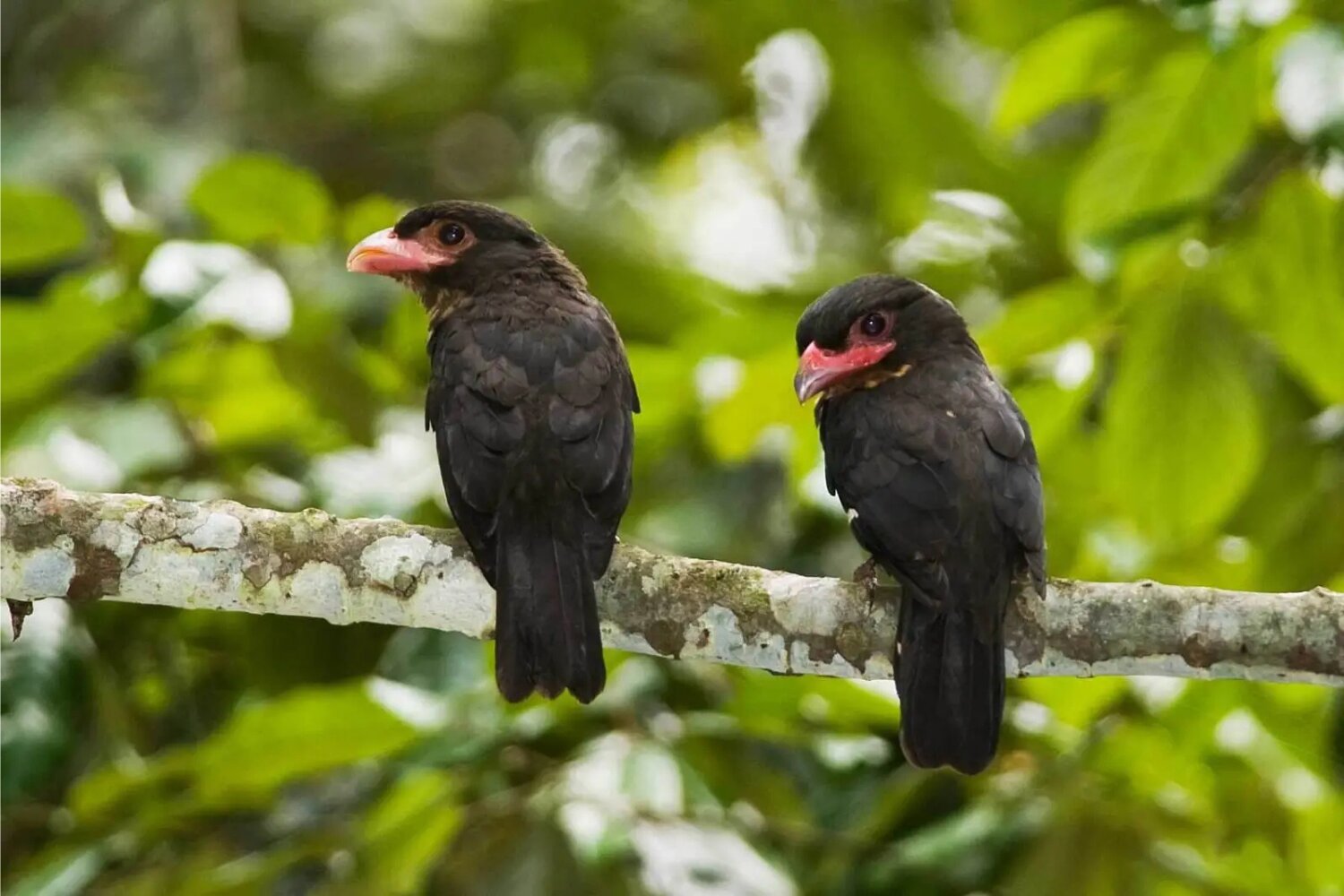
Hidden within the lowland forests of Cat Tien National Park is one of Southeast Asia’s richest birdwatching destinations. From colourful pittas moving quietly through the leaf litter to enormous hornbills soaring above the canopy, the park is home to hundreds of bird species - including some of the rarest and most remarkable birds in Vietnam.
Thanks to its mix of evergreen forest, bamboo thickets, wetlands and open grasslands, Cat Tien provides habitat for an extraordinary diversity of wildlife. For birdwatchers, photographers and nature lovers alike, every trail offers the chance to encounter species found nowhere else on Earth, alongside some of Asia’s most iconic forest birds.
In part 1 of this series, we will explore 10 stunning rare birds to spot in Cat Tien National Park from elusive ground dwellers to spectacular canopy residents, and where you may be lucky enough to encounter them in the wild.
Orange-necked partridge (Arborophila davidi)
The orange-necked partridge is among the most remarkable residents of Cat Tien National Park. Distinguished by its intricate head and neck pattern, this colorful, ground-dwelling partridge is a near threatened species endemic to Southern Vietnam and Eastern Cambodia. They can often be found in lowland broadleaved evergreen and semi-evergreen forests, often in areas with dense bamboo and plantations, ideally below 250 meters.
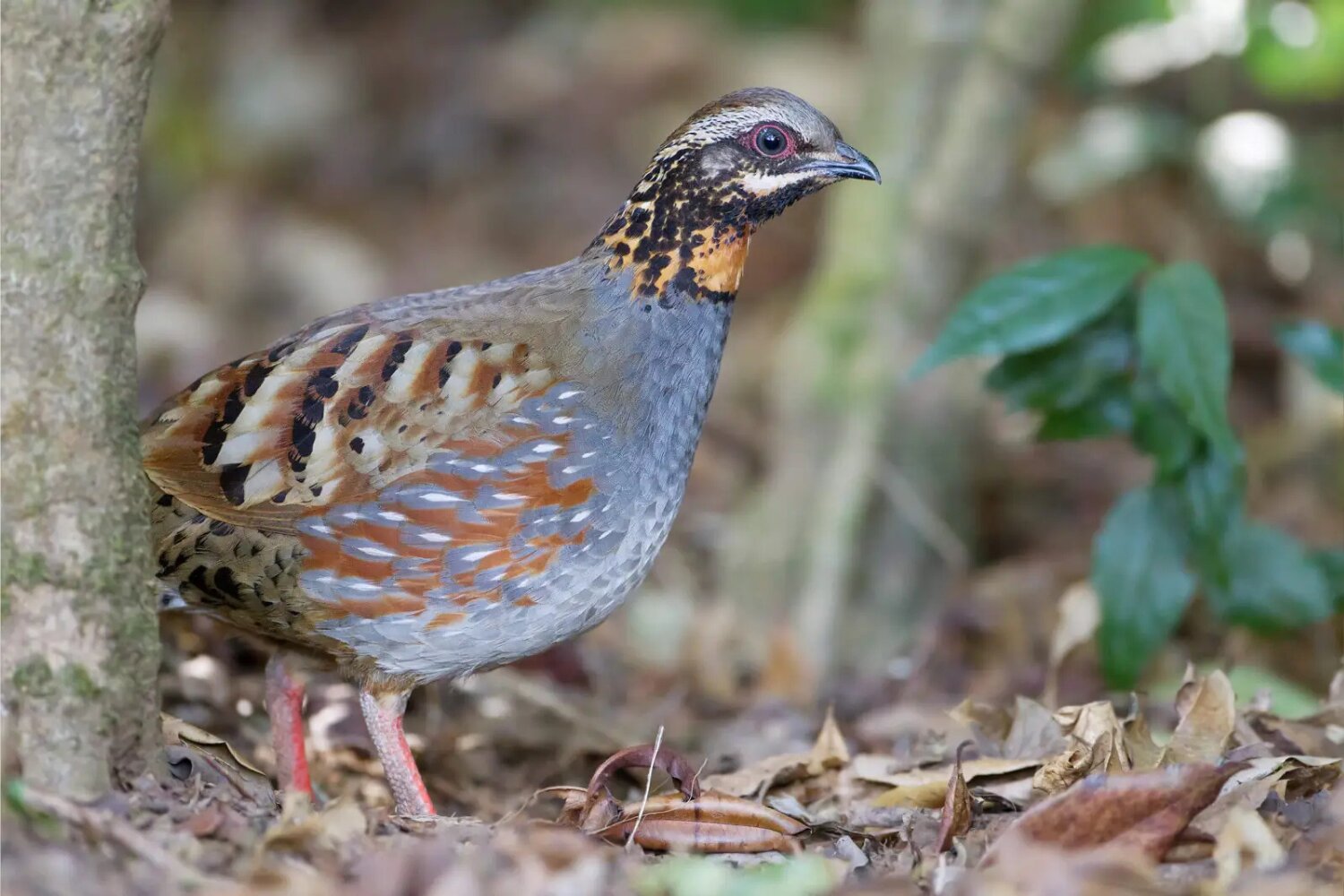
The orange-necked partridge appeared on Vietnam’s national postage stamp in 2000.
Adult orange-necked partridges often show a bold combination of black lores and an eye-stripe that extends along the neck to form a dark band, contrasting with a warm orange throat and hindneck. However, this orange tone can appear quite faint and can be difficult to spot in the dim light of dense forest understory. While their upperparts and breast are brown, their flanks are strikingly barred in black and white. As a shy species, they are more often detected by their voice: gentle, ascending series of whistles drifting through the undergrowth.
The orange-necked partridge is most often encountered in the quieter lowland forests of Cat Tien National Park, particularly along dense forest trails with thick bamboo understory. Birdwatchers occasionally hear their soft whistling calls in the early morning around the park’s interior forest routes, including areas near Heaven Rapids and along less-disturbed sections of the trekking trails leading deeper into the semi-evergreen forest. Because they are shy and spend most of their time on the forest floor, sightings are usually brief and require patience and quiet observation.
Measured around 27 cm in length and weighs roughly 240 grams, the orange-necked partridge has earned a place in Vietnam’s cultural identity, even appearing on a national postage stamp in the year 2000. Its limited range and ongoing habitat loss make it one of the more special birds to look out for in Cat Tien. For birdwatchers in Cat Tien, it represents both a rewarding sighting and a reminder of the region’s unique and fragile biodiversity.
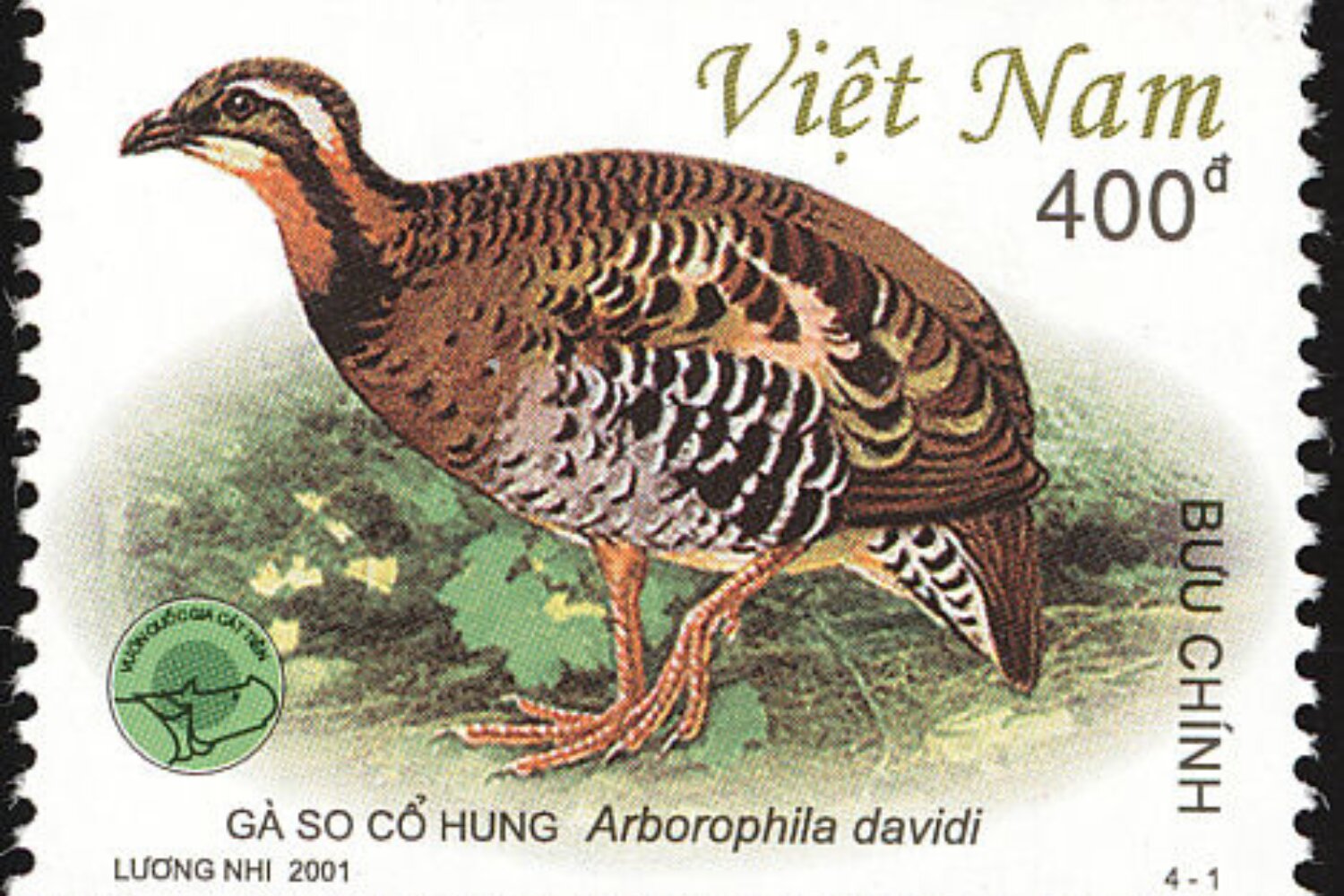
The orange-necked partridge on Vietnam’s postage stamp in 2000.
Bar-bellied pitta (Hydrornis elliotii)
A true gem of the forest floor, the Bar-bellied Pitta brings a burst of color to the shaded understory of Cat Tien National Park.
The male bar-bellied pitta is especially eye-catching. They usually have a pale blue-green head marked by a bold black mask stretching from the lores to the nape. Their upper breast is green, contrasting with a yellow belly finely barred black with a deep blue patch on the abdomen. On the other hand, females share a similar pattern but appear duller overall, with a buffy cinnamon crown and collar, and lacking the male’s deep blue abdominal patch. However, both males and females have wings that are often soft, sage green and their short tail shows a rich blue tone.
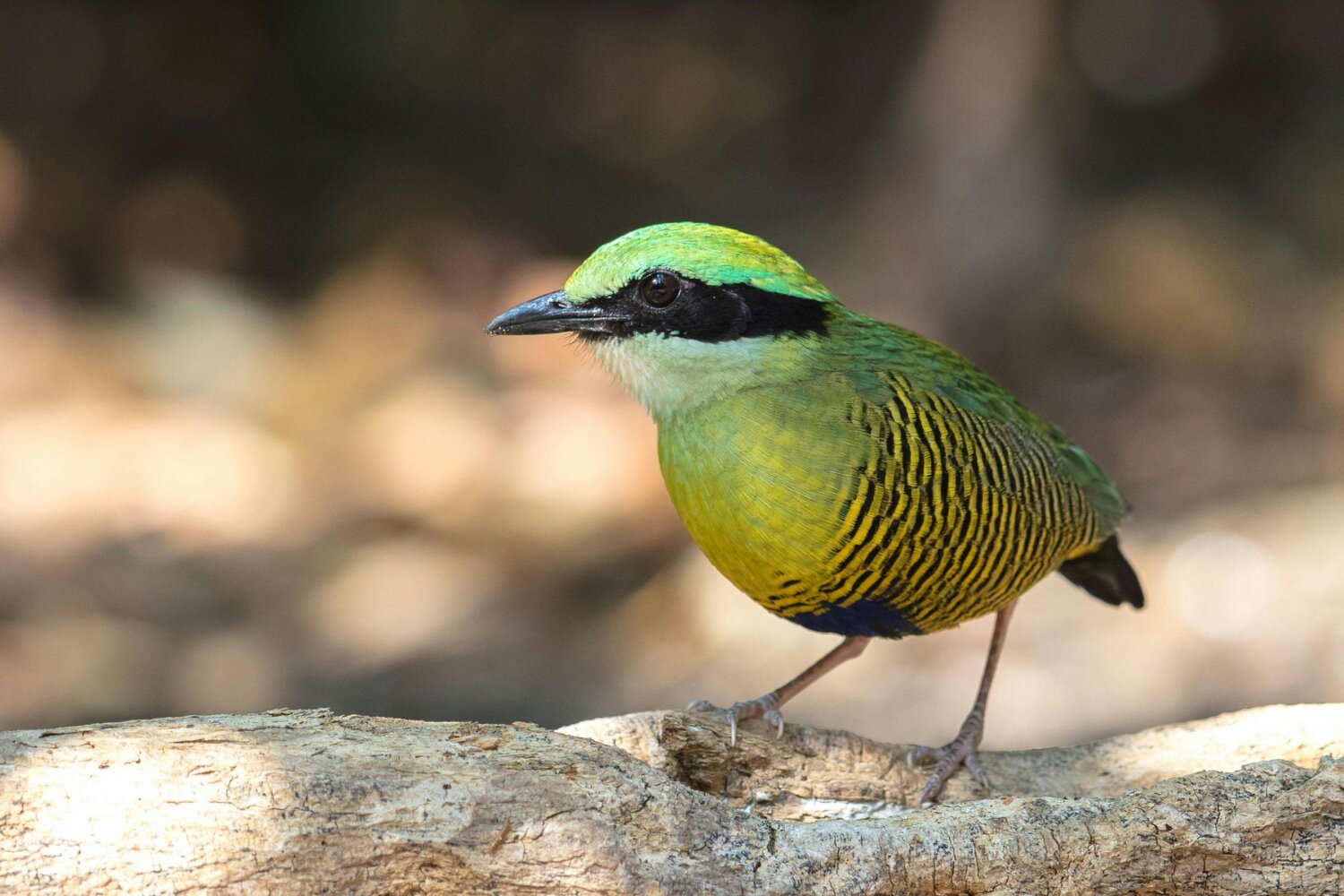
The bar-bellied pitta is a burst of colours under the forest canopy
Widespread and locally common across Vietnam, the bar-bellied pitta is primarily a lowland species, typically found below 800m. It inhabits a variety of forest types, including broadleaved evergreen, semi-evergreen, mixed deciduous forests and bamboo stands. Like many pittas, it spends most of its time on the ground, quietly foraging through leaf litter for worms, snails and other small invertebrates.
The bar-bellied pitta is regularly found in the shaded lowland forests of Cat Tien National Park, particularly in areas with dense leaf litter and thick understory vegetation. Birdwatchers often hear its distinctive three-note whistle along forest trails near the park headquarters, the Botanical Garden Trail and quieter sections of the routes leading toward Heaven Rapids. Early mornings during the dry season are usually the best time to detect this elusive species, as it quietly forages on the forest floor beneath bamboo and semi-evergreen forest cover.
Green Peafowl (Pavo muticus)
The Green Peafowl, one of the most iconic yet endangered species found in Cat Tien National Park. Once widespread across Southeast Asia, it is now scarce and largely restricted to remote areas, making any encounter in the wild especially memorable.
Both males and females share an iridescent green neck, breast, and back, complemented by dark wings and a distinctive upright crest. However, the male is unmistakable. It carries an extraordinary train of elongated upper tail coverts - reaching up to 1.5-2 meters - decorated with shimmering eyespots. When walking, this train is often held in a tight bundle, but during courtship it’s raised into the classic, eye-studded fan. Females, by contrast, lack these long plumes, having a much shorter tail, though they still retain a subtle green iridescence.
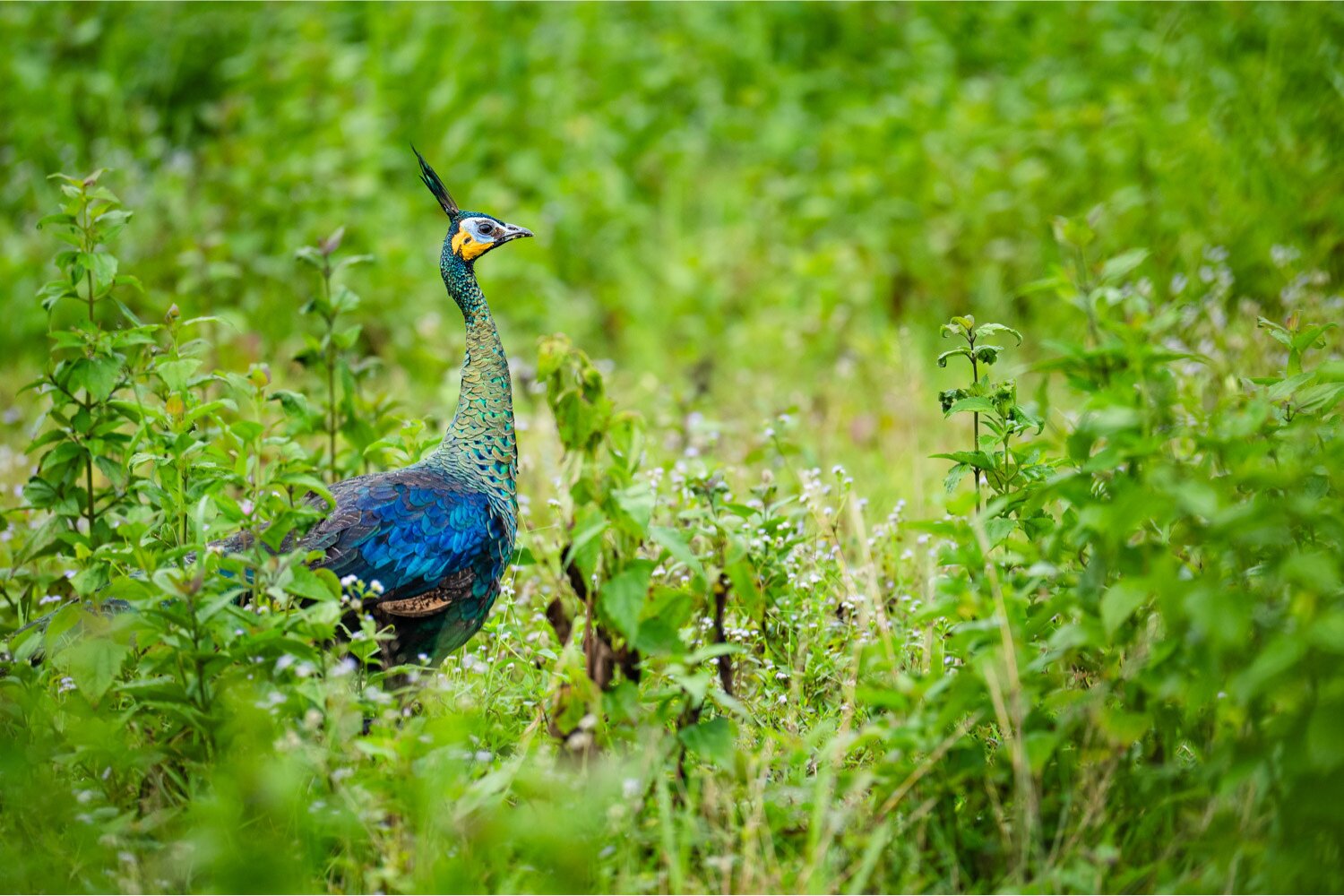
Classified as Endangered, the Green Peafowl faces ongoing threats from habitat loss and hunting.
Green Peafowl are typically seen in small groups, solitary males, or females with young. favouring open scrub, grasslands, and forest edges - often near water. Despite their size, they can be surprisingly wary.
They’re most often encountered in Cat Tien’s open grasslands, forest edges and wetland areas, particularly in quieter zones with nearby water sources. Some of the best chances to spot them are around the Dak Lua grasslands and along the routes leading toward Bau Sau, especially during the early morning or late afternoon when they emerge to forage. Their loud, trumpet-like calls can often be heard echoing across open habitats before the birds themselves are seen, making sound an important clue when searching for this elusive species.
Now classified as Endangered, the Green Peafowl faces ongoing threats from habitat loss and hunting. Till now, it remains one of the most impressive birds in the region - both a symbol of Southeast Asia’s rich biodiversity and a reminder of the importance of its conservation.
Greater Racket-tailed Drongo (Dicrurus paradiseus)
With a glossy blue-black plumage, vivid red eyes, and a distinctive backward curving crest, the Greater Racket-tailed Drongo carries an unmistakable presence in the forest. However, the Greater Racket-tailed Drongo’s most remarkable feature is its forked tail. Its tail split into two elongated outer feathers that extend into racket-shaped tips, sometimes appearing like delicate wires trailing behind it in flight.
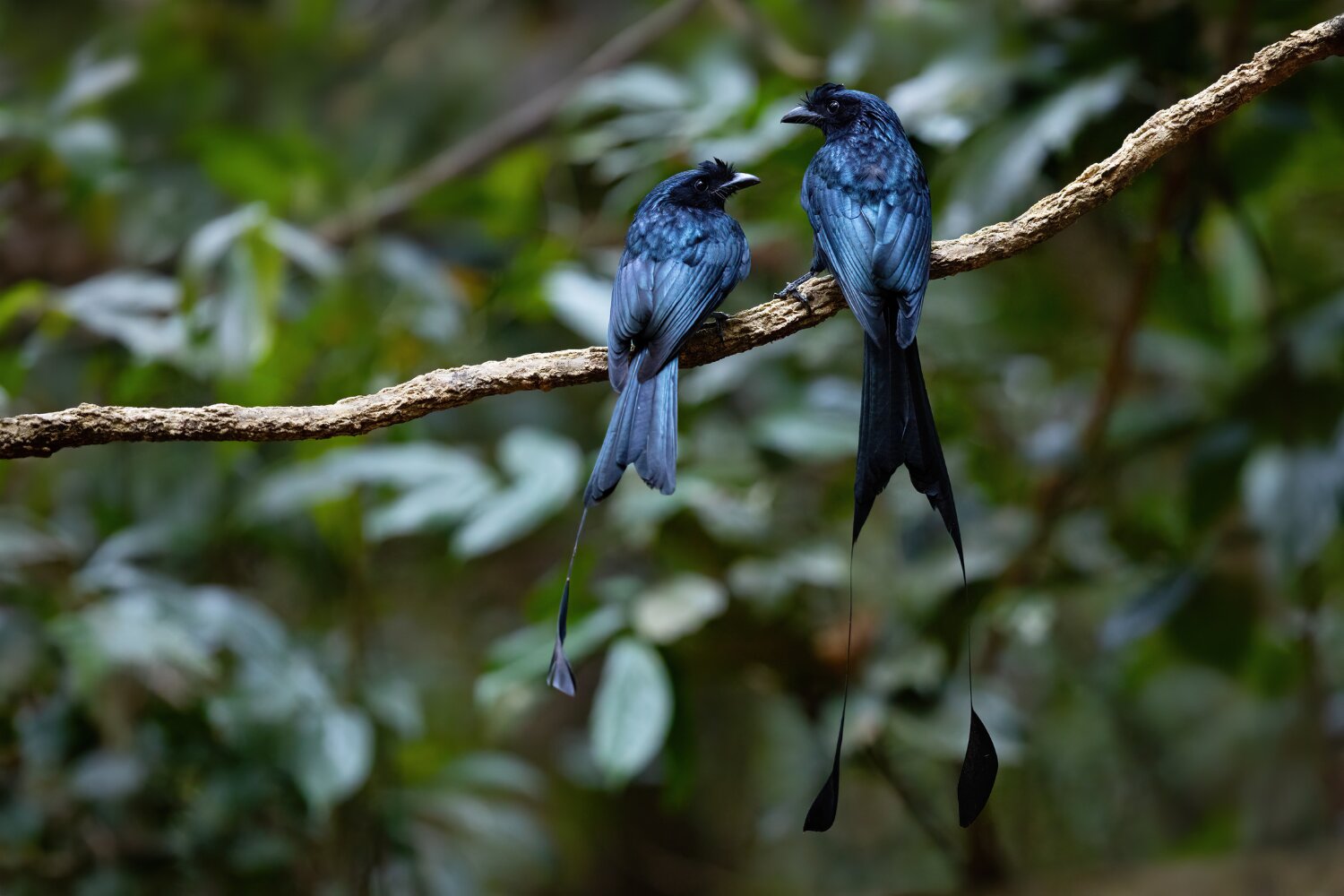
The Greater racket-tailed Drongo is an intelligent bird and can imitate the sounds of other birds.
Like its appearance would suggest, the Greater Racket-tailed Drongo is an active and skilled hunter. It’s also an intelligent bird and can produce a wide range of calls from harsh, mechanical sounds to impressively accurate imitations of other bird species.
Juvenile birds are noticeably duller and may lack the long tail streamer, making them less conspicuous than adult birds. Even so, their upright posture, notched tail and the subtle crest still hint at the elegance they’ll grow into.
The Greater Racket-tailed Drongo is commonly seen throughout the forests of Cat Tien National Park, especially along shaded trails and forest edges where mixed bird flocks move through the canopy. Birdwatchers frequently encounter them near the park headquarters, the Botanical Garden Trail and along the route to Heaven Rapids, where they perch conspicuously on exposed branches before darting out to catch insects in mid-air.
Although relatively common and currently listed as Least Concern, the Greater racket-tailed drongo remains a favourite among birdwatchers for its dramatic appearance, intelligence and constant activity - an unmistakable highlight of any visit to Cat Tien.
Black-and-red Broadbill (Cymbirhynchus macrorhynchos)
Bright, bold, and unmistakable, the Black-and-red Broadbill is one of the most striking birds you can encounter in Cat Tien National Park. With its vivid crimson underparts - spanning the belly, vent, throat, and rump - contrasted against deep black upperparts, it stands out even in the dense greenery of the forest.
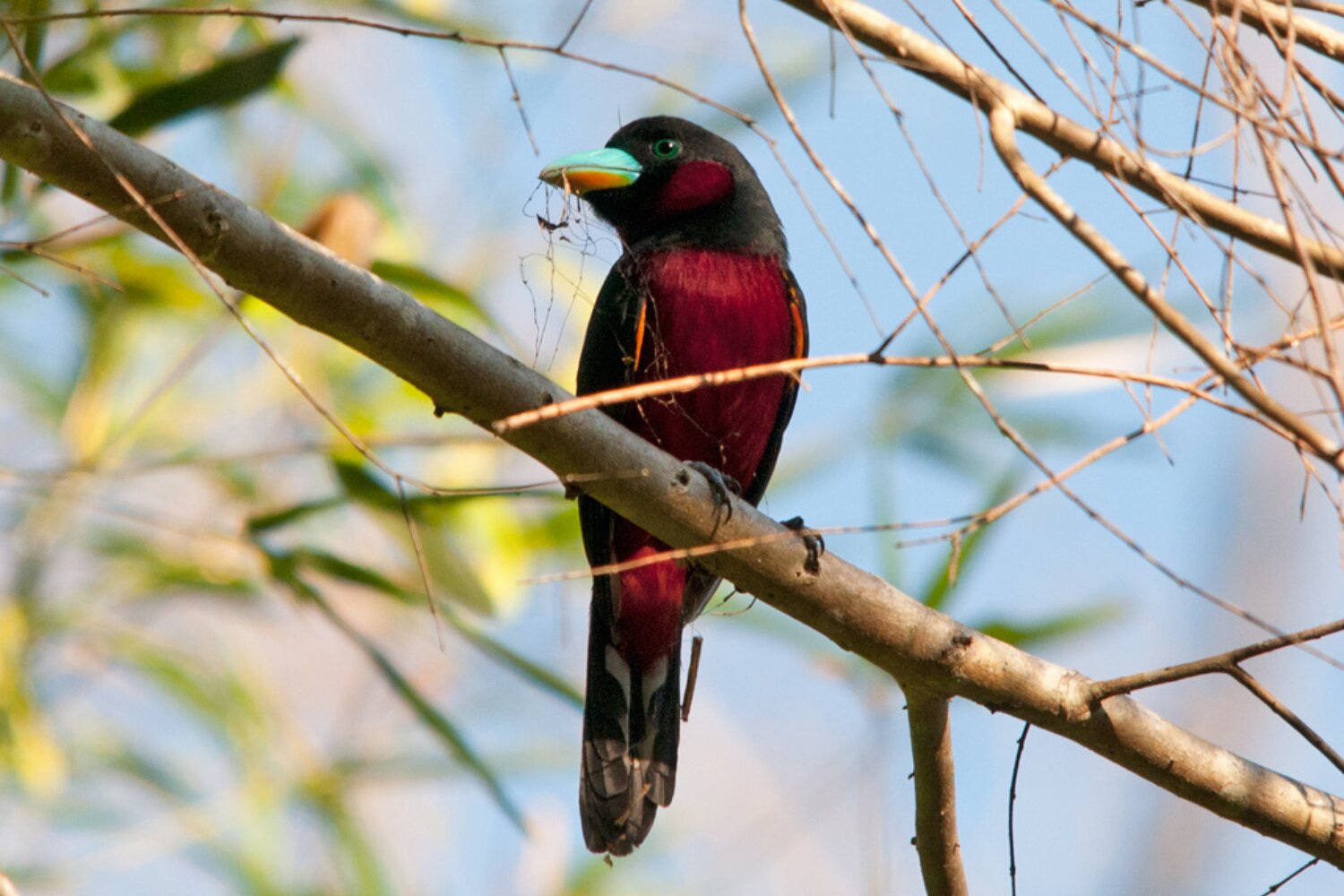
Black-and-red broadbill’s most striking feature is its bulbous blue with hints of orange bill.
The bird’s distinctive features include a black crown and upper breast band extending to the hindneck, as well as black wings and tail marked with fine white streaks. Its most eye-catching trait, however, is its large, bulbous bill, glowing in shades of powder blue with hints of orange and greenish-yellow - giving it an almost unreal, painted appearance.
In southern Vietnam, this species is a local resident, typically found in pairs or small groups. It favours forest edges and areas near water, including lowland broadleaved evergreen and semi-evergreen forests, as well as secondary growth and swamp forests.
Despite its vibrant colors, its voice is less charming - a series of nasal, mechanical rasps that contrast sharply with its beauty. Measuring around 20 - 24 cm in length, this species is a favourite among birdwatchers, offering both visual drama and fascinating behaviour along the waterways of Cat Tien.
Throughout Cat Tien National Park, the Black-and-red Broadbill is most often found near rivers, streams and wet forest edges. Birdwatchers regularly spot them along the Dong Nai River, around swampy forest sections near Bau Sau, and beside shaded waterways where overhanging branches provide ideal nesting sites. They are usually seen perched quietly above the water in pairs or small groups. True to its habitat, the Black-and-red Broadbill builds a large, messy nest of leaves that hangs conspicuously over water - especially notice-able during the breeding season.
Green-billed Malkoha (Phaenicophaeus tristis)
With its long, elegant tail and subtle yet distinctive features, the Green-billed Malkoha is a fascinating resident of Cat Tien National Park. Measuring around 55 cm in length, this large, grey bird is easily recognized by its very long tail tipped in white, pale breast, and grey (rather than brown) underparts.
Its bare facial skin is a deep red, outlined by a thin white border, and paired with a pale greenish-yellow bill that gives the species its name. A subtle dark green gloss can often be seen on the wings and tail, adding to its understated beauty. The overall appearance is softer and paler around the head and breast, with dark, watchful eyes.
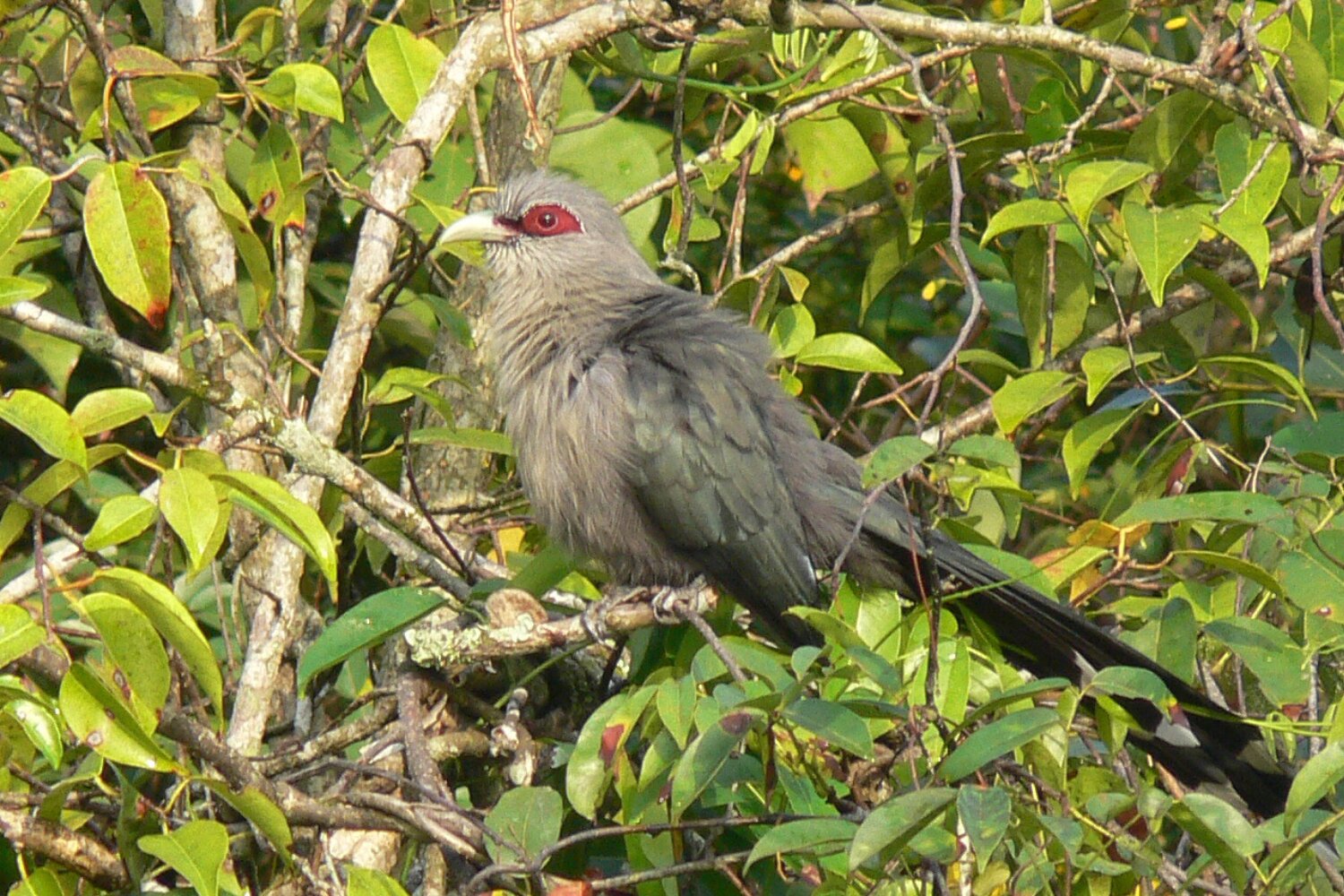
Green-billed Malkoha is often found creeping along branches like a squirrel.
Widespread and common across Vietnam, the Green-billed Malkoha inhabits a variety of environments, including lowland and foothill forests, forest edges, dense scrub, and even cultivated areas such as orchards and plantations. It’s also found in bamboo groves and coastal habitats across Southeast Asia.
Unlike many more conspicuous birds, this species moves quietly and deliberately through dense foliage, often described as creeping along branches like a squirrel. It forages for large insects and other small prey around tree trunks and within thick vegetation, rarely venturing into the open.
Its voice is just as unusual as its behaviour - consisting of a series of low, amphibian-like clucks and croaks that can be surprisingly difficult to trace back to the bird itself.
The Green-billed Malkoha is usually found in dense vegetation along forest edges, bamboo thickets and secondary forest throughout Cat Tien National Park. It is often encountered quietly moving through mid-level foliage along trails near the park headquarters, the Botanical Garden area and more lightly disturbed forest sections bordering grasslands or plantations. Because of its secretive behaviour, birdwatchers are more likely to notice its slow, squirrel-like movements through tangled branches or hear its low croaking calls before getting a clear view.
Although listed as Least Concern, the Green-billed Malkoha remains a rewarding find for those patient enough to spot its slow, secretive movements in the forest.
The Great Hornbill (Buceros bicornis)
One of the most spectacular birds of Cat Tien National Park, the Great Hornbill is impossible to overlook. Towering at up to 1.3 meters in length with a wingspan of around 1.5 meters, this massive bird is best known for its enormous yellow bill topped with a prominent casque - an iconic structure that gives the hornbill its unmistakable profile.
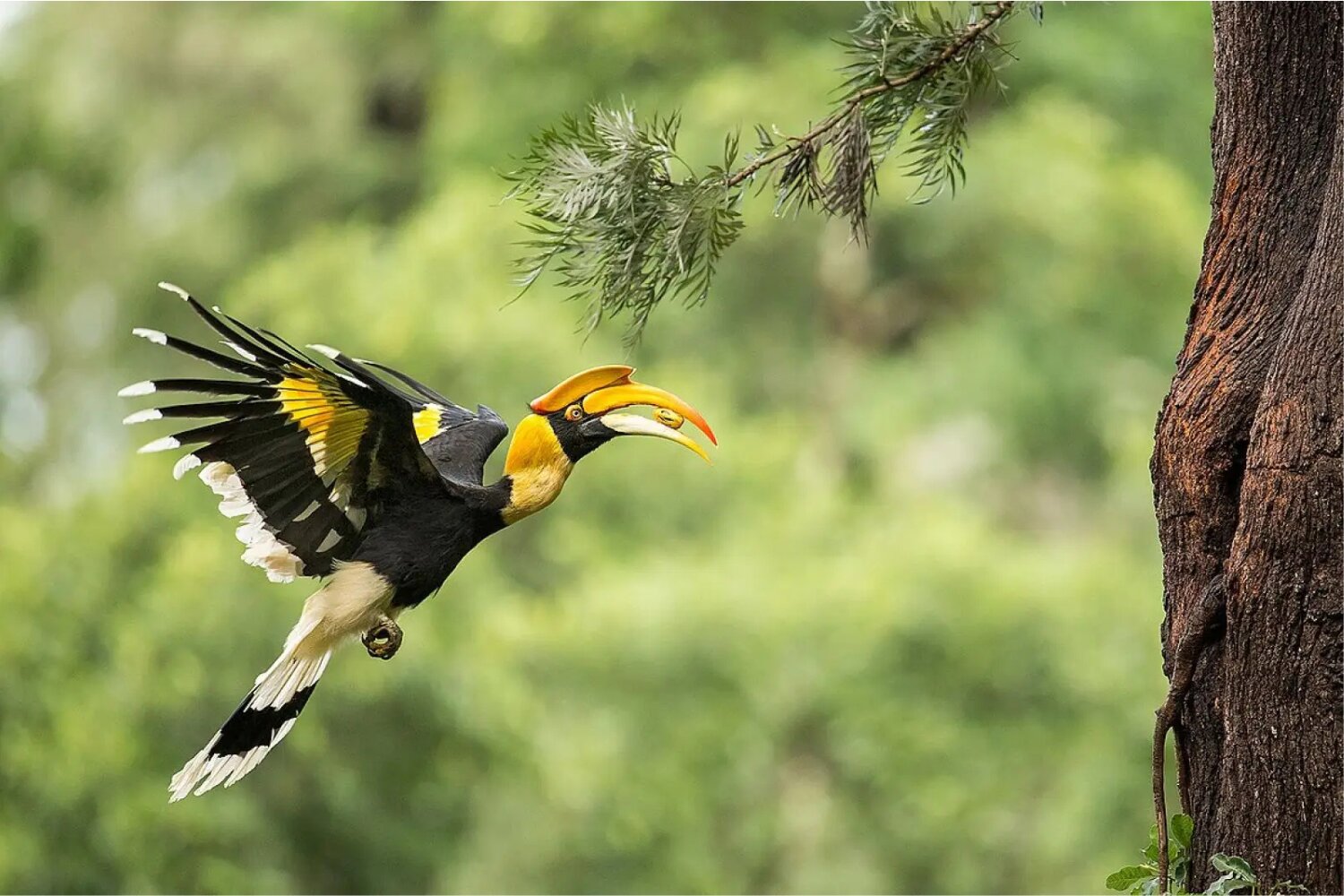
The Great Hornbill is most often seen in forest areas with large fruiting trees.
Its striking plumage features a bold contrast of black and white: black wings, face, and breast set against a white neck, belly, and tail, the latter marked with a thick black band. The casque itself is yellow and black, appearing U-shaped from the front with a concave top and ridged sides. Males and females are similar, though females tend to be smaller, with a fully yellow casque, bluish-white eyes, and pinkish bare skin around the eye, while males have red eyes and darker markings beneath the casque.
Inhabiting dense evergreen forests, the Great Hornbill is predominantly frugivorous, feeding largely on fruit, but it’s also an opportunistic hunter, occasionally taking small mammals, reptiles, and birds. It’s often seen in pairs or small groups, sometimes gathering in larger numbers at fruiting trees.
Even when hidden by the canopy, its presence is hard to miss. The heavy, rhythmic wingbeats produce a deep, whooshing sound - often compared to the puffing of a distant steam locomotive - as it flies with slow, powerful flaps followed by long glides. Its calls, too, are distinctive: a series of loud, resonant grunts that echo through the forest.
The Great Hornbill is most often seen in the mature evergreen forests of Cat Tien National Park, particularly in quieter interior forest areas with large fruiting trees. Birdwatchers occasionally spot them along the routes toward Bau Sau, Heaven Rapids and deeper forest trails where tall canopy trees remain intact. Early mornings are usually the best time to encounter them, either flying overhead with their unmistakable whooshing wingbeats or gathering noisily in fruiting fig trees high above the forest floor.
Although still found across parts of South and Southeast Asia, the Great Hornbill depends on large tracts of intact forest, making it a powerful symbol of healthy ecosystems - and an unforgettable highlight for anyone exploring Cat Tien.
Dusky broadbill (Corydon sumatranus)
Unusual in both shape and behaviour, the Dusky Broadbill is a distinctive canopy-dwelling bird of Cat Tien National Park. Measuring around 25 - 27 cm, it has a compact, somewhat chunky appearance, with dark brown to blackish plumage that blends into the forest shadows.
Its most noticeable feature is its broad, heavy bill - pink at the base with a greyish tip - paired with a soft buffy-white throat and upper breast that stand out against its otherwise dark body. A subtle white patch at the base of the primaries is sometimes visible in flight, adding a brief flash of contrast.
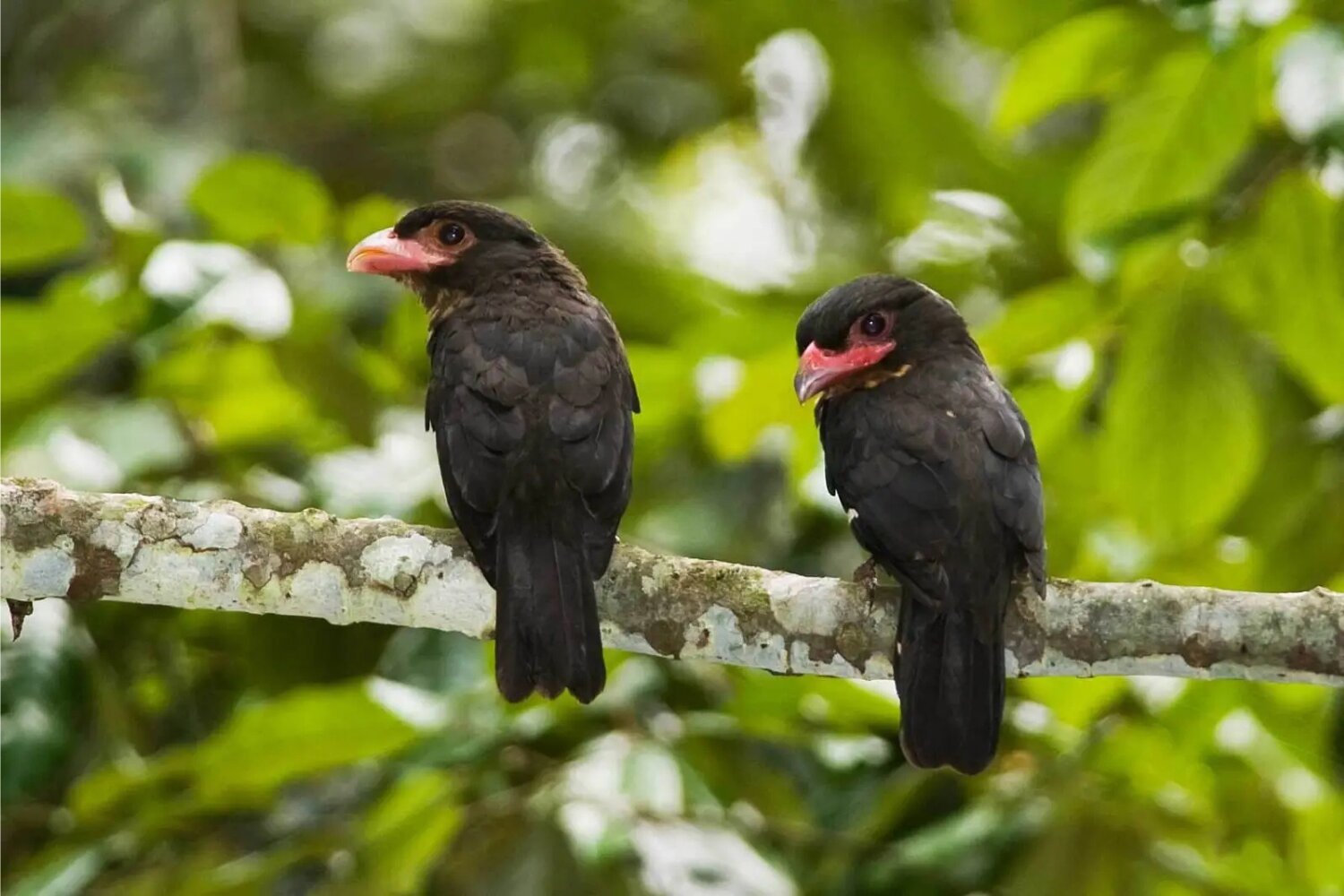
Dusky broadbills have a somewhat chunky appearance, with dark brown to blackish plumage that blends into the forest shadows.
This species is typically found in small groups, keeping to the main canopy level of broadleaved evergreen and mixed deciduous forests, including limestone habitats. It rarely descends, instead moving quietly through the upper layers of the forest in search of insects.
The Dusky Broadbill is most often encountered high in the canopy of Cat Tien National Park’s evergreen and semi-evergreen forests. Birdwatchers may spot small groups moving quietly through the upper branches along forest roads and taller woodland trails, particularly in less-disturbed interior forest areas near Bau Sau and deeper sections of the Park’s trekking routes.
Despite often remaining hidden among the leaves, the Dusky Broadbill can be quite vocal. Its calls are a series of harsh, rising screeches that carry through the canopy, often revealing its presence before it is seen.
Although listed as Least Concern, it remains a rewarding sighting for patient observers, offering a glimpse into the rich and often overlooked life of the forest canopy.
White-rumped Shama (Copsychus malabaricus)
Elegant and melodic, the White-rumped Shama is a favourite among birdwatchers visiting Cat Tien National Park. Measuring around 21 - 28 cm, this slender songbird is best known for its long, expressive tail and rich, musical voice.
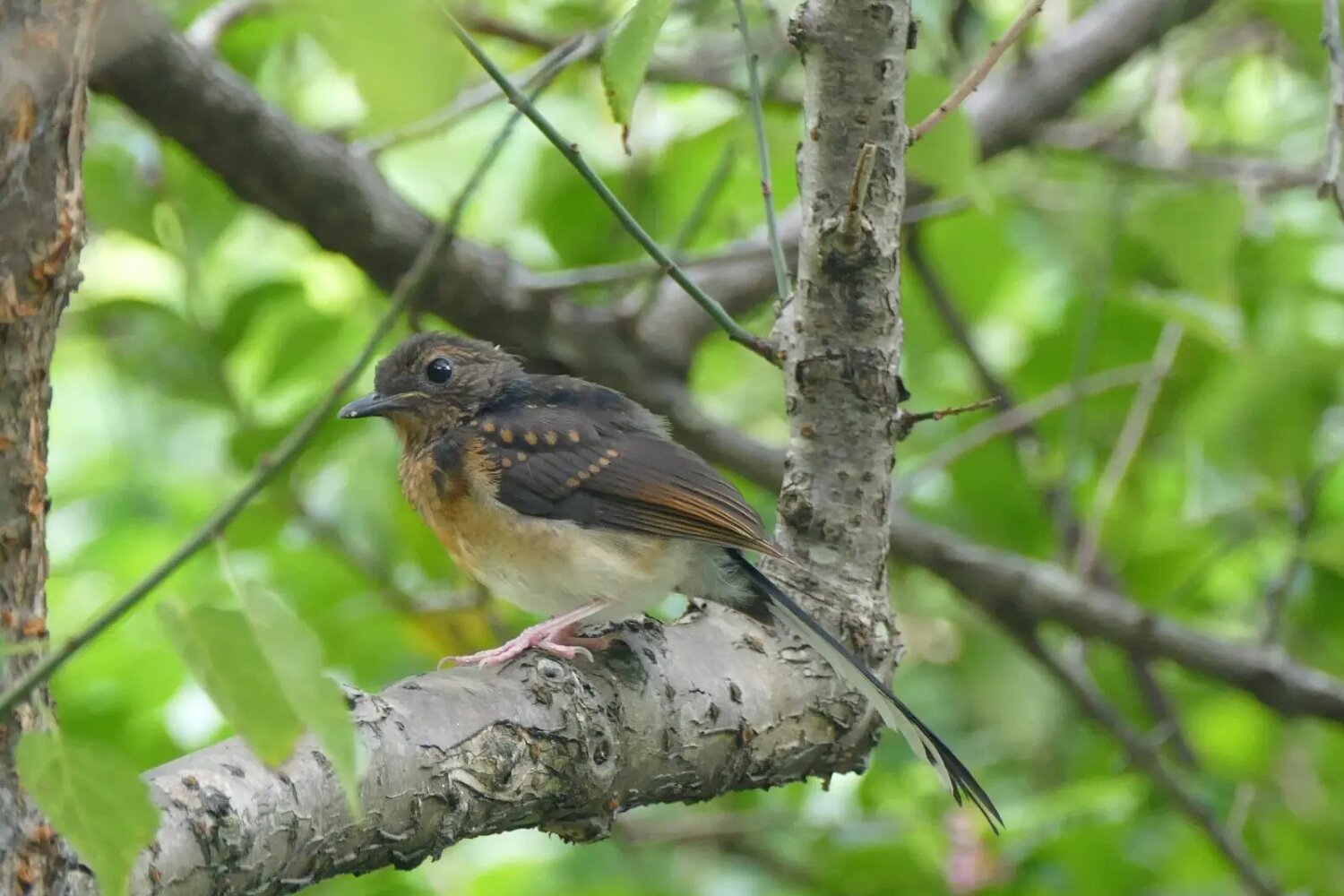
This slender songbird is best known for its long, expressive tail and rich, musical voice.
The male is striking, with a glossy black hood and back, contrasting against a warm rufous belly and a bright white rump that flashes in flight. Its long black tail is edged with white outer feathers, adding to its graceful appearance. Females are more subdued, with brownish-black upperparts, a softer brown belly, and a shorter tail, though they retain the same overall pattern.
This species inhabits a variety of forest types - from bamboo stands to deciduous, semi-evergreen, and broadleaved evergreen forests - ranging up to around 1,500 meters. It typically forages in the understorey or on the ground, searching for insects and other small invertebrates. Despite its delicate appearance, the White-rumped Shama is highly territorial, often defending its space with confidence.
The White-rumped Shama is commonly found in the shaded understorey of Cat Tien National Park, especially along quiet forest trails with dense vegetation and bamboo cover. Birdwatchers frequently hear its rich, melodious song around the Botanical Garden Trail, Heaven Rapids, and forest paths near the park headquarters during the early morning hours. Although often hidden in the shadows, patient observers may spot it hopping along the forest floor or perched low in the undergrowth with its long tail gently flicking behind it.
More often heard than seen, its song is one of its most captivating features: a series of clear, sweet whistles that rise and fall, sometimes expanding into a more complex and varied melody delivered from a shaded perch.
Although currently listed as Least Concern, many local populations have declined due to trapping for the cage bird trade. In the wild, however, its song remains one of the most beautiful and memorable sounds of the forest.
Racket-tailed Treepie (Crypsirina temia)
Graceful and unmistakable, the Racket-tailed Treepie is one of the more unusual birds you may encounter in Cat Tien National Park. Measuring around 30 - 32 cm, it appears wholly dark grey - often almost black in poor light - giving it a sleek, shadowy presence in the forest.
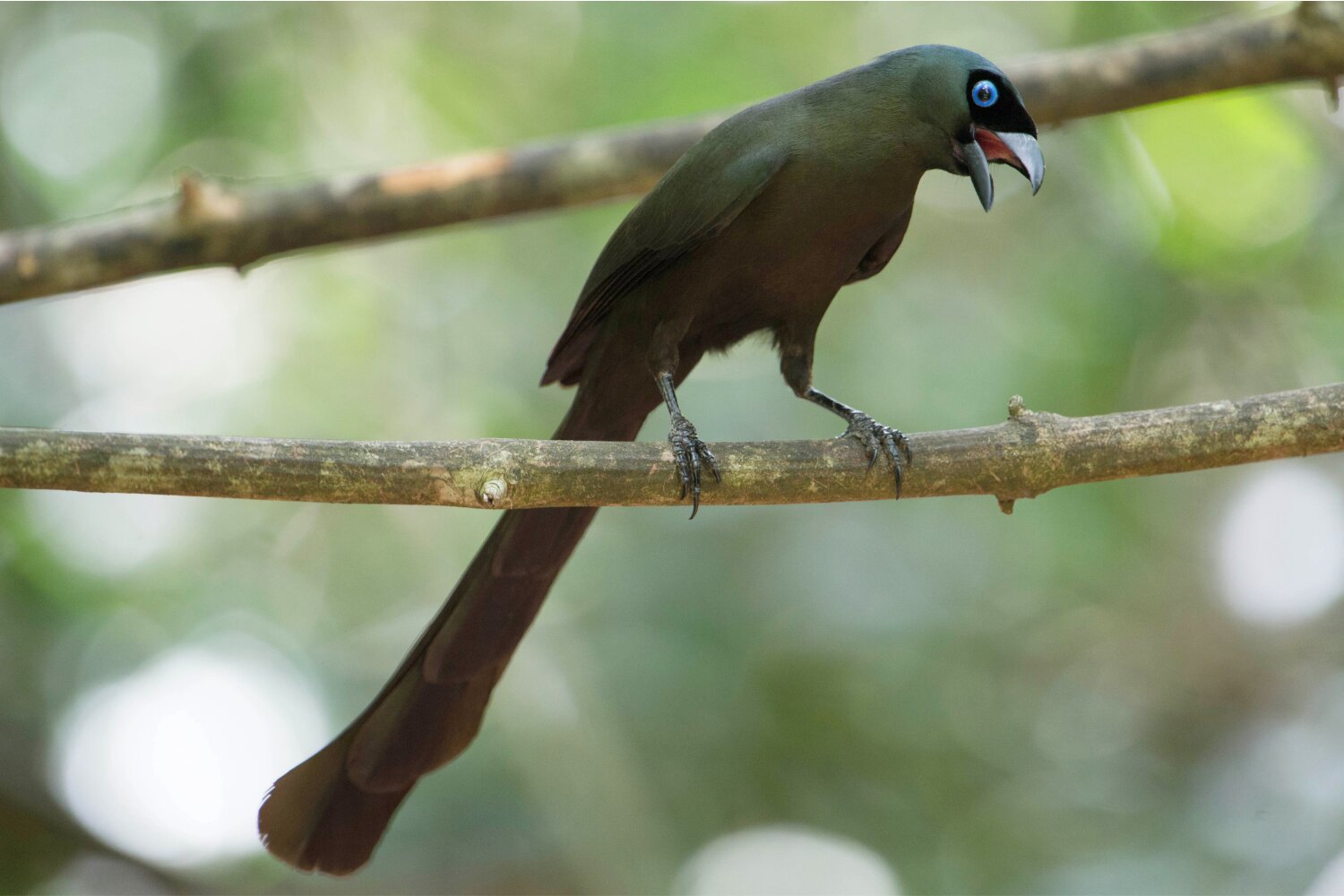
The racket-tailed treepie is one of the most unusual birds you may encounter in Cat Tien National Park.
What truly sets this species apart is its striking combination of features: vivid blue eyes that stand out against a darker facial mask, and a long, slender tail that ends in distinctive spatulate “rackets.” These elongated tail feathers give the bird an elegant, almost ornamental look as it moves through the trees.
The Racket-tailed Treepie is a lowland species, typically found below 950 meters in a wide range of habitats, including deciduous and semi-evergreen forests, bamboo stands, mangroves, and even parks and gardens. It is also commonly seen along well-wooded edges near wetlands, where it moves actively through the canopy in search of food.
The Racket-tailed Treepie is often seen along forest edges, bamboo patches and semi-open woodland areas throughout Cat Tien National Park. Birdwatchers regularly encounter it near the park headquarters, along forest roads and around wetter habitats bordering grasslands or riverine forest, where it moves actively through the mid to upper canopy in small groups or pairs. Its long racket-shaped tail and bright blue eyes are especially noticeable when sunlight filters through the trees, often making it easier to spot than many other canopy birds.
Although listed as Least Concern, the species faces localized pressure from trapping for the cage bird trade. In the wild, however., it remains a captivating sight - its fluid movements, unusual tail, and piercing blue eyes making it a memorable highlight for those exploring Cat Tien.
In conclusion
Birdwatching in Cat Tien National Park is more than simply spotting rare species - it’s an opportunity to experience one of Vietnam’s last great lowland forests and the extraordinary wildlife it continues to protect. Whether it’s hearing the haunting whistle of a pitta from the undergrowth, watching a hornbill glide above the canopy, or catching a brief glimpse of an orange-necked partridge deep in the forest, each sighting offers a deeper connection to the natural world.
Many of these birds face growing threats from habitat loss, hunting and the illegal wildlife trade, making protected areas like Cat Tien more important than ever. By visiting responsibly and supporting conservation-focused ecotourism, travellers play a small but meaningful role in helping preserve these forests and the species that depend on them.
For anyone passionate about birds, wildlife photography, or simply experiencing nature at its wildest, Cat Tien remains one of the most rewarding destinations in Vietnam to explore. If you'd like to learn about more of the species that make this forest such a remarkable birdwatching destination, be sure to continue to Part 2 - Rare Birds to Spot in Cat Tien National Park.