The Sambar deer (Rusa unicolor) is one of the largest deer species found across parts of Asia and other regions where it has been introduced. They are herbivores, feeding mainly on leaves, grasses, and fruits. Sambar deer live in a wide range of habitats, including forests, savannas, shrublands, grasslands, wetlands, and even some man-made environments. Despite Sambar deer’s adaptability, its overall population is declining, and the species is currently listed as Vulnerable on the IUCN Red List.
| Common name | Sambar Deer |
|---|
| Scientific name | Rusa unicolor |
|---|
| Taxonomy
|
Kingdom: Animalia
Phylum: Artiodactyla
Family: Cervidae
Genus: Rusa
|
| Weight / Size | 100 - 350kg in weight; 102 - 160cm in height; 1.6 - 2.7m in length |
|---|
| Lifespan | 20 years |
|---|
| Population | Unknown, Decreasing |
|---|
| Habitat | Forest, Savanna, Shrubland, Grassland, Wetlands (inland), Artificial/Terrestrial |
|---|
| Range | Asia, Oceania, Africa, North America |
|---|
| Diet | Herbivorous |
|---|
| Conservation status | Vulnerable in IUCN Red List |
|---|
Sambar deer characteristics
Sambar deer size and weight
The Sambar deer is known for being both shy and remarkably elusive in the wild, often slipping quietly into dense vegetation at the slightest disturbance. It is also the largest deer species in Asia, distinguished by its robust build, coarse dark-brown coat, and sturdy legs that help it navigate forests, grasslands, and wetlands with ease.
Adult Sambar deer are impressively large animals, typically weighing 100 to 350 kilograms, standing 102 to 160 centimeters at the shoulder, and measuring 1.6 to 2.7 meters in body length. Their substantial size makes them the heaviest and most robust deer species in Asia.
Sambar deer body structure
The Sambar deer stand about 1.2 - 1.4 meters at the shoulder. Its coat is coarse and unspotted, forming a noticeable ruff around the neck and ranging in color from light brown to dark brown, often with grayish or yellowish tones. Older individuals may appear almost black. While the overall coloration remains fairly uniform, shades can vary from deep gray to warm yellow-brown across different populations.
Male sambars carry long, three-tined antlers, with those of mature males weighing roughly twice as much as those of younger males (an average of 817 g compared to 402 g).
Sambar Deer also possess highly developed hearing and a strong sense of smell, allowing them to detect predators from a considerable distance.
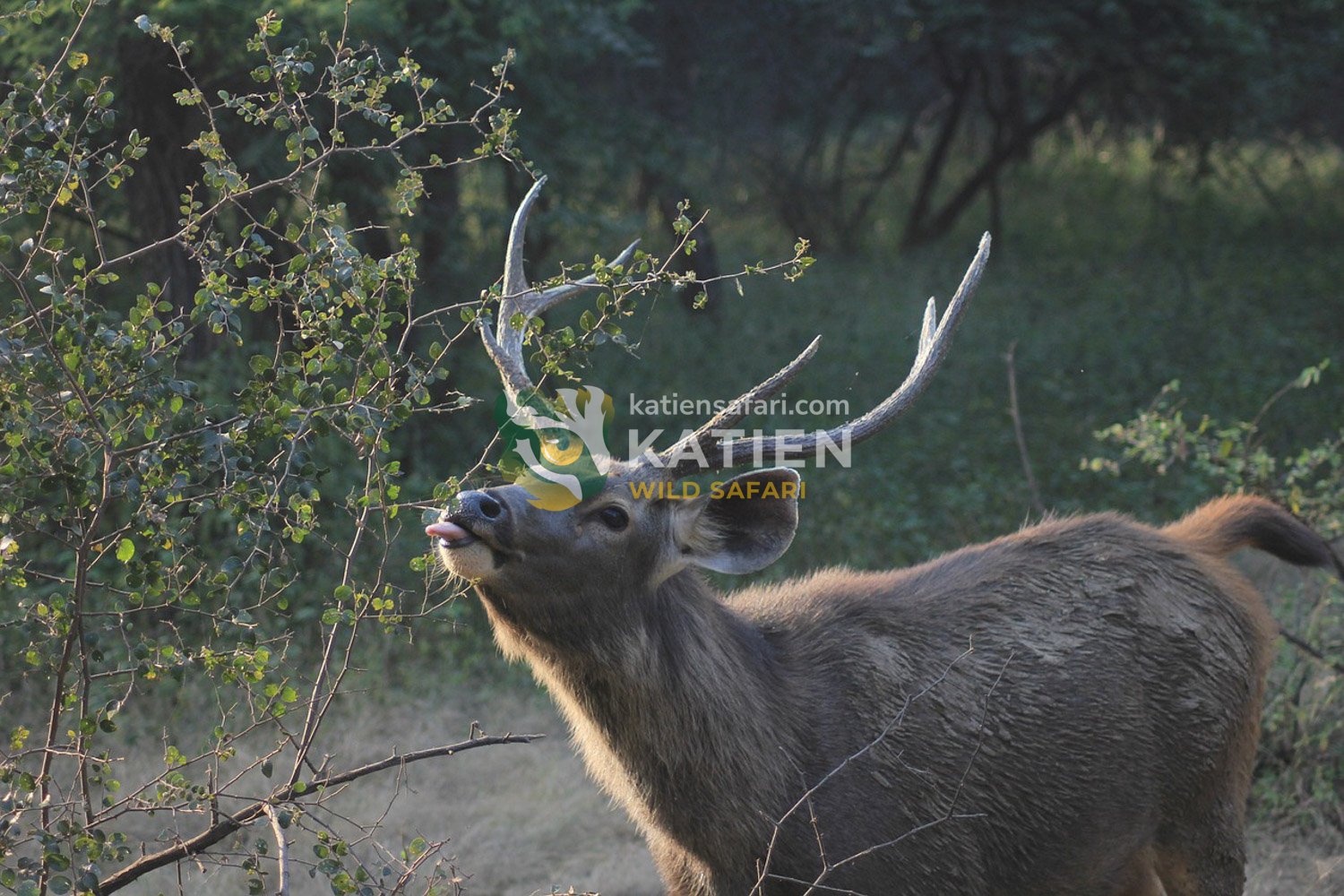
Male Sambar deer (Rusa unicolor) feeding on forest vegetation.
Distribution and habitat
Sambar deer habitat
Sambar Deer inhabit a wide range of forested environments and are often seen alone or in small, loosely formed groups. They prefer areas with dense cover, especially regions dominated by deciduous shrubs and tall grasses that provide both food and protection. These adaptable deer can also be found at impressive elevations, living in altitudes of up to 3,500 meters above sea level.
They tend to remain close to water sources, which are essential for their survival. In some areas, sambars also venture near cultivated lands, such as gardens and plantations, where food is more readily available.
Sambar deer distribution
Sambar Deer are native to much of South and Southeast Asia, including Bangladesh, Bhutan, Cambodia, China, India, Indonesia, Laos, Malaysia, Myanmar, Nepal, Sri Lanka, Taiwan, Thailand, and Vietnam, among others. They have also been introduced to several regions outside their natural range, such as Australia, New Zealand, South Africa’s Western Cape, and parts of the United States including Texas, Florida, and California.
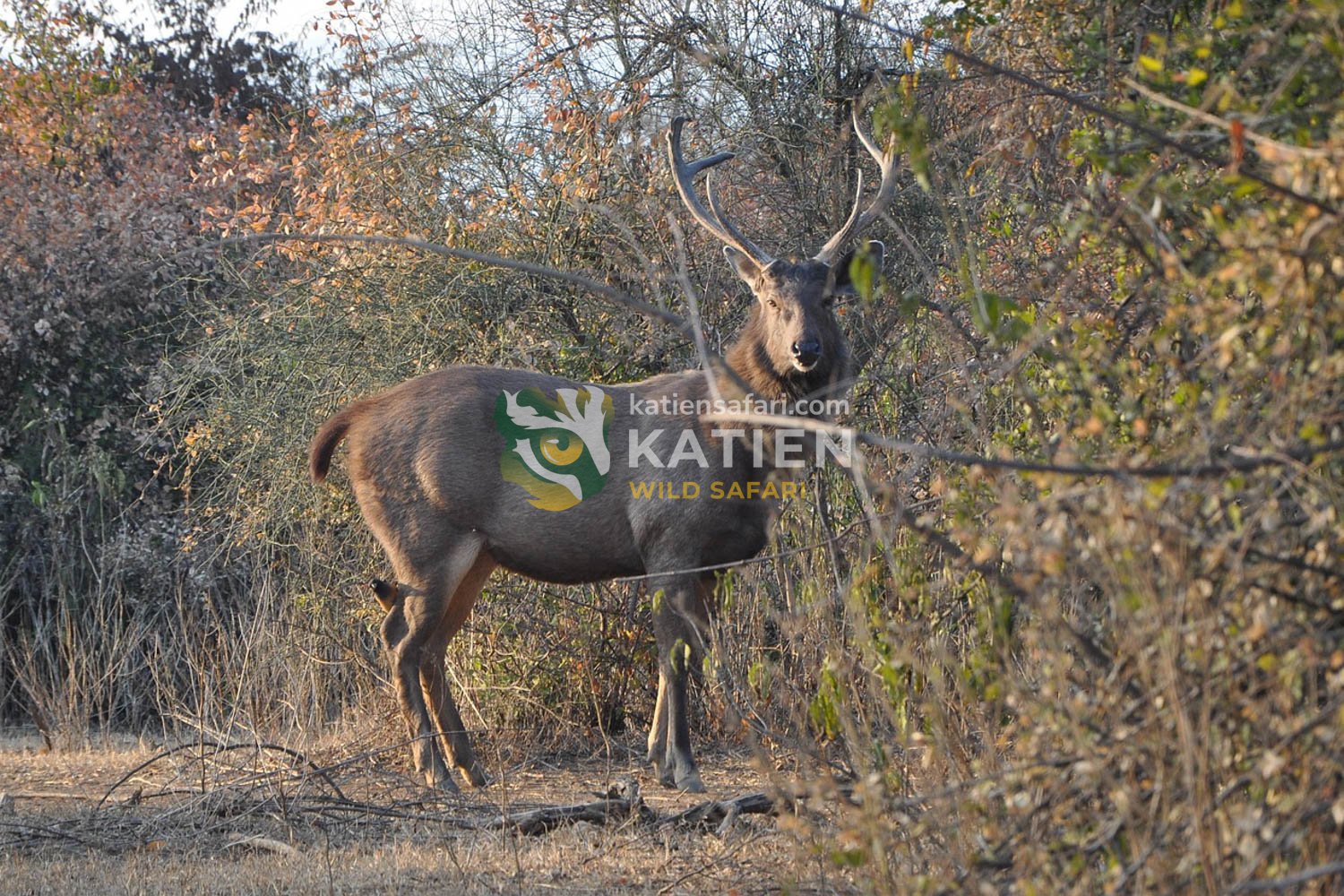
Sambar deer (Rusa unicolor) in forest edge habitat during daylight activity.
Sambar deer in Vietnam
In Vietnam, the local subspecies of the Sambar deer is the Nai den Nam Bo, which are found primarily in the Dong Nai region. They are most commonly seen in the grassland and open woodland habitats of Cat Tien National Park, where the landscape provides ideal conditions for feeding, hiding, and moving between forest patches.
Sambar deer in Cat Tien National Park
Cat Tien National Park is one of Vietnam’s key habitats for the Sambar deer. In the soft light of early morning or as dusk settles over the park’s wide grasslands, visitors may be fortunate enough to witness a serene yet lively scene, as herds of Sambar deer stroll across the open fields and quietly graze on tender new shoots.
Their powerful, slightly untamed beauty makes them a striking symbol of Cat Tien’s tropical forest ecosystem, reflecting the remarkable biodiversity and vibrant wildlife that thrive within the park.
Behavior and Lifestyle
Sambar deer behavior
Sambar deers are primarily nocturnal and crepuscular, meaning they are active at night and during the early morning hours while spending the heat of the day resting under dense forest cover.
Sambar deers are highly alert and naturally nervous. They often express tension by stamping their feet and producing a sharp, ringing alarm call known as “pooking” or “belling,” usually accompanied by an erect tail. When startled, the lead deer emits a sharp bark, prompting the entire group to scatter.
These deer exhibit a wide range of ecological behaviors, such as: browsing, grazing, scent marking, wallowing, and even zoochory as they disperse seeds through their movement.
In high densities, Sambar deer may influence forest regeneration through debarking, trampling, breaking saplings, spreading weeds and diseases, creating mud wallows, and forming trails that can lead to soil erosion.
Sambar deer also enjoy wallowing in mud and water, both to cool off and to remove parasites. When fleeing, they tend to shift from a careful, measured walk to a fast run with their heads lowered, eventually regrouping into small clusters once the threat has passed.
Did you know sambar deers are strong swimmers?
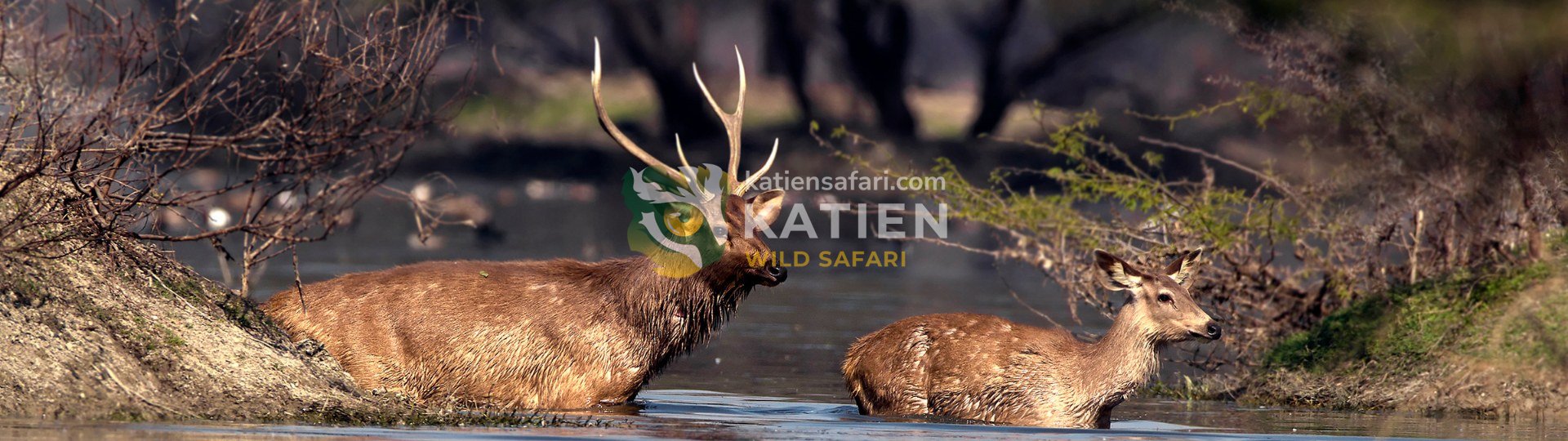
Sambar deers are remarkably strong swimmers, they are often found near rivers, lakes, and wetlands. When threatened, they do not hesitate to plunge into the water, using rivers as a safe refuge from predators such as tigers and dholes. Their confidence in water is one of the species’ most distinctive survival traits.
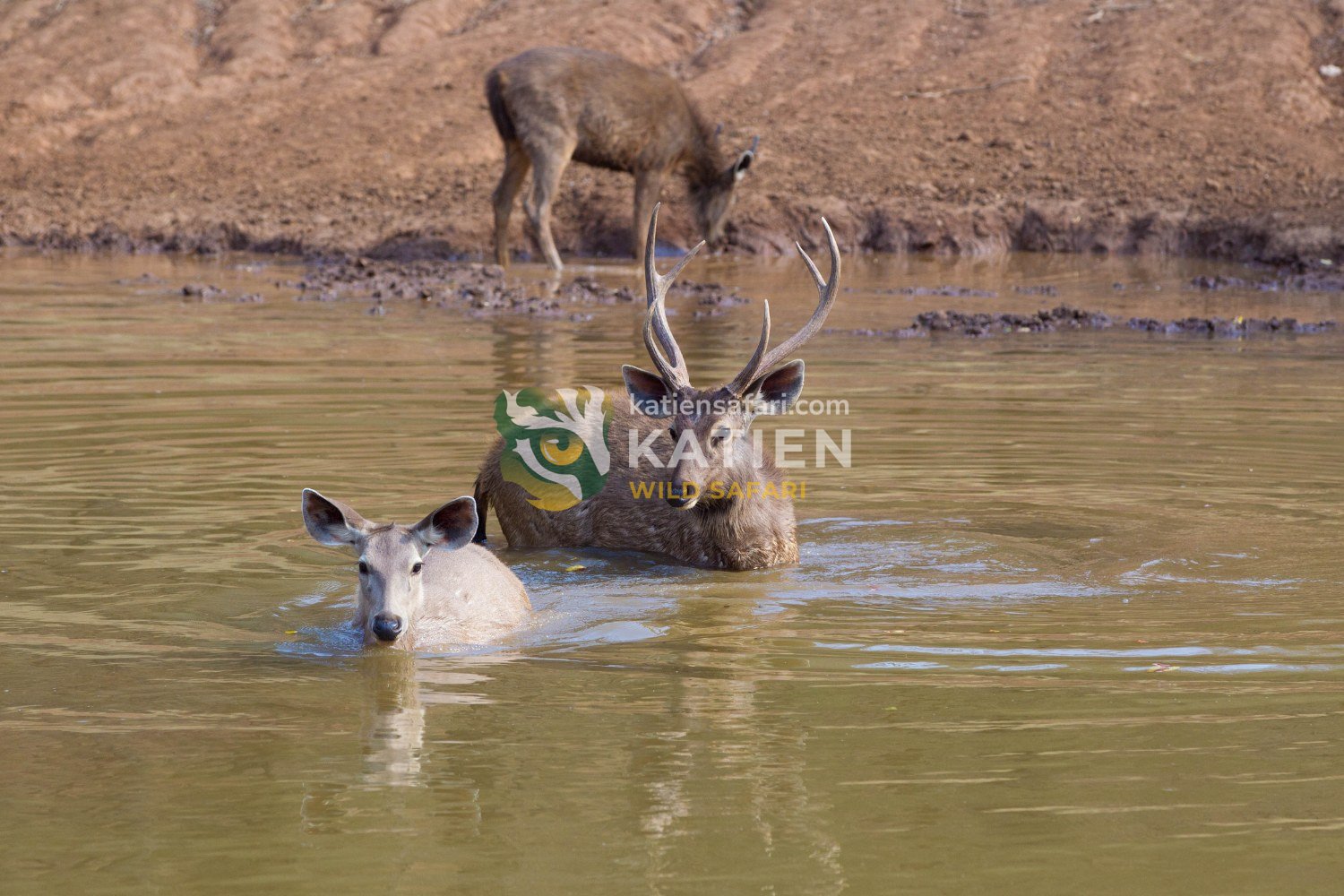
Sambar deers bathe in the river.
Sambar deer’s territorial behavior
Sambar deer mark and protect their territory by rubbing their antlers against trees and leaving scent marks. These scents act as natural signals, helping define their territory and warning other males to stay away.
During the breeding season, males become more territorial, wallowing in mud and rubbing their urine-soaked antlers against trees to mark their presence.
When faced with predators such as dholes or feral dogs, a Sambar deer lowers its head, raises its mane, and fights back with powerful kicks and strikes. They often defend themselves in shallow water, where several deer may stand close together, form a protective circle, and make loud calls to scare attackers away.
Sambar deer feeding behavior
Sambar deer usually feed at night and often visit natural mineral licks to get important nutrients. As herbivores, they eat many types of plants, including grasses, leaves, fruits, bamboo, water plants, and bark. This wide diet helps them survive in many different habitats.
Sambar deer reproduction
Sambar deer have a polygynous mating system, meaning one male mates with several females. Their breeding season mainly lasts from late May to early November. While males are usually calm, they become aggressive during this time as they compete for females, defend their territory, and attract mates using calls and scent marks.
A unique feature of tropical male sambars is that male Sambar deer can breed at any stage of antler growth, even when their antlers are still covered in velvet. This is different from red deer, which cannot reproduce during this stage. During the breeding season, male sambars also do not produce a strong body odor.
Female sambars, despite having no antlers, are strongly protective of their young. After a pregnancy of about nine months, a female usually gives birth to one fawn. The fawn starts eating solid food within the first two weeks, begins digesting plants a few weeks later, and stays with its mother for up to two years.
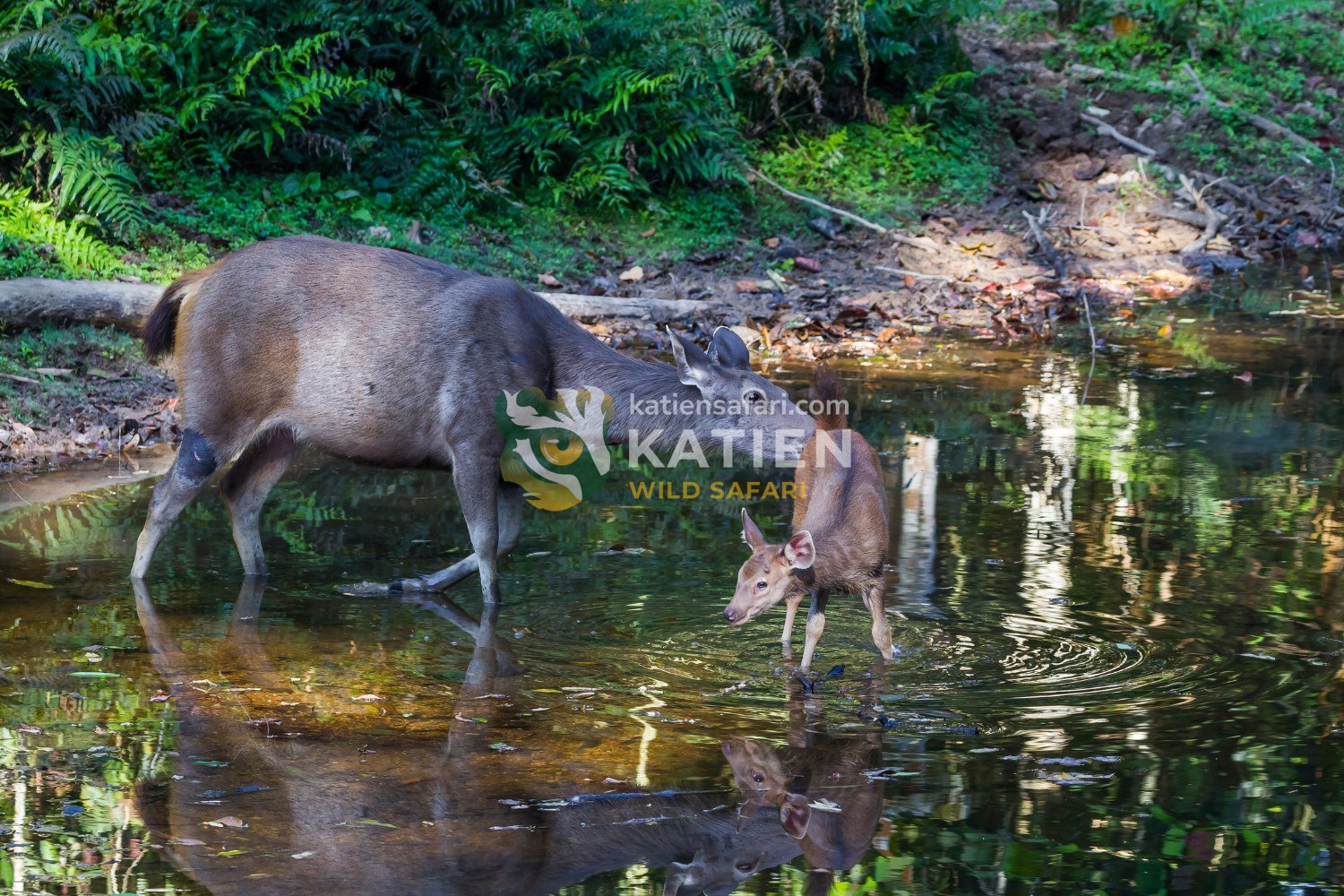
Female sambar deer and its fawn.
Conservation Status and Threats
Sambar deer conservation status
The Sambar deer is currently listed as Vulnerable on the IUCN Red List, assessed under criteria A2cd + 3cd + 4cd, with a continuing decline in population. Habitat loss, hunting pressure, and increasing human disturbance all contribute to the species’ downward trend across much of its range.
Threats to Sambar deer populations
Sambar deer predators
The main predators of Sambar deer include leopards, tigers, wolves, dholes, and crocodiles. When threatened, males defend themselves using their antlers, while females rely on strong, well-aimed kicks to fend off predators and protect their young.
Sambar deer threats
Sambar deer face a range of threats, notably from hunting and habitat encroachment. In many regions, persistent hunting has pushed the species toward a more nocturnal lifestyle as a survival response to human disturbance.
Another major threat is the use of sambar parts in traditional medicine and for food, which further reduces the quality of their habitat. Outside protected areas, populations are declining rapidly, and the species has already disappeared from several parts of its former range.
Why Sambar deer are important to ecosystems
Sambar deer play an important ecological role in the habitats they occupy, especially through seed dispersal, which helps maintain forest regeneration across their native range. As they browse and move through diverse landscapes, they transport seeds over long distances, supporting plant diversity and the overall health of the ecosystem.
Responsible sambar deer encounters with Katien Safari
Joining a Katien Safari tour in Cat Tien National Park offers a respectful way to see Sambar deer in the wild. The company partners with park rangers to lead small groups into key forest areas while ensuring the deers’ natural behavior is never disturbed.
Here are a few tips for better Sambar deer watching:
- Arrive before sunrise when Sambar deers are most active.
- Stay at least 40 - 60 meters away to avoid interrupting their feeding or alert stance.
- Wear muted, earth-toned clothing that blends into the forest and reduces visual disturbance.
- Move slowly and remain downwind, allowing the deer to detect your presence naturally without feeling threatened.
- Keep noise to a minimum, silence phones, avoid sudden movements, and use quiet camera settings.
- Never block pathways or approach does, as mothers are highly alert and may abandon a feeding site if disturbed.
- Follow ranger guidance and stay on designated trails, helping protect sensitive vegetation and avoiding stress on wildlife.
Interesting facts about Sambar deer
1. Sambar deers are the largest deers in Asia and in places they have been introduced to.
2. Sambar deers are polygynous, meaning one male mates with several females.
3. Sambar deers are strong swimmers and they don’t hesitate to take refuge in rivers to escape its predators.
5. Female Sambar readily defense its youngs in danger despite lacking of antlers.
6. Sambar deers usually give birth to one single fawn.
Reference
- Idris, I. S. M. A. I. L., Moin, S. A. I. D. I., Suliah, S. A. M. T. O., & Jiwan, D. A. W. E. N. D. (2000). Some physical characteristics of Sambar deer (Cervus unicolor). Pertanika Journal of Tropical Agricultural Science, 33, 55–59.
- Semiadi, G., Muir, P. D., Barry, T. N., Veltman, C. J., & Hodgson, J. (1993).
Grazing patterns of sambar deer (Cervus unicolor) and red deer (Cervus elaphus) in captivity. New Zealand Journal of Agricultural Research, 36(2), 253–260.
- Semiadi, G., Muir, P. D., & Barry, T. N. (1994).
General biology of sambar deer (Cervus unicolor) in captivity. New Zealand Journal of Agricultural Research, 37(1), 79–85.
- Watter, K., Thomas, E., White, N., Finch, N., & Murray, P. J. (2020).
Reproductive seasonality and rate of increase of wild sambar deer (Rusa unicolor) in a new environment, Victoria, Australia. Animal Reproduction Science, 223, 106630.
- Wills, T. J., Retallick, R. W., Greet, J., & Bennett, A. (2023).
Browsing by non-native invasive sambar deer dramatically impacts forest structure. Forest Ecology and Management, 543, 121153.
- Yen, S. C., Lin, C. Y., Hew, S. W., Yang, S. Y., Yeh, C. F., & Weng, G. J. (2015).
Characterization of debarking behavior by sambar deer (Rusa unicolor) in Taiwan. Mammal Study, 40(3), 167–179.