When we think of turtles, we usually imagine slow animals carrying heavy, hard shells on their backs. But nature has created a surprising exception, the softshell turtles (Trionychidae). As their name suggests, these turtles break the usual rules. Instead of a hard shell, they have a tough but flexible skin shell, which makes them lighter and more agile. This allows them to move smoothly in water and even run faster on land than most other turtles. With their webbed feet and three sharp claws, softshell turtles are not gentle, slow creatures. They are powerful swimmers and skilled ambush predators, perfectly adapted to life in rivers and wetlands.
| Common name | Softshell Turtles |
|---|
| Scientific name | Trionychidae (family) |
|---|
| Taxonomy
|
Class: Reptilia
Order: Testudines
Family: Trionychidae
Genera: 12–15 genera (Amyda, Pelodiscus, Rafetus, etc.)
Species: 25–30 species
|
| Weight / Size | 11–22 cm (smallest) to 100 cm and ~120 kg (largest species) |
|---|
| Lifespan | Up to about 25–30 years (varies by species) |
|---|
| Population | Decreasing (many species endangered) |
|---|
| Habitat | Freshwater rivers, lakes, ponds, swamps, canals; soft sand or mud bottoms |
|---|
| Range | Asia, Africa, and North America |
|---|
| Diet | Mostly carnivorous: fish, crabs, snails, insects, frogs; some plants |
|---|
| Conservation status | Many species listed in CITES; several are Critically Endangered |
|---|
Physical Characteristics and Appearance
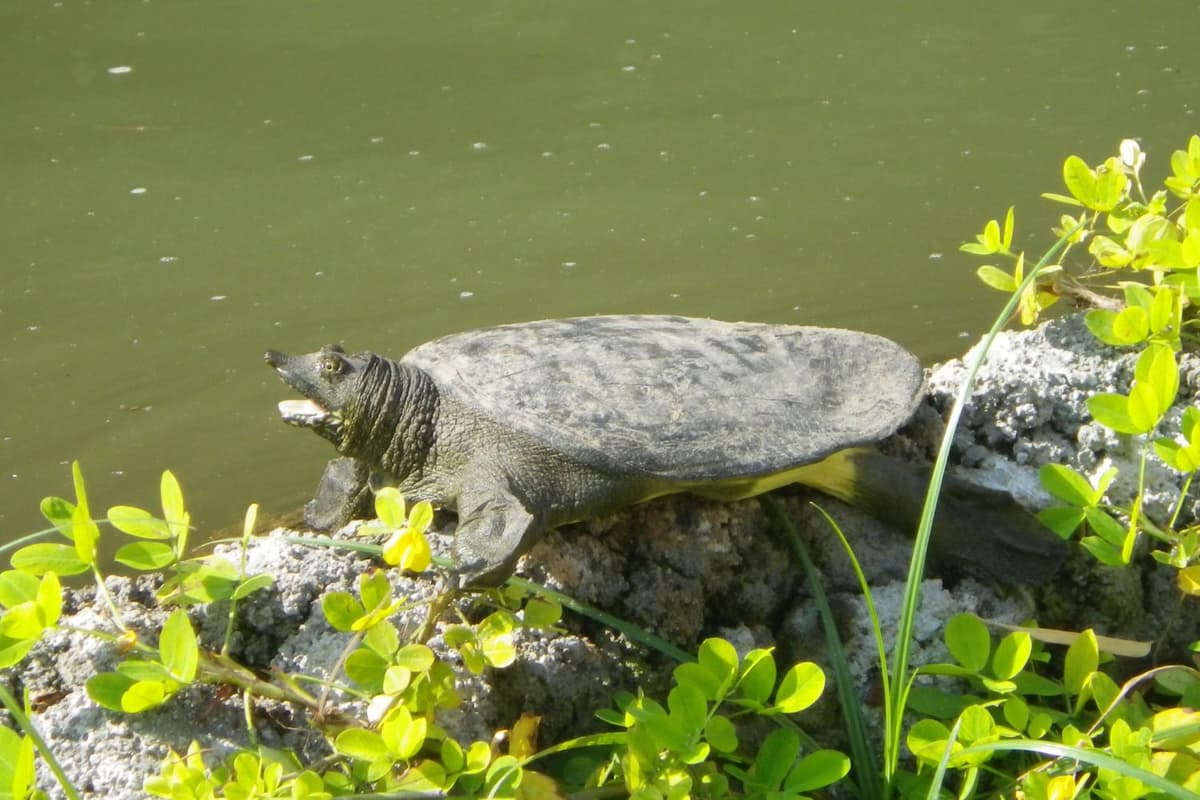
Softshell turtles are easy to recognize because their bodies are very different from other turtles. Their shells do not have hard plates. Instead, the shell is covered by soft, tough skin. The middle of the shell is hard inside, but the edges are soft and flexible, so the shell looks flat and smooth.
They have a long neck and a long, soft nose like a small tube, with the nostrils at the tip. Their lips are thick and cover the beak. Their feet have webbing for swimming and usually three claws on the middle toes.
The shell is often the color of sand or mud, such as olive or green, which helps them hide. Their light and flexible shell helps them swim fast, move easily in mud, and run faster on land than many other turtles. Softshell turtles can breathe underwater using their mouth, which has many blood vessels. One species, Pelodiscus sinensis, can even release waste through its mouth, which helps it live in salty water.
The largest species is Cantor’s giant softshell turtle, which can reach 100 cm and weigh about 120 kg. The smallest is the Zambezi flapshell turtle, only 11–22 cm long.
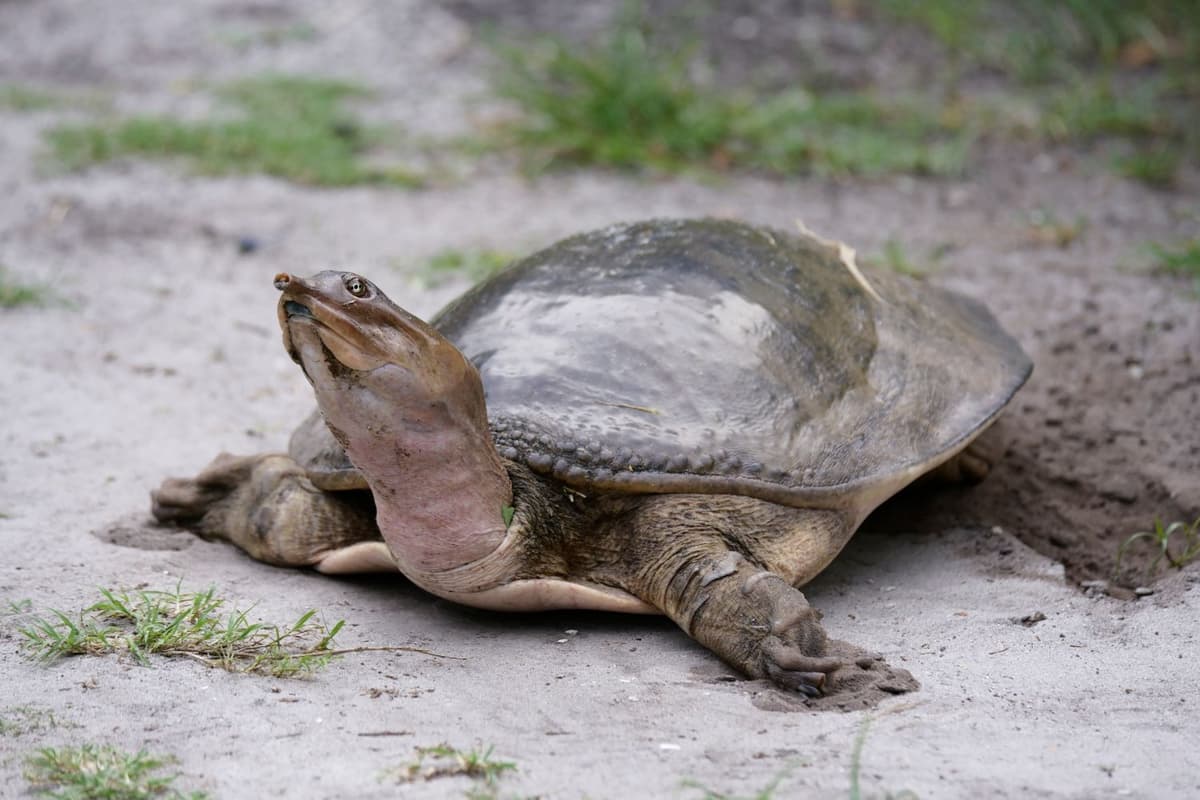
Softshell turtles have flat, leathery shells and long snorkel-like noses.
Subspecies of Softshell Turtles
The softshell turtle family Trionychidae includes about 12–15 genera and 25–30 species. These turtles live in Asia, Africa, and North America. Asia has the most species. Important Asian groups include Amyda, Nilssonia, Pelodiscus, Pelochelys, Chitra, Lissemys, and Rafetus. Many of these turtles are very large and highly endangered.
The genus Amyda is also called the Asian giant softshell turtles. It is now divided into two main species: Amyda cartilaginea, found on islands in Indonesia, and Amyda ornata, found on the mainland of Southeast Asia, including Vietnam. Several new subspecies have been found using DNA studies.
The genera Pelodiscus and Palea include common softshell turtles in Vietnam and China, such as Pelodiscus sinensis, Pelodiscus variegatus, and Palea steindachneri. These turtles are often farmed and traded. Some of the largest and rarest softshell turtles are Pelochelys cantorii (the giant softshell turtle) and Rafetus swinhoei, one of the rarest turtles in the world.
Habitat and Global Distribution
Global Distribution
The softshell turtle family Trionychidae, first described in 1826 by Leopold Fitzinger, includes some of the largest freshwater turtles in the world. These turtles are found in Africa, Asia, and North America. Asia has the greatest number of species. Softshell turtles live from the Middle East and South Asia through Southeast Asia (Vietnam, Laos, Cambodia, Thailand) to East Asia, and also on the large islands of Indonesia, Malaysia, and Brunei. They are also found across the Indian subcontinent, including India, Pakistan, Nepal, and Bangladesh.
Freshwater Habitat
Softshell turtles are highly aquatic. They spend most of their time buried in the bottom of rivers or lakes. They prefer slow-moving or still water such as rivers, streams, lakes, ponds, swamps, and canals. A soft bottom of sand or mud is very important so they can hide and rest. Some species can live in brackish water and are found in places from hill streams to rivers, wetlands, and even farm areas.
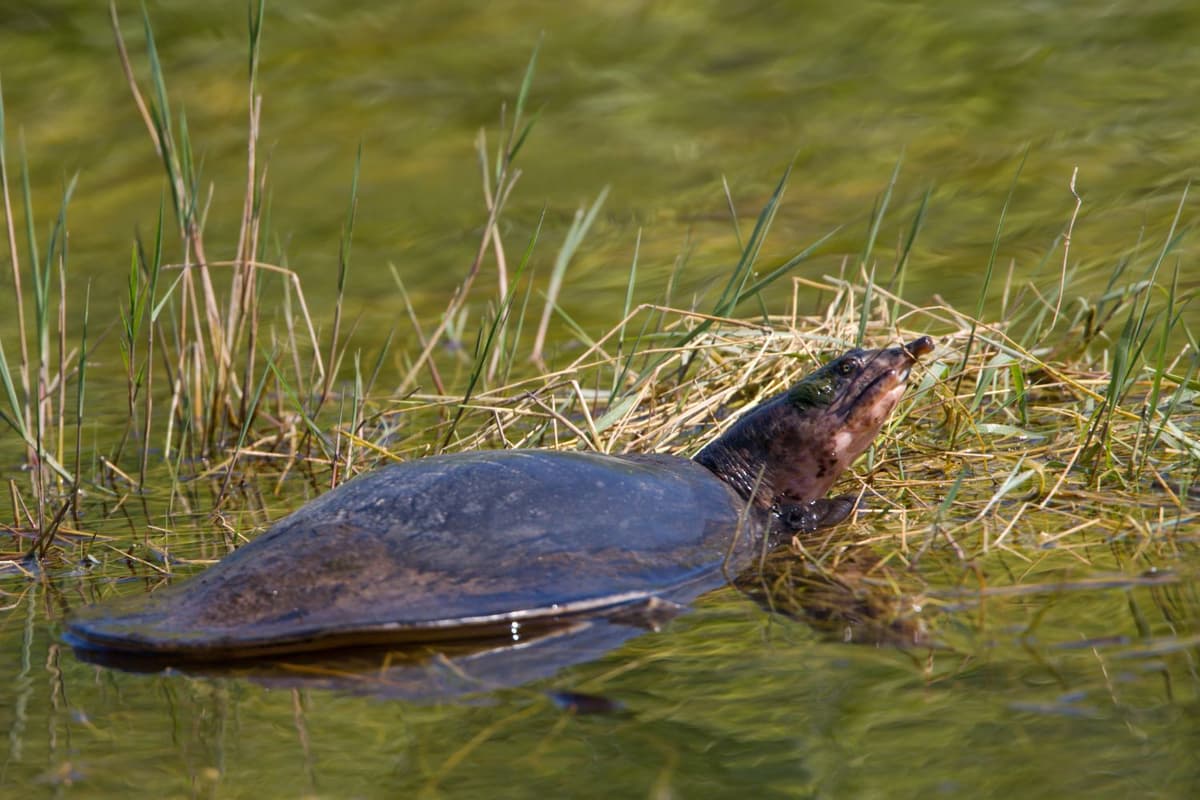
Softshell turtles live in slow-moving rivers, lakes, and sandy freshwater habitats.
Softshell Turtles in Vietnam
Vietnam is home to several important softshell turtle species, but their populations are under strong pressure from hunting and trade. They live mainly in freshwater areas in northern, central, and southern Vietnam, including natural lakes, large rivers, swamps, and the Mekong River system. Important river systems include the Da, Ma, and Chu rivers, and the Mekong Delta.
According to the 2021 Asian Turtle Program (ATP), Vietnam has these softshell turtles:
- Amyda ornata (Southern softshell turtle) – Vulnerable (VU)
- Palea steindachneri (Spiny softshell turtle) – Critically Endangered (CR)
- Pelochelys cantorii (Giant softshell turtle) – Critically Endangered (CR)
- Pelodiscus variegatus (Vietnamese softshell turtle)
- Rafetus swinhoei (Hoan Kiem turtle) – Critically Endangered (CR)
Softshell Turtles in Cat Tien
Cat Tien National Park has been identified as an important site for the survival of softshell turtles in the wild. At present, there is no exact number of Amyda living in Cat Tien, because no full population survey has been completed. However, studies and field surveys confirm that Cat Tien is one of the protected areas where this species is still present. This shows that Cat Tien plays a key role in protecting softshell turtles in Vietnam.
Diet and Predators
Diet
Softshell turtles are omnivores, but they mostly eat animals. Their main food includes fish, crabs, shrimp, snails, clams, insects, frogs, earthworms, and sometimes small birds or mammals. Softshell turtles are ambush predators, also called “lie-in-wait” hunters. They spend most of their time buried in sand or mud, with only their eyes and nose above the surface.
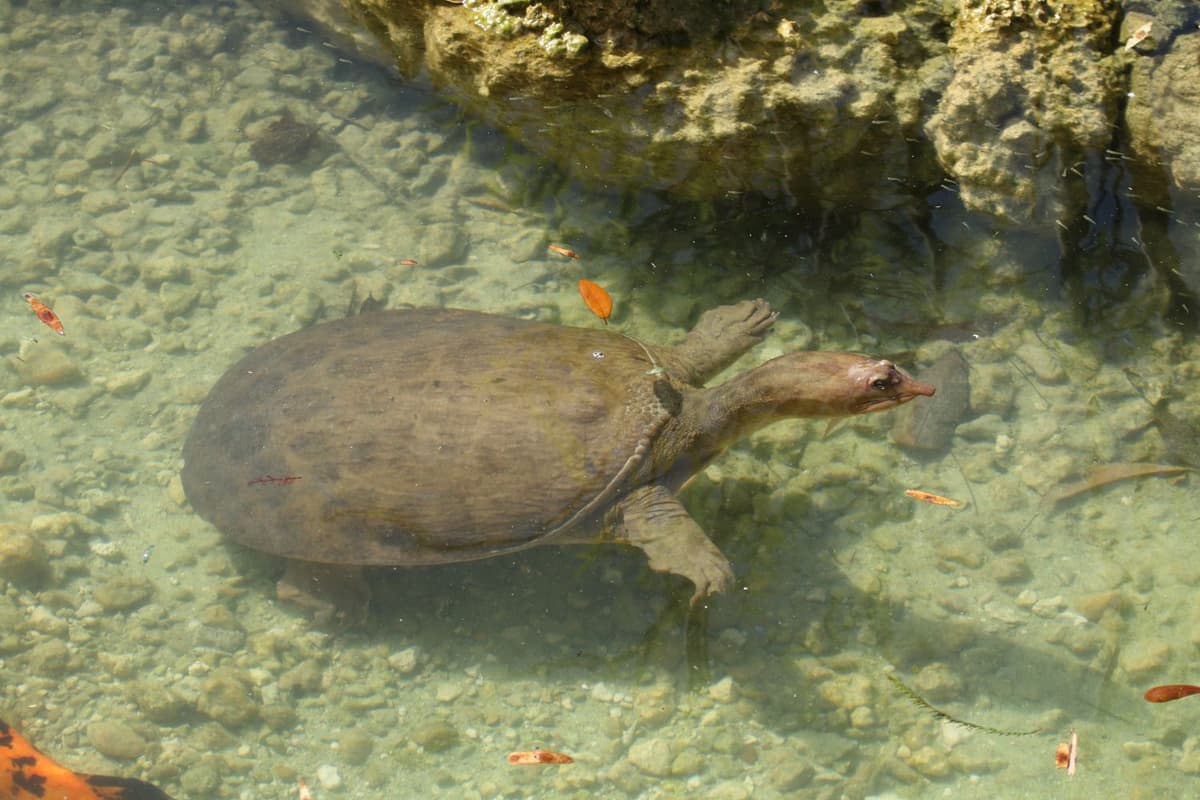
Softshell turtles live in slow-moving rivers, lakes, and sandy freshwater habitats.
Predators
Eggs and young turtles are the most vulnerable. Their natural predators include monitor lizards, crows, snakes, eagles, wild pigs, and many small animals. Adult turtles have fewer enemies, but they can still be attacked by large predators like tigers, smooth-coated otters, and crocodiles. However, humans are the biggest threat due to hunting for meat and traditional medicine.
Behavior and Habit
Are softshell turtles nocturnal? Softshell turtles are not strictly nocturnal. Many species, such as Amyda cartilaginea, can be active during the day or at night, but they are usually most active at dawn and dusk. Nesting often happens in the late afternoon or evening to avoid predators and heat.
Swimming Ability: Softshell turtles are excellent swimmers. Their soft, flat shell is lighter and more flexible than hard shells, helping them move faster. Some species, such as Pelochelys, can even swim across shallow sea water to travel between islands.
Burrowing Behavior: They spend much of their time buried in soft sand or mud. Their long neck and snorkel-like nose allow them to breathe air while their bodies stay hidden.
Softshell turtles are active hunters, often burying themselves in sand to ambush prey.
Reproduction of Softshell Turtles
The breeding season usually happens during the dry or hot season. Females come onto land only to lay eggs, usually choosing moist sand or muddy banks. The eggs are round and have a hard shell. Each nest usually contains about 20 eggs.
Unlike most other turtles where sex depends on temperature, softshell turtles have genetic sex determination (ZZ/ZW). This means the temperature does not change the sex of the hatchlings.
Threats and Conservation
Threats to survival
Overhunting and trade are the biggest threats. They are hunted for meat, eggs, and traditional medicine. Habitat loss from sand mining, water pollution, and dam building also destroys their living areas. Additionally, accidental capture in fishing nets causes many deaths.
Conservation
International laws like CITES help monitor and limit trade. In-situ conservation includes guarding nesting sites in protected areas such as Cat Tien National Park. Community protection and captive breeding programs also help reduce pressure on wild populations.
Interesting Facts of Softshell Turtles
1. Unlike other turtles, they do not have hard plates, making them lighter and faster.
2. Their long neck and tube-shaped nose work like a snorkel for breathing while buried.
3. The Chinese softshell turtle can release waste through its mouth.
4. They can run faster on land than most other turtles due to their light shell.
5. The sex of babies is decided by chromosomes, not nest temperature.
Reference
- Auliya, M., van Dijk, P. P., Moll, E. O., & Meylan, P. A. (2016). Amyda cartilaginea (Boddaert 1770) – Asiatic softshell turtle, Southeast Asian softshell turtle. Chelonian Research Monographs, 5(9), 092.1–092.17. https://doi.org/10.3854/crm.5.092.cartilaginea.v1.2016
- Le, M. (2007). Conservation of turtles in Vietnam: A survey of Cat Tien National Park. Oryx, 41(4), 544–547. https://doi.org/10.1017/S0030605307012148
- Gray, T. N. E., Phan, C., & Long, B. (2010). https://www.iied.org/sites/default/files/pdfs/migrate/G02746.pdf
- Thathi, P. R., & Singh, S. K. (2025). A review on conservation-based research on Trionychidae. Journal of Entomology and Zoology Studies, 13(3), 324–333. https://doi.org/10.22271/j.ento.2025.v13.i3d.9528

__639083009039368323.jpg)