The Siamese Crocodile (Crocodylus siamensis) is a freshwater crocodile native to Southeast Asia. This species has existed for about 2.6 million years but now faces a serious survival crisis. Listed as Critically Endangered (CR) on the IUCN Red List, it is one of the world’s most threatened crocodile species.
| Common name | Siamese Crocodile |
|---|
| Scientific name | Crocodylus siamensis |
|---|
| Taxonomy | Class: Reptilia Order: Crocodylia, Family Crocodylidae |
|---|
| Weight / Size | Adults usually reach 2.5–3.5 m in length and weigh 150–350 kg; males can reach up to 4 m. |
|---|
| Lifespan | Around 35 years in the wild; longer in captivity. |
|---|
| Population | Estimated 1,000 individuals in the wild; over 700,000 in captivity. |
|---|
| Habitat | Freshwater rivers, lakes, swamps, and slow-moving streams |
|---|
| Range | Mainly Cambodia, with small groups in Laos, Thailand, and reintroduced in Cat Tien National Park, Vietnam. |
|---|
| Diet | Carnivorous; eats fish, frogs, reptiles, birds, and small mammals. Juveniles feed on insects and snails. |
|---|
| Conservation status | Critically Endangered (CR) – IUCN Red List. |
|---|
Today, about 1,000 individuals remain in the wild, while more than 700,000 live in captivity. The Cat Tien National Park reintroduction program in Vietnam - with 60 purebred crocodiles released at Bau Sau - is recognized as the first and most successful effort to restore wild populations.
Features and Characteristics of the Siamese Crocodile
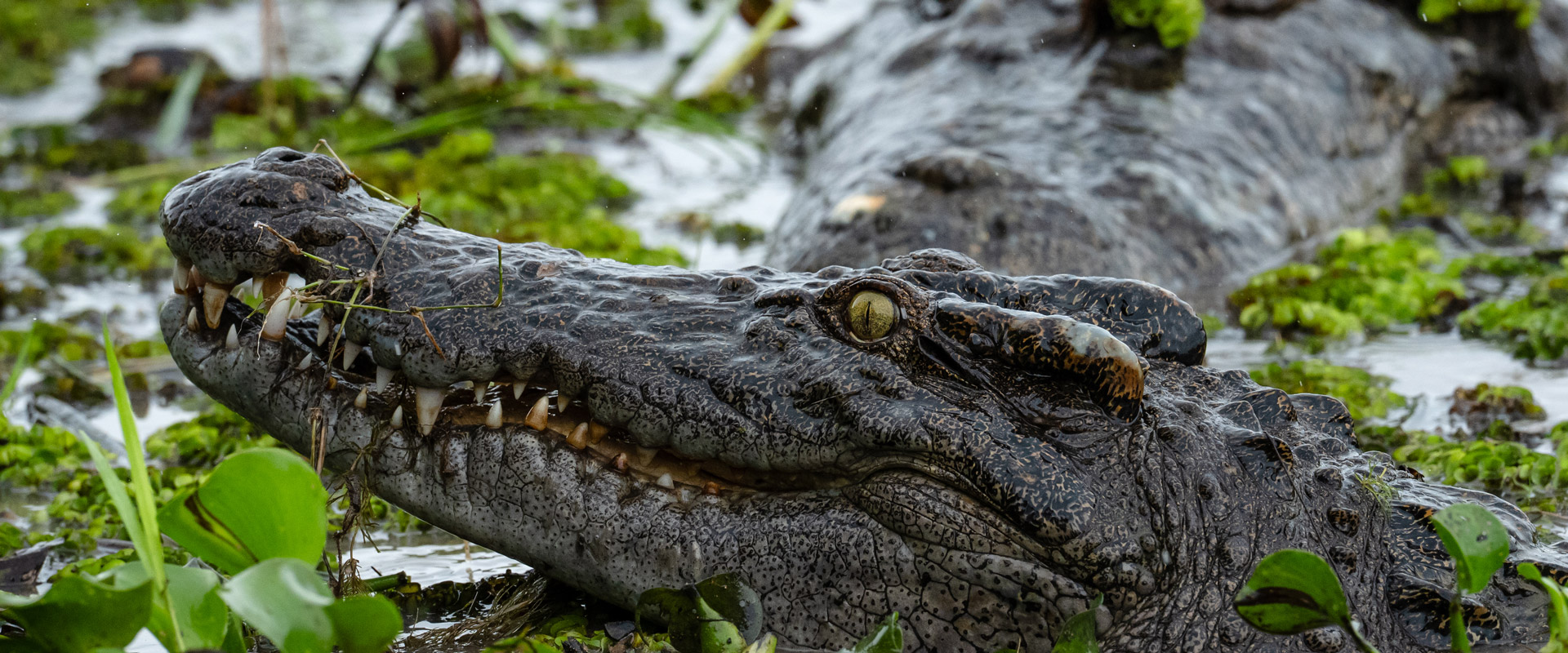
The Siamese crocodile (Crocodylus siamensis) is a medium-sized freshwater species found in Southeast Asia. It has an olive to dark green color and a broad snout. Adult males can reach up to 4 meters, but most grow to about 3.5 meters.
On average, adults weigh between 150 and 250 kilograms. Some captive-bred crocodiles may be larger and weigh around 350 kilograms. Its body is covered with rectangular bony scales arranged in horizontal rows.
The tail is tall and strong, with four ridges on top. The back legs have webbed toes to help it swim easily.
In Siamese crocodile biology, this species is smaller than saltwater crocodiles, which can exceed 6 meters. It has 4-6 post-occipital scales behind the head and clear bony ridges behind each eye.
However, due to hybrid breeding in farms, many second or third-generation hybrids look almost identical to pure individuals. The Siamese crocodile has a lifespan of about 35 years in the wild (recorded in Vietnam) and can live longer in captivity.
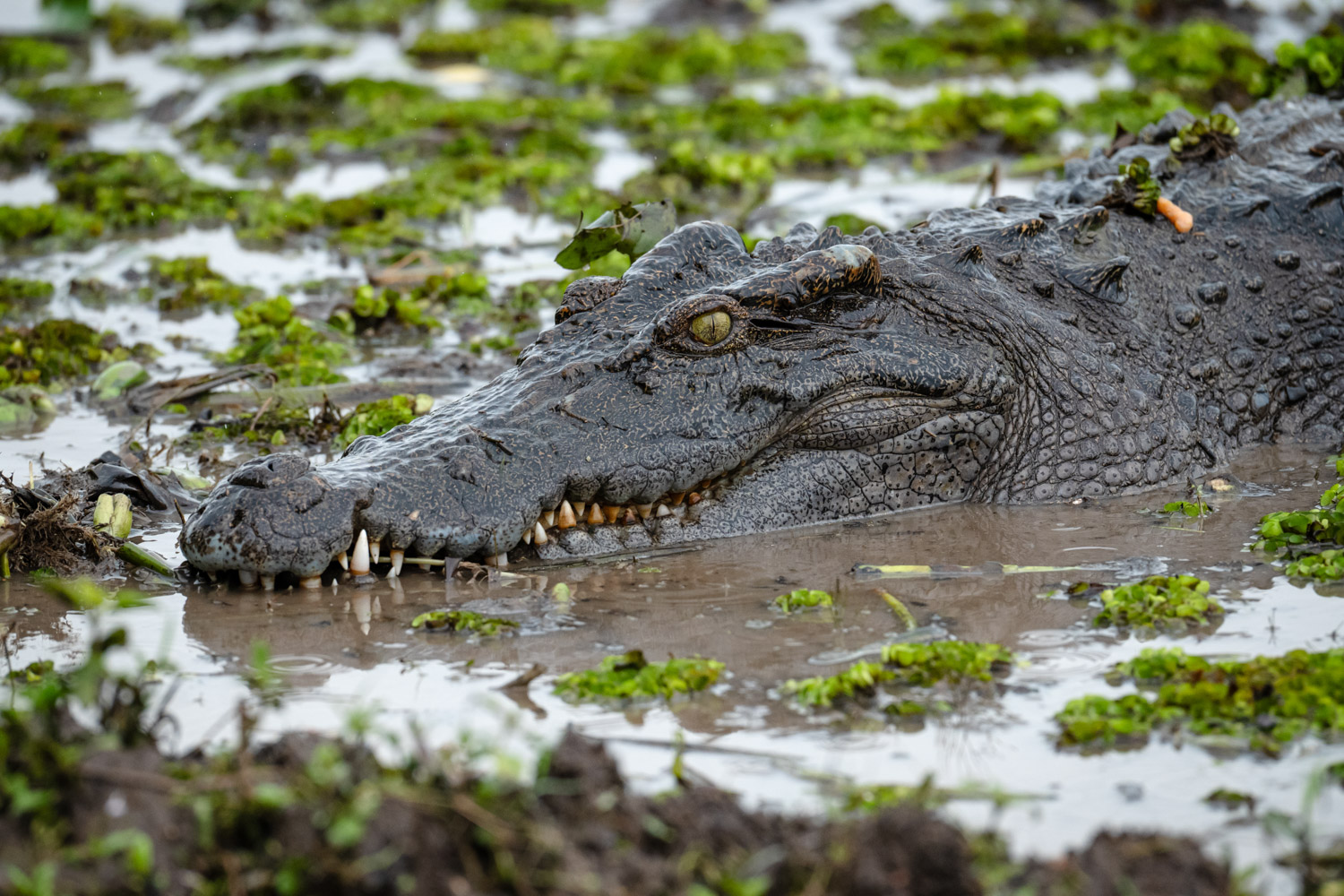
A wild Siamese crocodile basking in its natural habitat at Cat Tien National Park.
Distribution and Habitat
The Siamese crocodile is a freshwater species that lives in slow-moving rivers, lakes, seasonal oxbow ponds, swamps, and wetlands. Typical Siamese crocodile habitats include gentle riverbanks, a mix of shaded and open areas, and surrounding forest.
These permanent water bodies usually maintain at least 1.1 meters of depth during the dry season. They prefer calm waters like swamps and lakes. Although mostly found in lowland regions, some have been recorded at elevations up to 600 meters.
In Crocodylus siamensis ecology, this Southeast Asian crocodile plays a vital role in wetland ecosystems, helping control fish populations and maintain water balance.
Siamese Crocodile Global Range
The Siamese crocodile is native to Southeast Asia. It once ranged widely across the region, possibly including Peninsular Malaysia and islands such as Borneo and Java. Today, its range has shrunk drastically, leaving only a few fragmented populations. Confirmed populations (including reintroduced ones) occur in:
- Cambodia: This country has the largest wild population of Siamese crocodiles. They live in rivers such as Srepok, Sekong, Sre Ambel, Pursat, Koi, Kep, Tatai, and Areng. Many are also found in Veal Veng Marsh in the Cardamom Mountains.
- Laos (Lao PDR): Only small groups remain in 8 river systems across 5 provinces. The strongest populations live in the Xe Champhone, Xe Banghiang, Xe Bangfai, and Xe Xangxoy rivers of Savannakhet Province. Others are in Xe Pian, Xe Khampho, Xe Kong, and Xe Don.
- Indonesia: A single population survives in the Mahakam River of East Kalimantan, on Borneo Island. This group is genetically different from the mainland crocodiles.
- Thailand: Most wild crocodiles have disappeared. A few small groups remain in Pang Sida and Kaeng Krachan National Parks, where reintroduction programs continue.
Siamese Crocodile in Vietnam
The Siamese crocodile once inhabited freshwater wetlands widely across southern Vietnam. Its range stretched from the Mekong Delta to the Central Highlands. Historical records show its presence in Phu Yen, Kon Tum, Gia Lai and Dak Lak. It was also found in Dong Nai (Cat Tien), southern provinces, and Phu Quoc Island in Kien Giang.
Over time, wild populations in Vietnam have declined severely. The species is now considered extinct or nearly extinct in the wild. Surveys in 1992 already classified it as almost gone from nature. Later surveys in the late 1990s and early 2000s found no viable populations.
At Crocodile Swamp in Cat Tien National Park and Lak Lake, no crocodiles were seen. In Ha Lam Lake (Phu Yen), once home to many, only 2 individuals were recorded in 2005.
A few isolated individuals were later reported, such as 1 in the Song Hinh area of Phu Yen, but these are likely remnants of an extinct wild population.
Siamese Crocodile in Cat Tien National Park
The Siamese crocodile once lived in Cat Tien National Park but was hunted to extinction. The last wild crocodile was killed in 1996.
In 1999, the park began the Siamese Crocodile Reintroduction Program. This was the first successful project in the world for this species. The work took place in the Bau Sau Wetland Complex, in the north of Nam Cat Tien. This site was chosen because it has good water quality, plenty of fish, and no large predators.
Bau Sau has swamps, grasslands, and permanent water areas. The size changes by season. In the dry months (December-March), the water area is about 151 hectares. During the rainy months (April-November), it expands to around 2,668 hectares.
From 2001 to 2004, 60 adult and sub-adult crocodiles were released into Bau Sau. They came from Hoa Ca Crocodile Farm and Cu Chi Crocodile Conservation Farm. Each crocodile was DNA tested to make sure it was a pure Crocodylus siamensis. One hybrid crocodile was found and removed.
The program showed quick success. The first nest appeared in September 2005. Young crocodiles were seen in 2009, proving that they were breeding in the wild. By 2010, the population reached 100-150 individuals.
By 2019, monitoring showed at least 286 crocodiles, including 228 young ones. This means the population is healthy and stable. Rangers count the crocodiles every month at night using spotlight surveys. The method finds only part of the group (about 5-32%), but the results stay consistent.
Today, the Siamese crocodiles in Bau Sau are thriving. They are spreading into nearby lakes, making Cat Tien a true success story for wildlife recovery in Southeast Asia.
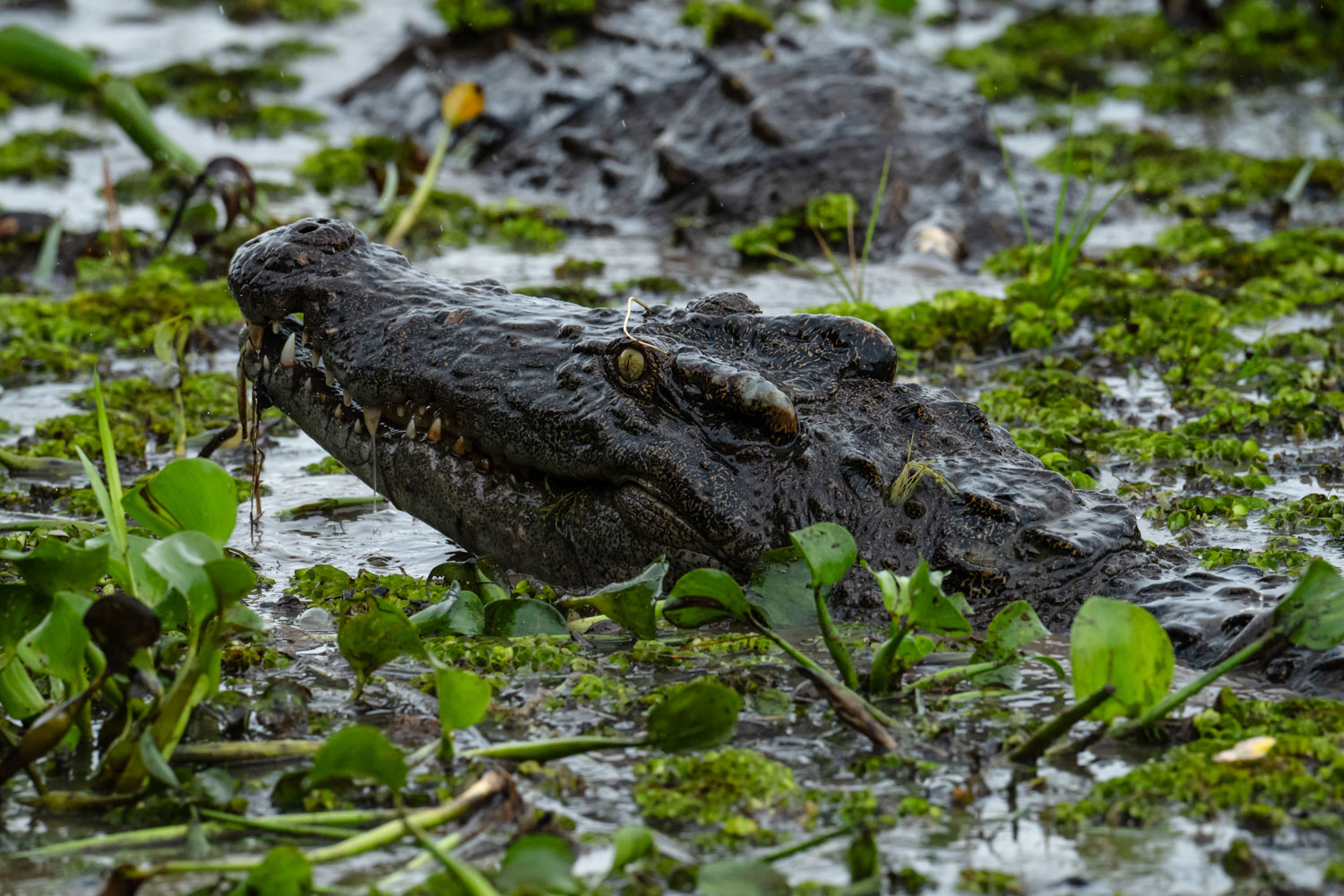
The successfully reintroduced Siamese crocodile population thriving in Crocodile Swamp (Bau Sau).
Behavior and Diet
The Siamese crocodile is a semi-aquatic reptile that lives mostly in freshwater. Like other reptiles, it is ectothermic, meaning its body temperature depends on the environment. It spends most of its time in the water and comes onto land during the day to warm itself under the sun.
During the wet season, crocodiles spread out across flooded areas. Some individuals fitted with radio trackers have moved up to 25 km before returning to their dry-season shelters.
These crocodiles use burrows dug into riverbanks or lakeshores. Up to five crocodiles may share the same burrow at one time.
Fighting can occur between individuals. Some reintroduced crocodiles have been killed by others, especially when space is limited or when smaller ones enter another’s territory. Wild Crocodylus siamensis are generally not dangerous to humans. There have been no confirmed attacks on people unless the animal was provoked.
Diet
The Siamese crocodile is an opportunistic predator with a varied diet. It does not depend on a single type of prey. Adults weighing 40-87 kilograms can deliver a bite force of 2,073-4,577 newtons, strong enough to capture animals of different sizes.
The species has unique underwater adaptations. A small opening in its heart, called the Foramen of Panizza, lets blood bypass the lungs while diving. This system lets the crocodile use less oxygen and stay underwater for many minutes. It can slow its heartbeat to only 2-3 beats per minute to conserve energy.
The Siamese crocodile diet includes fish, frogs, reptiles, birds, small mammals, crabs, and invertebrates. Adults and sub-adults hunt by ambush, waiting quietly near water edges. They also eat carrion when available.
Scat analysis often shows fish scales, insect shells, and feathers, though bones are rarely found. Young Siamese crocodiles feed mainly on small fish, insects, snails, and other tiny aquatic animals. As they grow, their diet expands to larger prey.
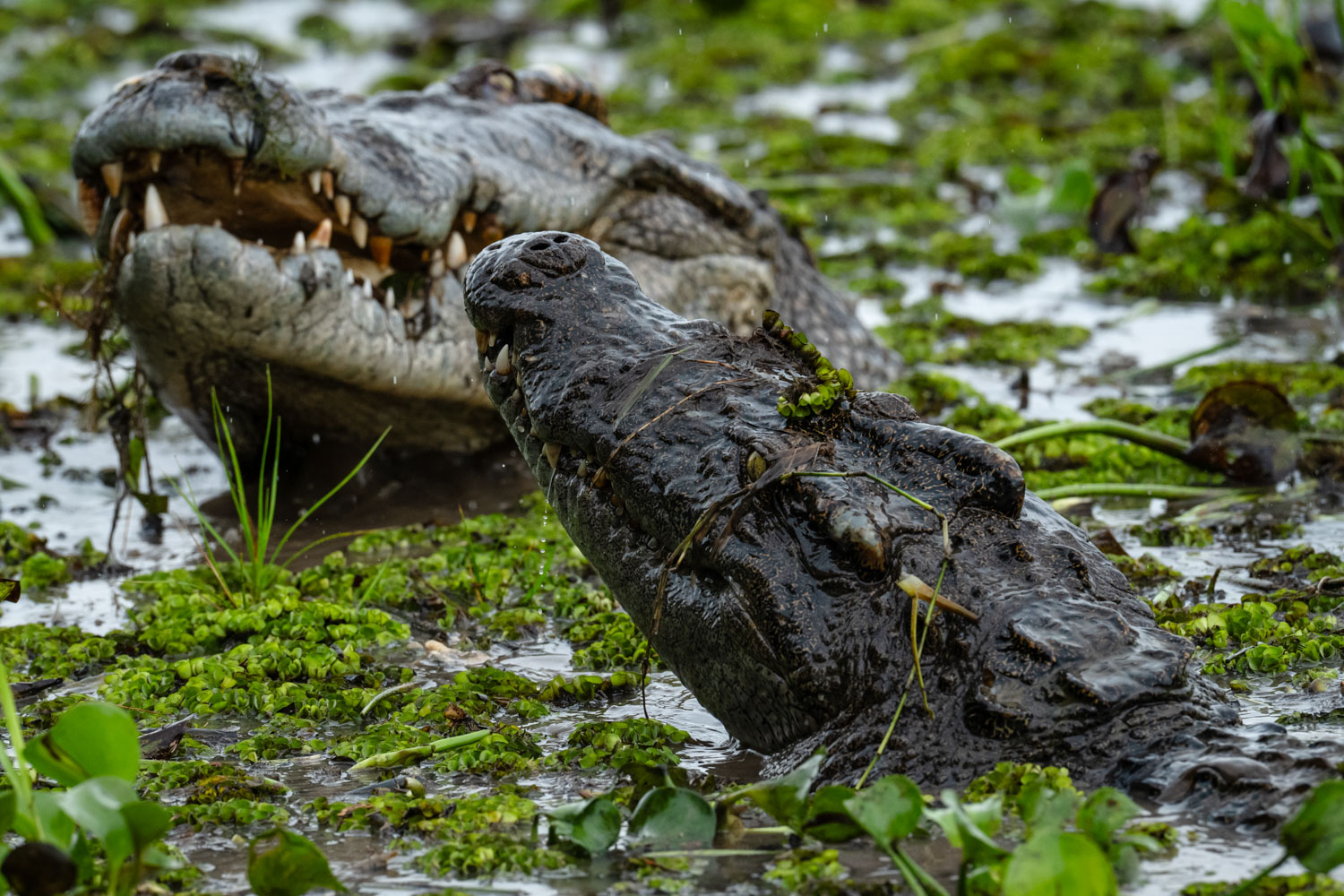
A Siamese crocodile silently waiting for prey in the waters of Cat Tien.
Breeding Season and Nesting
The Siamese crocodile nesting season happens at the end of the dry season, from February to April. Female crocodiles build mound nests made of soil and plant material. Nests are placed on floating vegetation mats or along the banks of rivers and lakes. Females often return to the same nesting sites every year, showing strong site fidelity.
Siamese crocodiles usually breed in the wet months, from April to October. Each female lays about 15 to 26 eggs at a time, and sometimes up to 40 eggs. Eggs also hatch during the wet season, about 70-80 days after being laid.
This timing helps the hatchlings find enough water and food once they emerge. The female stays close to the nest during incubation to protect it from predators. The temperature of the nest determines the sex of the hatchlings. Newly hatched crocodiles are small, measuring 30-50 cm in length.
Conservation and Threats
From only 9 individuals recorded after the reintroduction period from 2000-2005, the Siamese Crocodile population at Bau Sau has now grown to over 600 individuals, making this area one of the most successful conservation models for this Critically Endangered species on the IUCN Red List.
This achievement is the result of over 20 years of relentless conservation efforts by the park management, various government departments, and the absolute dedication of the ranger force.
Not only a safe haven for the Siamese Crocodile, Bau Sau is also recognized as a Wetland of International Importance (Ramsar Site), supporting a wide array of rare wildlife such as gaur, wild boar, long-tailed macaques, and endemic water birds.
The main threats to Siamese crocodile are habitat loss, illegal hunting and trade, accidental capture, and very small, isolated populations.
Main Threats
Illegal Hunting and Trade
Heavy hunting during the 1900s caused a sharp crocodile population decline. People hunted them for meat, skin, and trade, or caught them alive for crocodile farms. Even though there are more than 700,000-1.5 million farmed crocodiles in Thailand, Cambodia, and Vietnam, poaching still hurts wild crocodiles.
Habitat Loss and Degradation
Crocodiles have lost many wetland homes because of farming, pollution, and dam building. In Cambodia, new dams may destroy half of the remaining breeding areas in the next 10 years. In Vietnam, the Song Ba dam flooded Ha Lam Lake, which used to have wild crocodiles. Dams on the Dong Nai River may lower water levels at Bau Sau, an important crocodile wetland. Forests and wetlands are also being cleared for rubber, palm oil, and banana farms, and mining makes things worse.
Accidental Capture and Drowning
Many crocodiles die when they get trapped in fishing nets or traps. Fishing is still common, even in protected areas. Modern nylon nets are stronger and harder for crocodiles to break, so the chance of drowning is high.
Hybridization
Crocodile crossbreeding in farms is a serious problem. Many farmed Siamese crocodiles have been mixed with Saltwater crocodiles (C. porosus) or Cuban crocodiles (C. rhombifer) to make bigger animals for the leather trade. These hybrids can reproduce and look very similar to pure Siamese crocodiles. If released, they can mix with wild ones and harm the species’ genetics.
Conservation Actions
People are working to protect the Siamese crocodile at the international, regional, and local levels. The main goal is to bring back healthy wild populations.
Reintroduction Efforts
At Cat Tien National Park in Vietnam, 60 crocodiles were released between 2001 and 2004. This was the first successful reintroduction in the world. The crocodiles formed a healthy group at Bàu Sấu.
In Thailand’s Pang Sida National Park and Cambodia, young crocodiles were also released into safe rivers. Since 2012, over 50 purebred crocodiles have been released into community-protected areas in Cambodia.
The Cambodian Crocodile Conservation Programme (CCCCP) breeds pure Siamese crocodiles using DNA testing at Phnom Tamao Wildlife Rescue Centre. In Laos, the Wildlife Conservation Society (WCS) hatched and raised eggs for release. In July 2024, 60 hatchlings were found in Cambodia’s Southern Cardamom National Park, showing great success.
Protecting Vital Habitats
Groups like Fauna & Flora International (FFI) support Siamese crocodile conservation by working with the governments of Cambodia and Laos to protect important wetlands. These include Veal Veng Marsh, Tatai River, and Areng River.
In Vietnam, Bàu Sấu in Cat Tien National Park is a key home for the reintroduced population. Efforts also focus on protecting crocodile habitats from threats such as dams, farming, and land clearing.
Law Enforcement and Protection
Rangers need more patrols, including night patrols, as part of ongoing anti-poaching efforts to stop hunting and illegal fishing. Authorities should remove fishing nets and traps from crocodile habitats and ensure poachers are punished.
Community and Habitat Management
In Laos and Cambodia, where crocodiles live outside national parks, community projects help protect them. Education in areas near Cat Tien, such as Dak Lua commune, raises awareness and reduces hunting. The Bau Sau Wetlands in Cat Tien are now a designated Ramsar Site, showing their global value.
International Cooperation
Groups like IUCN, CITES, WCS, and FFI work together across Southeast Asia. They run international conservation projects and surveys in Cambodia and Laos to find where crocodiles still live.
They also study freshwater crocodile species to understand them better. Governments and NGOs build management plans to link breeding farms with national parks, especially Cat Tien, where wild crocodiles have successfully returned.
Explore Bau Sau with the Cat Tien Wild Expedition by Katien Safari
Today, the rich ecosystem and the miraculous recovery story of the Siamese Crocodile at Bau Sau have turned Cat Tien National Park into an ideal destination for those who love adventure and wildlife exploration. To experience this unique journey yourself, you can join the Cat Tien Wild Expedition with Katien Safari.
Participating in the Cat Tien Wild Expedition with Katien Safari, you will have the unique opportunity to walk through the jungle to Bau Sau alongside the forest protection force at Cat Tien National Park, as well as enjoy dinner and admire the sunset amidst the wild nature here.
Not stopping there, this expedition is also an opportunity for you to cross the primary forest to watch the sunset at Ta Lai grassland, visit the Wildlife Rescue Center, as well as discover more about the culture and traditions of the Ma and Cho Ro people here.
From primary forests to the revival story of the Siamese Crocodile, every journey at Cat Tien brings a different perspective on wild nature. Book your spot with Katien Safari today to experience this special adventure yourself!
While Siamese crocodiles are famously calm and shy around humans, they remain wild predators. Therefore, visitors must strictly follow these safety guidelines:
- Keep a safe distance: Maintain a distance of at least 20 to 30 meters; never try to feed or approach them.
- Stay quiet and calm: Avoid shouting, making loud noises, splashing water, or sudden movements near the water's edge.
- Do not swim or bathe in rivers, lakes, or marshes where crocodiles live.
- Watch your steps near riverbanks: Crocodiles may dig burrows to rest underground, sometimes sharing one burrow among multiple individuals.
- Follow park rules strictly: Never disturb or harm the crocodiles, as this species is Critically Endangered.
- Inform park staff immediately if you spot a crocodile in an unexpected area to support management and conservation efforts.
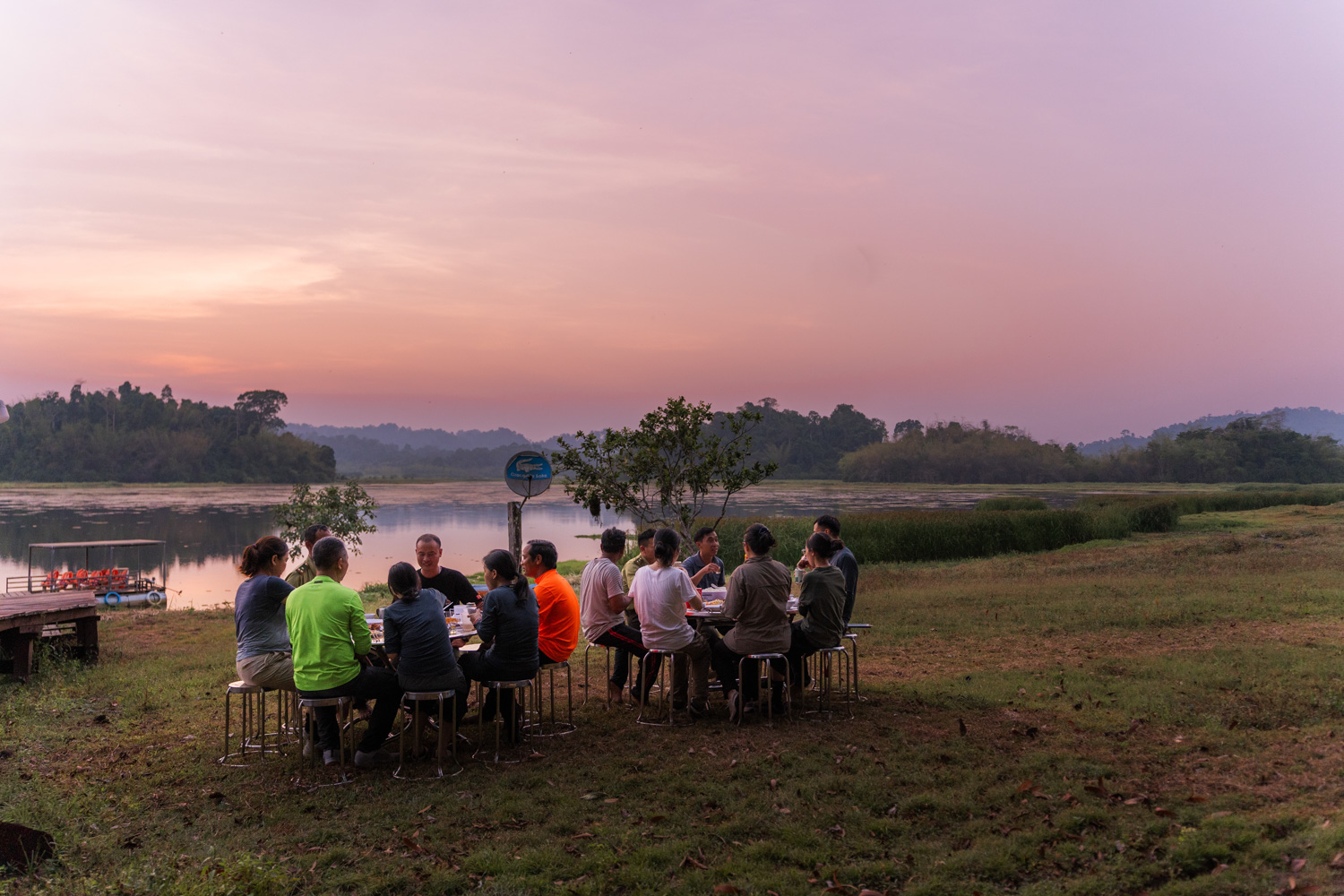
Having dinner and enjoy the sunset at Bau Sau Ranger Station.
6 Interesting Facts about Siamese Crocodile
- The size of Siamese crocodile droppings is linked to body length. Scientists can use it to estimate the crocodile’s size.
- Cambodia is home to the largest remaining wild population of Siamese crocodiles — around 150 individuals still living in the wild!
- Siamese crocodiles dig burrows along riverbanks or lakes. Up to 5 crocodiles may share one burrow at the same time.
- The survival rate of Siamese crocodile hatchlings in the wild is very low. Only about 22% live through their first year.
- Their bite force can reach 4,450 newtons, similar to hyenas, lions, and tigers. This is one of the interesting Siamese crocodile facts showing how strong its jaws are.
- Some Indigenous groups in Cambodia, like the Khmer Dauem in the Cardamom Mountains, believe crocodiles bring good luck and should not be harmed. This belief helps protect wild populations.
Reference
- Simpson, B. K., & Bezuijen, M. R. (2010). Siamese Crocodile (Crocodylus siamensis). In S. C. Manolis & C. Stevenson (Eds.), Crocodiles. Status Survey and Conservation Action Plan (3rd ed., pp. 120–126). Crocodile Specialist Group: Darwin.
- Ariyaraphong, N., Wongloet, W., Wattanadilokchatkun, P., & Srikulnath, K. (2023). Should the Identification Guidelines for Siamese Crocodiles Be Revised? Differing Post-Occipital Scute Scale Numbers Show Phenotypic Variation Does Not Result from Hybridization with Saltwater Crocodiles.
- Sudrajat, S., & Amalia, H. (2019). The potential of Mesangat Lake, East Kutai, Indonesia as an essential ecological area for habitat conservation of critically endangered Crocodylus siamensis. Biodiversitas, 20, 3126–3133.
- Murphy, D., Phan, D. T., & Nguyen, T. L. (2004). The Siamese crocodile re-establishment programme in Cat Tien National Park, Vietnam 1999–2004 (Technical Report No. 48). Cat Tien National Park Conservation Project.
- Kurniati, H., & Widodo, T. (2015). Surveys of Siamese Crocodile (Crocodylus siamensis) Habitat in the Mahakam river, East Kalimantan, Indonesia. LIPI: Bogor.
- Ross, C. A., Cox, J. H., Kurniati, H., & Frazier, S. (1998). Preliminary surveys of palustrine crocodiles in Kalimantan. In Proceedings of the 14th Working Meeting of the IUCN-SSC Crocodile Specialist Group (pp. 46–79). IUCN: Gland.
- Nguyen, T., Ziegler, T., Rauhaus, A., & Le, M. (2018). Genetic screening of Siamese crocodile (Crocodylus siamensis) in Laos and Vietnam: Identifying purebred individuals for conservation and release programs.
- Platt, S. G., & Ngo, V. T. (2000). Status of the Siamese crocodile in Vietnam. Oryx, 34(3), 217–221. https://doi.org/10.1046/j.1365-3008.2000.00121.x
- Nguyen, D. T. (2023). Successful rewilding Siamese Crocodiles in Bau Sau Ramsar Site, Cat Tien National Park. PANORAMA.
- Nguyễn, Q. T. (2023). Crocodylus siamensis (Cá sấu xiêm). Danh lục Đỏ Việt Nam (RT2). VAST / IEBR.
- Polet, G., Murphy, D. J., Lam, P. V., & Mui, T. V. (2002). Crocodile Conservation at Work in Vietnam: Re-establishing Crocodylus siamensis in Cat Tien National Park. In Proceedings of the 16th Working Meeting of the IUCN-SSC Crocodile Specialist Group (pp. 86–95). IUCN.