Once thought to have disappeared for over 60 years, the Orange-necked Partridge has made a remarkable return from the shadows. This rare bird stands out with its unique orange-marked neck, yet remains hidden within a very limited range of lowland forests. Its story, appearance, and rarity make it one of the most fascinating species to discover in Vietnam. Let’s explore what makes this bird so special.
Let’s discover why saving this bird is vital for our ecosystem.
| Common Name | Orange-necked Partridge |
|---|
| Scientific Name | Arborophila davidi |
|---|
| Taxonomy |
Phylum: Chordata
Class: Aves
Order: Galliformes
Family: Phasianidae
Genus: Arborophila
Species: Arborophila davidi
|
| Weight / Size | 241 g. Body length: 27cm |
|---|
| Lifespan | Lifespan wild: 5 - 7 years |
|---|
| Population (latest estimate) | 2,500 - 9,999. Year of estimate: 2009 |
|---|
| Habitat | Lowland forests, shrubland, and plantations |
|---|
| Range | Southern Vietnam and a small area in Mondulkiri, Cambodia |
|---|
| Diet | Plants: seeds, fruits, berries, and young plants.
Animals: beetles, ants, and other small invertebrates. |
|---|
| Conservation Status | IUCN Red List: Near Threatened |
|---|
Physical Characteristics of the Orange-necked Partridge
The Orange-necked Partridge (Arborophila davidi) is a rare, ground-dwelling bird endemic to southern Vietnam. It has a compact and sturdy shape, measuring about 27 - 28 cm in length and weighing around 241 grams. Its rounded body, short legs, and short tail help it move easily through dense forest undergrowth and leaf litter.
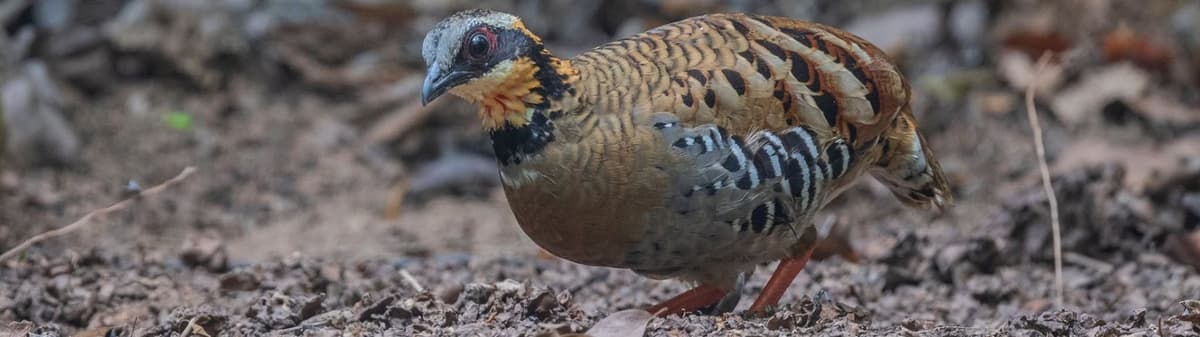
Its plumage is complex and mainly serves as camouflage. The head shows a dusky brown crown and a mottled brown nape. A thick black stripe runs from the bill through the eye and down the sides of the neck. Above this, a pale stripe starts over the eye and fades into a light orange tone along the neck, this is the key feature behind its name. The throat is mostly pale with a hint of orange below. A clear black band separates the throat from the upper chest.
The body is more muted in color. The chest is olive-brown, while the belly becomes lighter with greyish or pale tones. The flanks show fine black-and-white scalloped patterns, which are an important detail for identification. On the upperparts, the back and wings are olive-brown with dark bars and fine black-grey markings.
The bill is black, sometimes with a reddish base. The eyes are brown with a visible reddish eye-ring, and the legs are pinkish to orange-red. Males and females look alike, making it difficult to tell them apart based on appearance.
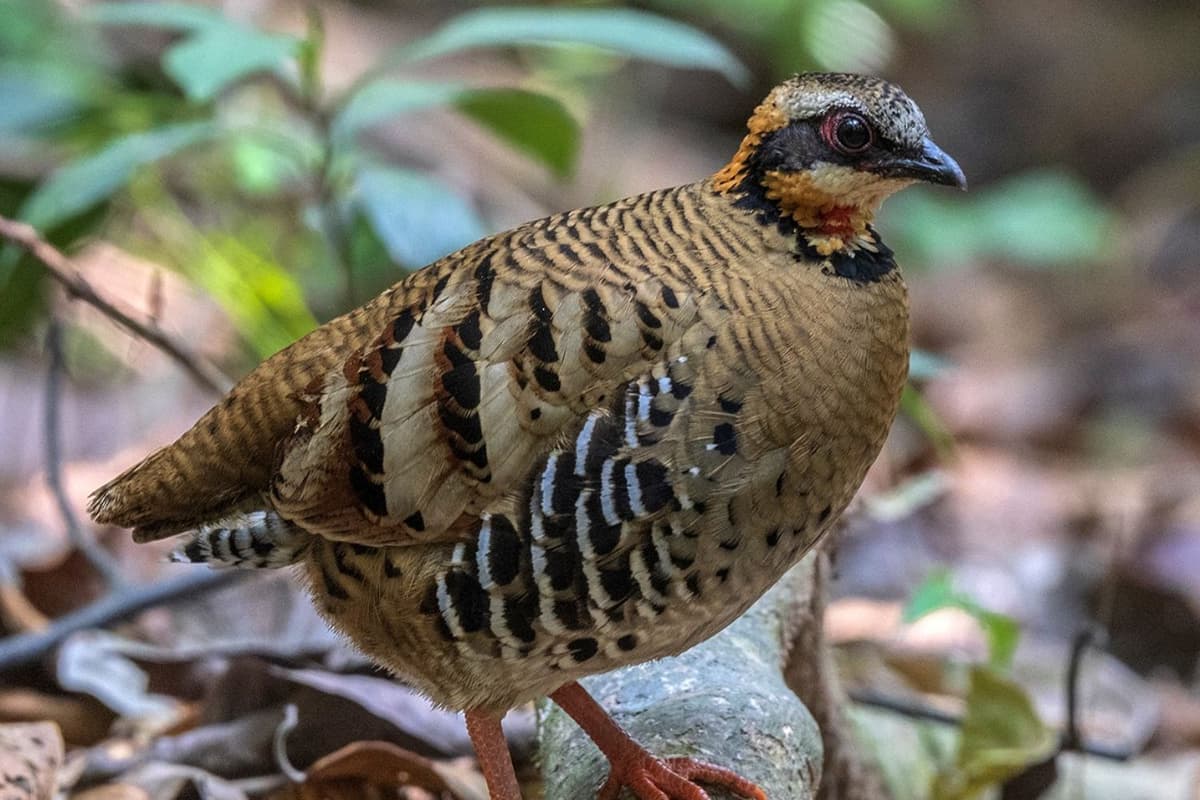
A small forest bird with a subtle orange neck and finely patterned dark plumage. Source: eBird
The Orange-necked Partridge Distribution
The Orange-necked Partridge Global Distribution
The Orange-necked Partridge has a very limited global range, found mainly in southern Vietnam with a small extension into eastern Cambodia. In Cambodia, it is only recorded in Mondulkiri Province, especially within the Seima Protected Forest.
Its overall distribution is restricted, with an estimated Extent of Occurrence (EOO) of about 10,100 km2. The Area of Occupancy (AOO) is much smaller, around 2,300 km2, mostly within protected forest areas in Vietnam.
This species typically lives at low to mid elevations, from about 85 to 600 meters above sea level, with the highest concentration between 120 and 400 meters. It generally avoids both lowland plains and higher mountainous regions, staying within suitable forest habitats.
The Orange-necked Partridge Distribution in Vietnam
In Vietnam, the Orange-necked Partridge has a fragmented range, mainly located in the transition zone between the Central Highlands and the southern lowlands. Its distribution is limited to scattered forest areas in the south.
The species has been confirmed in 4 main provinces: Dong Nai (holding the largest population), southern Lam Dong, Binh Phuoc, and possibly Binh Duong. These isolated records reflect the patchy nature of remaining suitable habitats.
Among these areas, Cat Tien National Park is the most important site, known for having a stable and well-studied population. Another key location is Bu Kroai in Binh Phuoc, where the species was first described in 1927. Additional records come from protected areas such as Bu Gia Map National Park, Da Teh (Lam Dong),...
The Orange-necked Partridge in Cat Tien National Park
Cat Tien National Park is the most important site for the Orange-necked Partridge in Vietnam and globally. The species was rediscovered here in 1991 near Dak Lua, after being unrecorded since 1927.
Surveys in 1997 showed stable numbers: small groups of 2 - 5 birds near Dak Lua, up to 27 individuals recorded in four days at Cat Loc, and several pairs on Elephant Mountain. The species was described as fairly common, especially in Cat Loc.
Today, Cat Tien, particularly Nam Cat Tien and Cat Loc, remains the main stronghold, supporting the largest known population of this species.
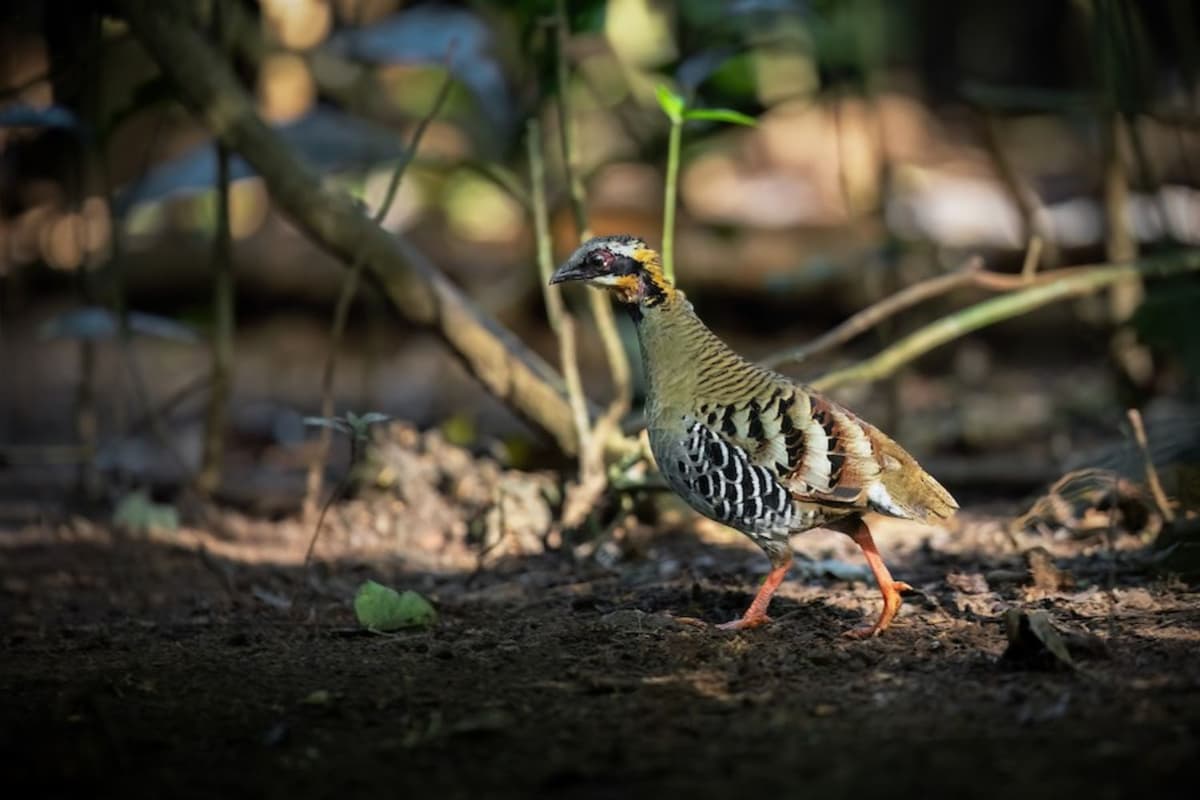
The image of the Orange-necked Partridge was taken in Cat Tien National Park. Source: eBird
The Orange-necked Partridge natural habitat
The Orange-necked Partridge lives mainly in lowland forest with rolling hills and gentle to moderate slopes. It avoids flat open land and very steep terrain.
It prefers evergreen and semi-evergreen forests that are still intact or only lightly disturbed. Common habitats include mixed broadleaf forest with thick leaf litter and bamboo stands with a relatively open understory. These conditions provide both food and cover.
The species can also adapt to modified environments. It is often recorded in secondary forest, dense bamboo, lodged forest, and even acacia plantations. Survey data show that about 70% of records come from tropical deciduous forest, 18% from seasonal forest, and 12% from pure bamboo habitat.
However, it generally avoids dry dipterocarp forest, open grassland, farmland, and wet or flooded areas.
The Orange-necked Partridge Diet
The Orange-necked Partridge has an omnivorous diet, feeding on both plant and animal matter found on the forest floor. Its diet changes depending on food availability in different seasons.
Plant matter makes up a large part of its diet, including seeds, fruits, berries, and young plant parts such as shoots and leaves. These are commonly found among leaf litter and low vegetation.
It also feeds on animal matter, especially insects such as beetles, ants, and other small invertebrates. Earthworms and similar ground-dwelling prey are also important food sources. Protein from insects becomes especially important during the breeding season, when adults need to feed their chicks.
The Orange-necked Partridge Behavior
The Orange-necked Partridge is a shy, ground-dwelling bird with most of its activity taking place during the day. It spends much of its time foraging on the forest floor, moving slowly and searching through leaf litter for insects, seeds, and fallen fruits. This species usually feeds in pairs or small groups of 2 - 5 individuals and rarely forms large flocks. When disturbed, it prefers to run quickly through dense vegetation rather than fly far.
At night, it roosts on low tree branches, which helps reduce the risk of predators on the ground. In general, it walks more than it flies, and flight is only used for short distances when necessary.
Vocalizations are often the easiest way to detect this species, as it is more often heard than seen. Its typical call is a series of clear, rising whistles that become faster and higher in pitch. Pairs may perform duets, with one bird calling and the other responding with short, repeated notes. It also gives a short, sharp alarm call when threatened. These sounds are most commonly heard in the early morning or late afternoon, especially in forested hills with bamboo.
The natural lifespan of the Orange-necked Partridge is estimated to be around 5 - 7 years, similar to other Southeast Asian forest partridge species.
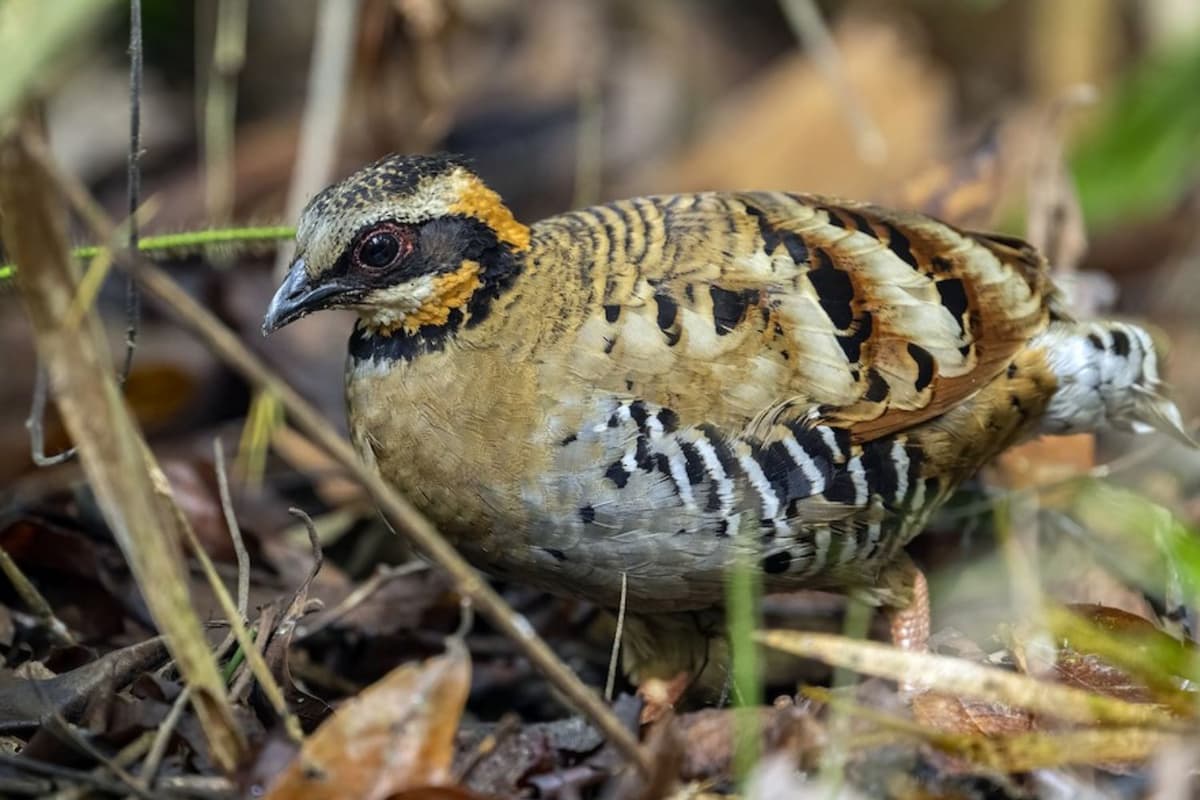
The Orange-necked Partridge is shy and secretive, usually running swiftly on the forest floor rather than flying. Source: eBird
The Orange-necked Partridge Reproduction and Offspring
The breeding season of the Orange-necked Partridge likely begins around March and is often linked to the early rainy season (April to July), when food such as insects and fruits becomes more abundant. This species is monogamous, forming stable pairs that stay close together during the breeding period.
The nest is a simple structure on the ground, usually a shallow depression hidden under dense vegetation, shrub or leaf litter. It is lightly lined with dry leaves and grass, typical of ground-nesting partridges. The female typically lays 3 - 5 eggs. Incubation lasts about 18 - 21 days and is mainly carried out by the female, although the male may assist.
The chicks are precocial, meaning they are well-developed at hatching. They can leave the nest soon after birth and follow their parents to forage. Both adults take part in caring for and protecting the young. The chicks stay with the parents as a small family group until they are fully grown and able to survive on their own, learning to feed on insects, seeds, and fruits in the same way as adults.
The Orange-necked Partridge Threats & Conservation
Threats to The Orange-necked Partridge
The Orange-necked Partridge is currently classified as Near Threatened (NT) by the International Union for Conservation of Nature. After its rediscovery in 1991, it was once listed as Critically Endangered, then downlisted to Endangered in 2000, and later to Near Threatened in 2009 as more populations were found and the species showed some ability to survive in secondary forest.
The main threat is habitat loss and degradation. Forests are cleared for agriculture such as cashew, cassava, rubber, and acacia plantations, as well as through both legal and illegal logging. In addition, hydropower projects and infrastructure development inside or near protected areas continue to fragment forests and increase human access.
Hunting is another serious threat, especially outside protected areas. The species is hunted for food and sometimes for trade, which puts pressure on local populations.
Habitat fragmentation further increases the risk. The species now survives in small, isolated forest patches, reducing genetic exchange and making populations more vulnerable to local extinction. Because it depends on lowland forest with bamboo and thick leaf litter, any break in habitat continuity can strongly affect its survival.
The Orange-necked Partridge Conservation
Conservation of the Orange-necked Partridge focuses on protecting habitats, reducing hunting, and improving long-term monitoring. The most important actions include stronger law enforcement to control hunting and trapping, and protecting lowland forests with bamboo outside national parks, where about 75% of suitable habitat still remains. Continued population monitoring and research on breeding and ecology are also needed to better understand and manage the species.
In Cat Tien National Park, a key partnership between Save Vietnam’s Wildlife and the park management focuses on SMART patrols, anti-snaring work, EarthRanger systems, community-based forest protection, and scientific research. These efforts helped the park achieve recognition on the IUCN Green List in 2024.
Legally, the species is protected under Vietnam’s Biodiversity Law and is listed in the Vietnam Red Data Book. Hunting and forest destruction within protected areas are illegal.
Wildlife Watching Experience in Cat Tien National Park with Katien Ranger Patrol
Wildlife watching has become a popular activity in Cat Tien National Park, especially birdwatching. For visitors interested in nature, Katien offers guided experiences that give you the chance to see rare species such as the Orange-necked Partridge if you are lucky.
Katien organizes a range of activities designed to explore the park in different ways. Jungle treks allow visitors to walk through forest trails and observe wildlife in its natural environment. Sunset watching offers a quiet moment over open landscapes, while night safari tours provide opportunities to see nocturnal animals. Tours are usually arranged in small, private groups for a more focused and less disturbing experience.
You can improve your chances of seeing the Orange-necked Partridge in Cat Tien National Park by visiting during the dry season, from December to April. This period offers better forest conditions and more active bird behavior. Early morning and late afternoon are the best times, as the birds are more vocal and easier to detect by their calls before they move quietly on the forest floor.
5 Interesting Facts of The Orange-necked Partridge
- In 2000, the Orange-necked Partridge appeared on a national postage stamp of Vietnam.
- Despite being a bird, it runs very fast on the forest floor and often escapes danger by running instead of flying.
- The Orange-necked Partridge sometimes sings in duets, one bird calls, and the other answers with “tchew-tchew-tchew.”
- The scientific name of the Orange-necked Partridge, davidi, honors André David-Beaulieu, who collected the first specimen in 1927.
- The Orange-necked Partridge was thought lost after 1927 and was rediscovered in 1991 at Cat Tien National Park.
Reference
- Atkins, R. A., & Tentij, M. (1998). The Orange-necked Partridge Arborophila davidi and five other galliforms in two protected areas in southern Vietnam. Institute of Systematics and Population Biology, University of Amsterdam. https://repository.naturalis.nl/pub/506342/VTG1998073001.pdf
- BirdLife International. (2024). Species factsheet: Arborophila davidi. BirdLife International DataZone. https://datazone.birdlife.org/species/factsheet/orange-necked-partridge-arborophila-davidi
- Delacour, J. T. (1927). Description of a new Arborophila from southern Annam. Bulletin of the British Ornithologists’ Club, 47, 169.
- Nguyen, T. V., Savini, T., & Carroll, J. P. (2014). Defining the present range of the Orange-necked Partridge (Arborophila davidi) in Vietnam. Natural History Bulletin of the Siam Society, 60(1), 23–30. https://thesiamsociety.org/wp-content/uploads/2020/04/NHBSS_060_1e_Nguyen_OrangeNeckedPartridge.pdf
- Vy, N. T., Savini, T., & Carroll, J. P. (2018). Status and range decline of two galliform species in South-East Asia. Bird Conservation International, 28(4), 493–508. https://doi.org/10.1017/S0959270917000326
- Eames, J. C., et al. (1992). Records of birds from Vietnam: 1991 (including the first record of Orange-necked Partridge). Forktail, 7, 95 - 102.
- McGowan, P. J. K., Kirwan, G. M., & Boesman, P. F. D. (2020). Orange-necked Partridge (Arborophila davidi), version 1.0. In J. del Hoyo, A. Elliott, J. Sargatal, D. A. Christie, & E. de Juana (Eds.), Birds of the World. Cornell Lab of Ornithology. https://doi.org/10.2173/bow.ornpar1.01
- Conservation Leadership Programme. (n.d.). Status survey for Orange-necked Partridge in Binh Phuoc, Vietnam. https://www.conservationleadershipprogramme.org/project/status-survey-orange-necked-partridge-binh-phuoc-vietnam/